





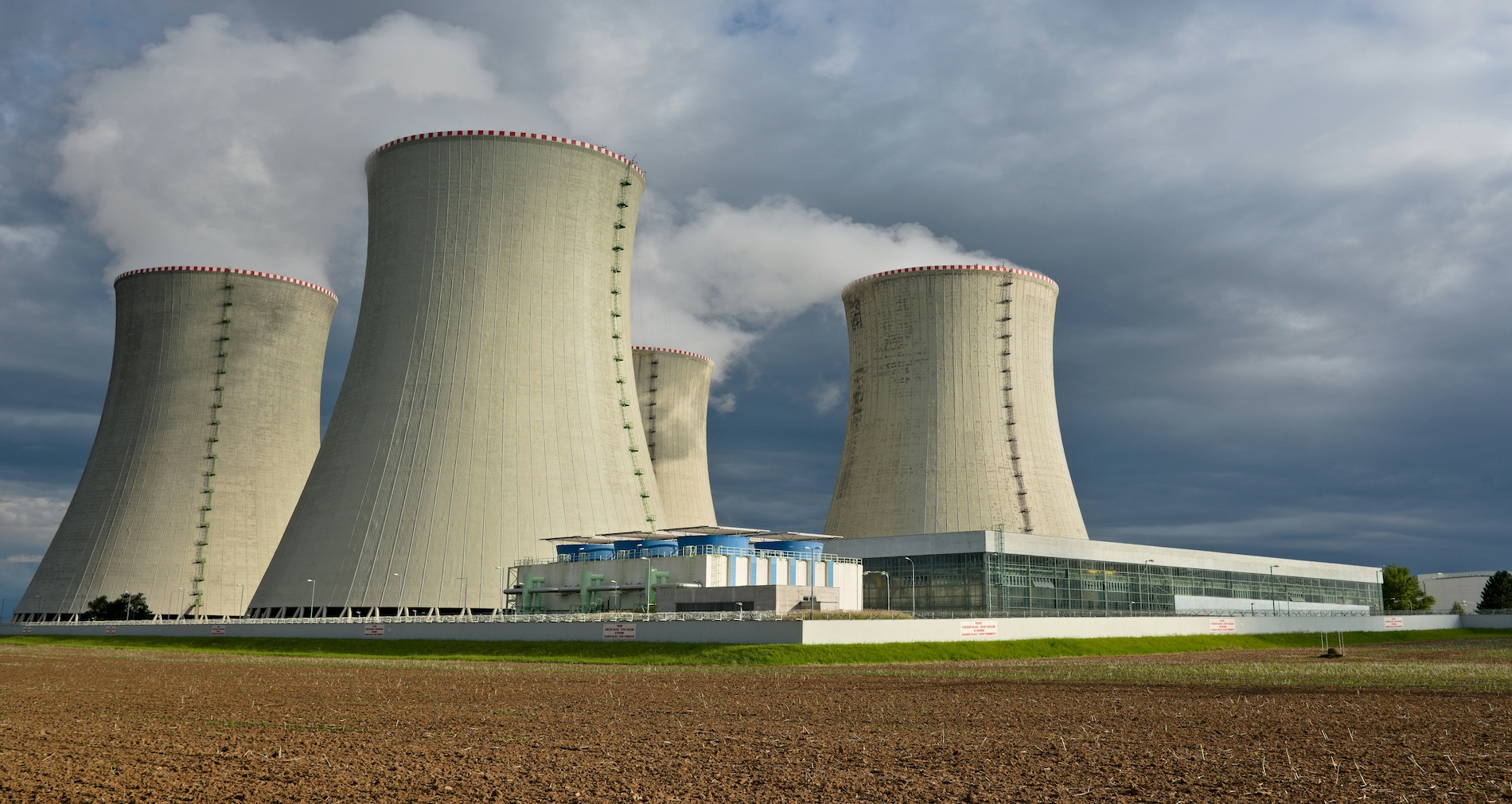
The country is on the verge of a “nuclear renaissance” driven by data centers that require consistent, reliable energy.
In the past two years, four nuclear power plants in Ohio and Pennsylvania have announced plans to restart or extend operations to power data centers.
Unlike other energy types, nuclear offers something to data centers that others can’t: data centers operate around-the-clock, as do nuclear power plants, says Mark Frye, president of Palmer Energy, an energy consulting firm based in Toledo, Ohio.
“Nuclear power plants run 24/7, 365 days, and when you turn one on, it should run for two or three years without stopping,” Frye said. “That’s one of the things that data centers find attractive.”
Nuclear power plants are also seen as a “clean” energy source, as they don’t emit harmful air pollution or greenhouse gases while they’re operating. This is, in part, why the Biden administration supported expanding domestic nuclear energy production.
The second Trump administration is also throwing its support behind the nuclear industry, taking numerous actions to expand nuclear energy to power artificial intelligence data centers, including allowing reactor design testing at U.S. Department of Energy labs, pushing for the rapid development of new reactors, strengthening domestic uranium enrichment and requiring the Nuclear Regulatory Commission to issue timely licensing decisions.
The state of nuclear
Though it’s considered to be one of the safer forms of energy production, public sentiment about nuclear energy has been mixed after the high-profile nuclear accident at Three Mile Island in 1979 and the nuclear disasters in Chernobyl, Ukraine, in 1986, and Fukushima, Japan, in 2011.
Nuclear energy production isn’t perfectly clean, either. The process to enrich uranium, an essential step in the process of making the element usable as fuel, produces radioactive waste called uranium tails. Spent reactor fuel — waste produced from nuclear energy — is also highly radioactive.
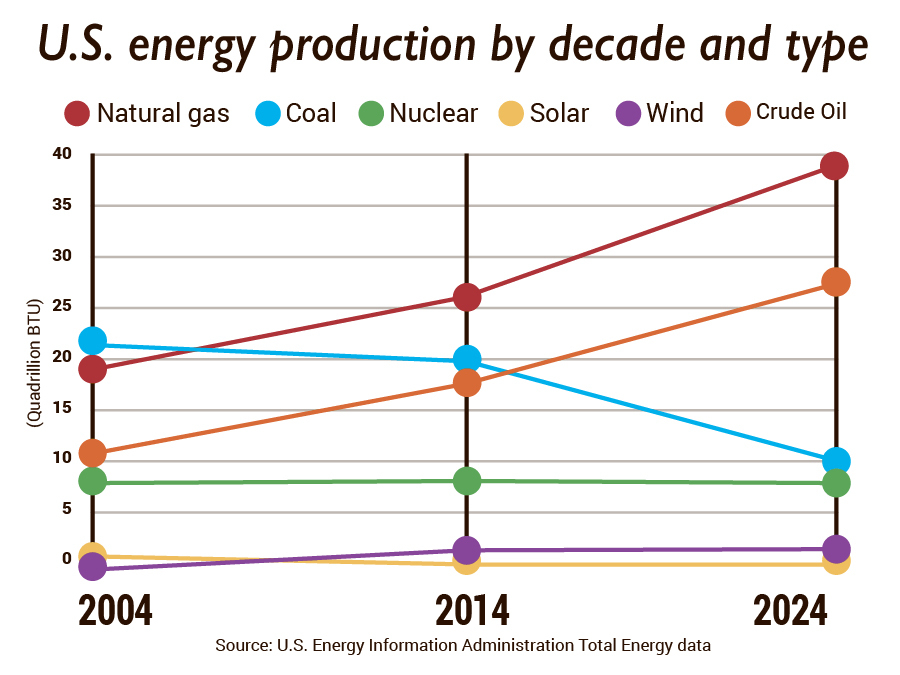
Despite this, nuclear power produces nearly 20% of the electricity in the United States. Most nuclear reactors were built between 1970 and 1990. There have only been two nuclear plants built since 2000 in the country.
The average age of a nuclear reactor in the U.S. is 44 years old, according to the U.S. Energy Information Administration. Because of this, many nuclear reactors need to undergo significant upgrades as new technologies emerge.
The same is true for nuclear power plants that will soon power data centers in Ohio and Pennsylvania.
Nuclear energy for data centers
One of these power plants is the former Three Mile Island, in Middletown, Pennsylvania — the site of the worst nuclear accident on U.S soil, where the Unit 2 reactor partially melted down.
In September 2024, Constellation Energy signed a 20-year power purchase agreement with Microsoft to restart Three Mile Island Unit 1, which will power the tech giant’s data centers. Unit 1 was shut down five years ago for “economic reasons.”
The reactor will undergo upgrades to the turbines, generator, main power transformer and cooling and control systems. In November 2025, Constellation Energy received a $1 billion loan from the DOE to finance the Crane Clean Energy Center Restart project.
The restart, aimed for 2028, is estimated to bring thousands of jobs to the region, generate 835-megawatts of energy and provide billions of dollars in taxes to the state and federal government. Constellation Energy is still waiting for approval from the NRC to restart Unit 1.
Three Mile Island isn’t the only nuclear power plant in the region getting a new life because of data centers.
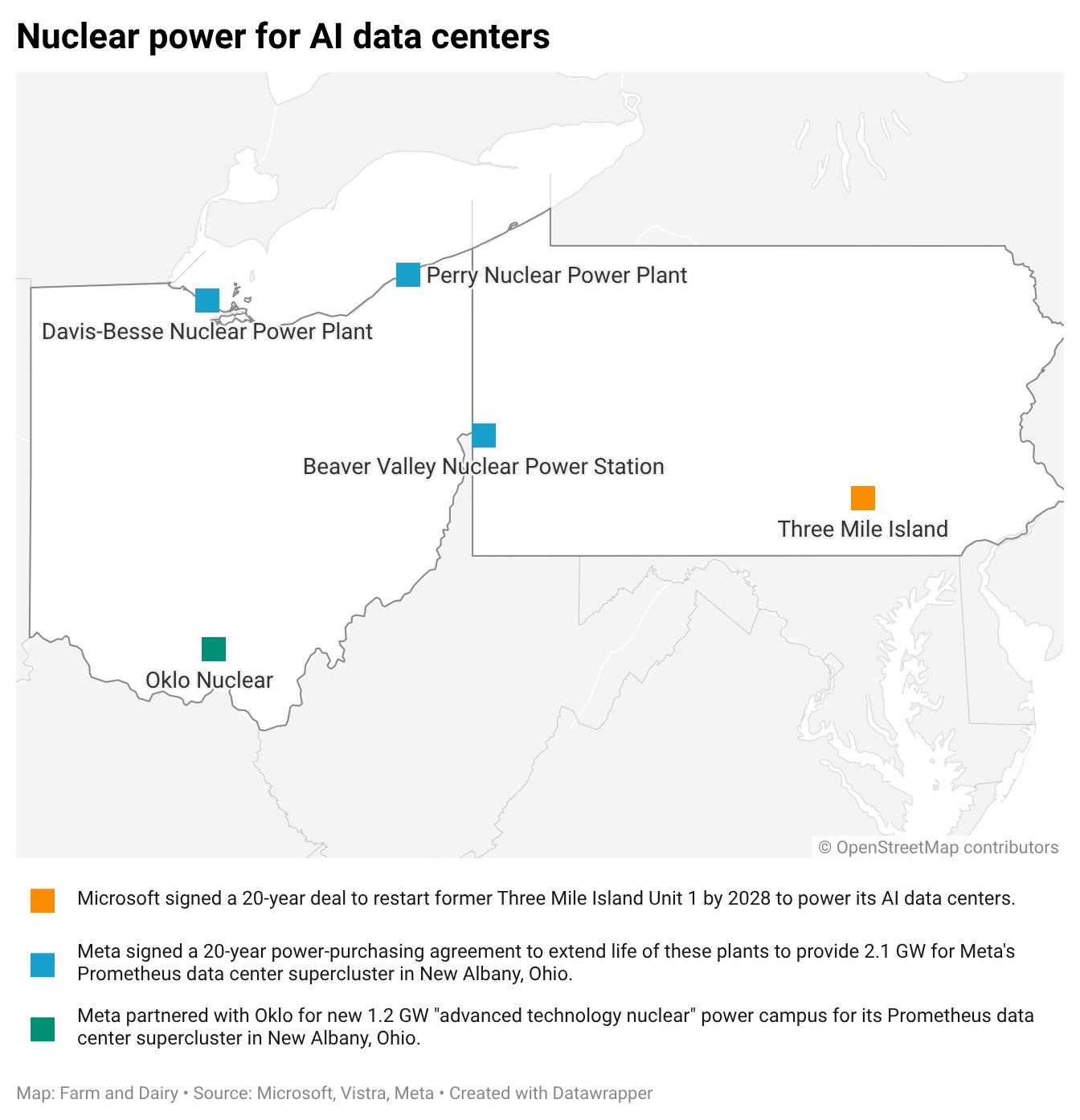
In January, Texas-based Vistra Corp. entered a 20-year power purchase agreement with Meta, the parent company of Facebook, to power its data centers from three nuclear power plants: the Davis-Besse Nuclear Power Station in Oak Harbor, Ohio; the Perry Nuclear Power Plant in Perry, Ohio and the Beaver Valley Power Station in Shippingport, Pennsylvania.
Prior to Vistra acquiring the power plants in 2024, all of them were slated for retirement. In total, the nuclear power plants will produce 2,600 megawatts of electricity, the majority of which — 2,176 megawatts — will power Meta’s data centers.
Roughly 15% of this energy will be new energy on the PJM grid, according to a press release by Vistra. PJM is the largest grid operator in the U.S., serving the Northeast and portions of the Midwest.
The plants, which already have licenses from the NRC, will provide thousands of jobs and support local taxes, according to Vistra.
Meta also announced an agreement with Oklo, an advanced nuclear energy company, in January to use nuclear energy to power its data centers. Oklo will develop a 1.2 gigawatt power campus on the site of the former Portsmouth Gaseous Diffusion Plant, a uranium enrichment facility in Piketon, Ohio.
The campus will power Meta’s Prometheus AI data center supercluster in New Albany, Ohio, that is set to come online this year.
The restart of these power plants has gotten support from numerous state and federal government officials.
Pennsylvania Gov. Josh Shapiro has since vocalized support for both plants in Pennsylvania:
“With more power comes more national security, more independence, and more economic freedom. Projects like this — bringing new clean energy to our grid to power next-generation technology — are exactly the types of projects we want to welcome to the commonwealth,” he said.
Other legislators in support include Sen. Dave McCormick, R-Pa., Sen. Bernie Moreno, R-Ohio and Ohio state Rep. Adam Holmes, R-Nashport.
Both Microsoft and Meta say their investment in nuclear power plants will “provide clean, reliable power that is essential for advancing our AI ambitions and strengthening American leadership in energy innovation,” said Urvi Parekh, head of global energy at Meta.
“By supporting nuclear power, we ensure that our operations — and the communities we serve — benefit from energy solutions that drive both technological progress and economic growth.”
(Liz Partsch can be reached at epartsch@farmanddairy.com or 330-337-3419.)


Thousands of jobs? No. Many jobs during construction phase. Pitifully few after that. A skeleton crew at best.
We don’t want data centers, small modular actors or a gas power plant here in southern, Ohio. We have the highest childhood cancer in the nation here.
Portsmouth/Piketon Residents for Environmental Safety and Security has been here for 40 years and broke every big story about this plant. We need the cancer addressed before anything else is put here.
PRESS/NNWJ
vcolley888@gmail.com
740 357 8916