





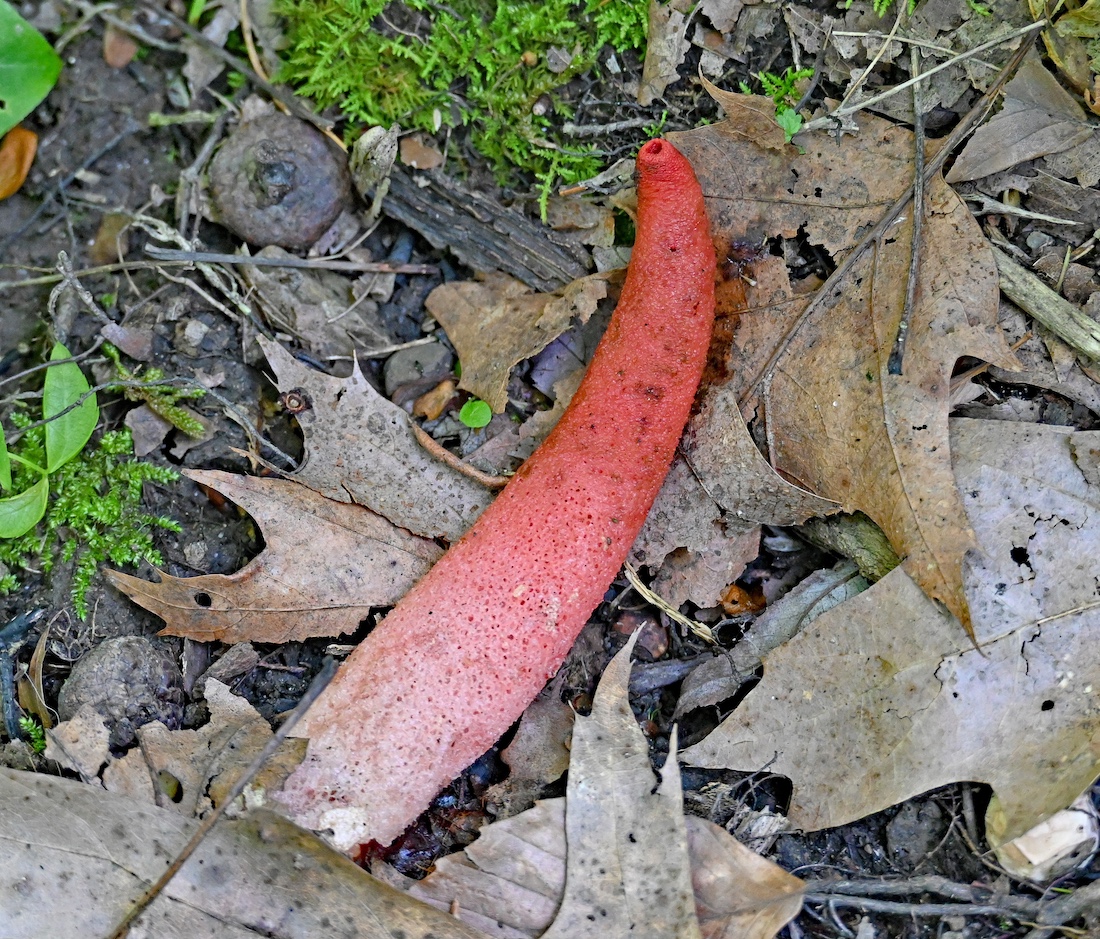
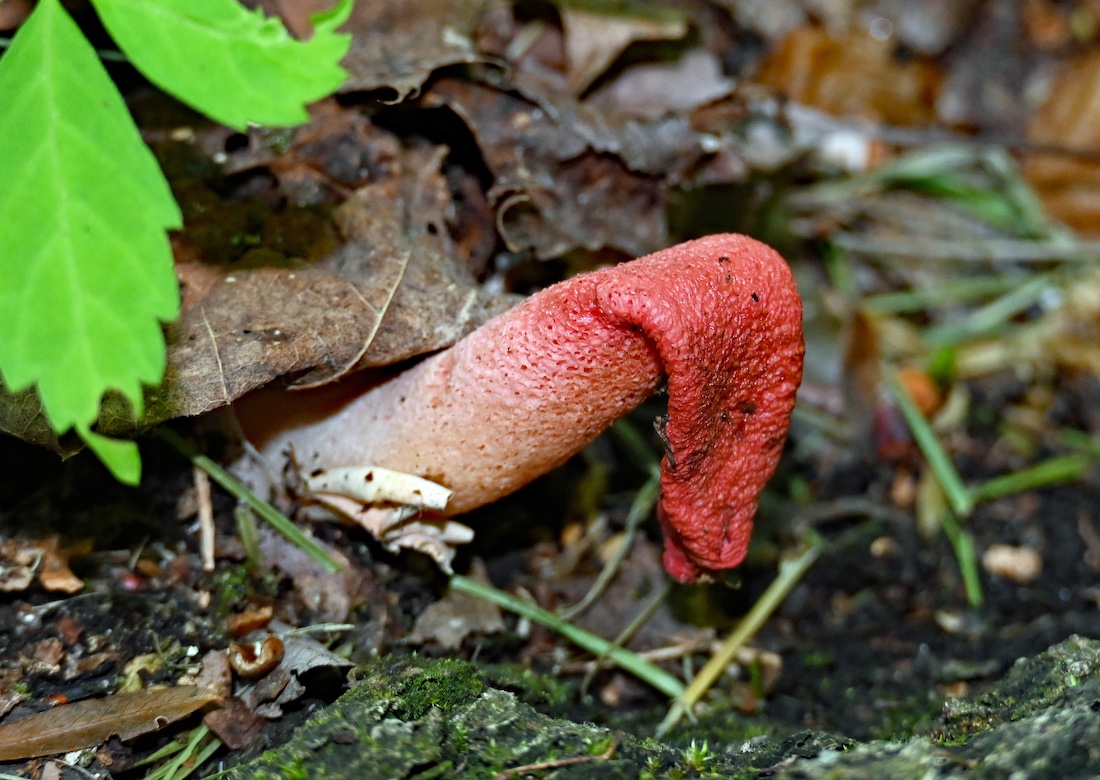
For those of you that have a male dog, or have been around one, you may have an easier time relating to this subject. You know how male dogs plop down after a good romp, tongue lolling…just letting it all hang out? Well, when I came upon this fungus poking up through the leaf litter while walking a wooded path last week, for some reason, that image was the first thing that came to mind. I guess it should be no surprise, then, to learn that a common name for this type of fungus is the “dog stinkhorn.”
Stinkhorns are unique, belonging to the order Phallales, a name that references their distinct phallic shape resembling…well…male genitalia. They come in a variety of shapes and sizes; those in the family Phallaceae bear an incredible resemblance to human anatomy, while others, like the one we will discuss here, appear as something belonging to a canine. These amazing likenesses have made stinkhorns interesting subjects in ancient folklore as well as ethnological superstitions throughout the world.
The stinkhorn starring in this article is known as the elegant stinkhorn (Mutinus elegans). Also referred to as the headless stinkhorn or devil’s dipstick, it gets it start in fertile woodland leaf litter but can also thrive near areas rich with manure or wood chips as well as rotted stumps or logs. It is known as a saprotroph, an organism that secretes chemicals in order to digest the organic matter upon which it feeds. Organisms that function in this manner are essential decomposers, breaking down biological matter and recycling important nutrients back into the ecosystem.
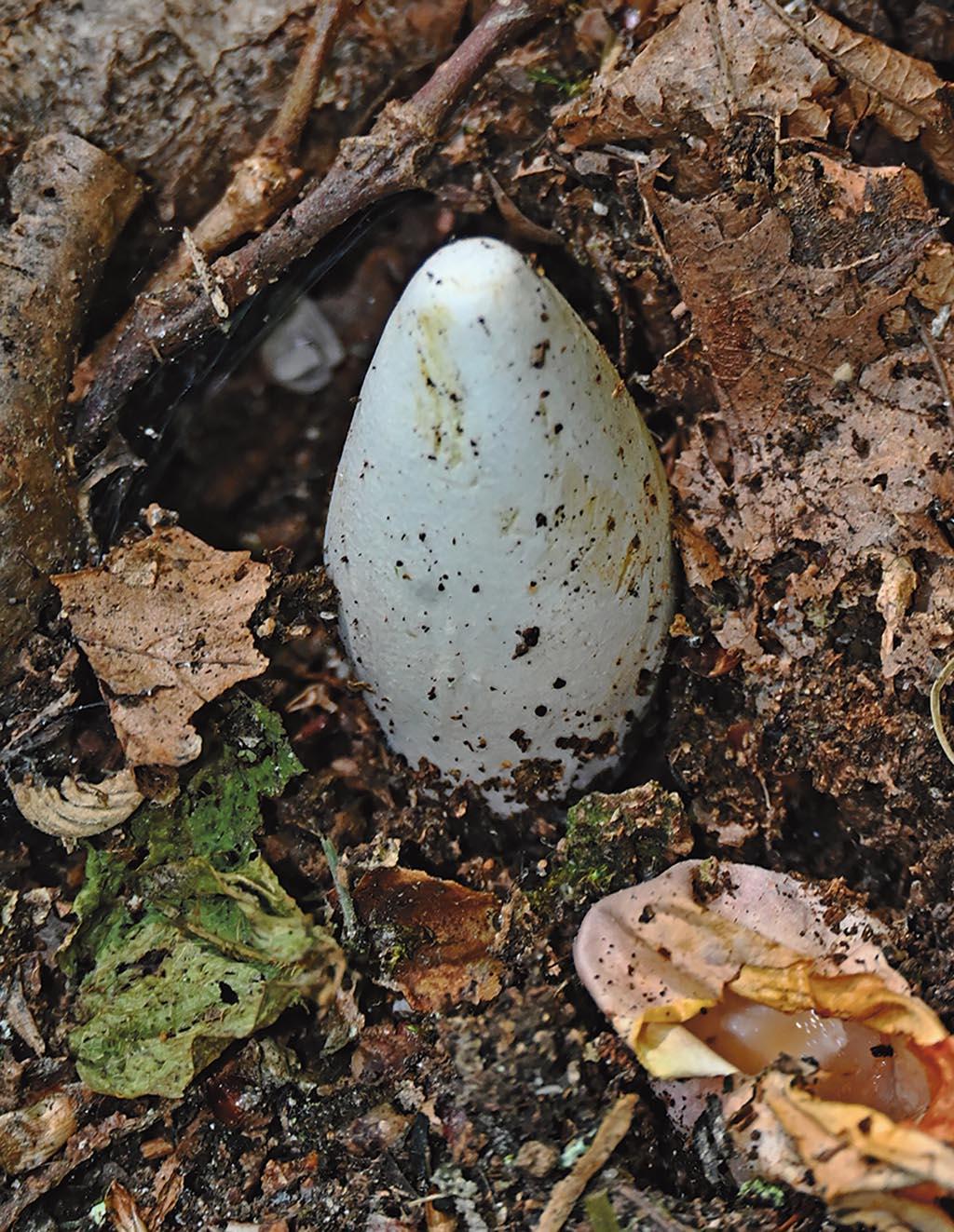
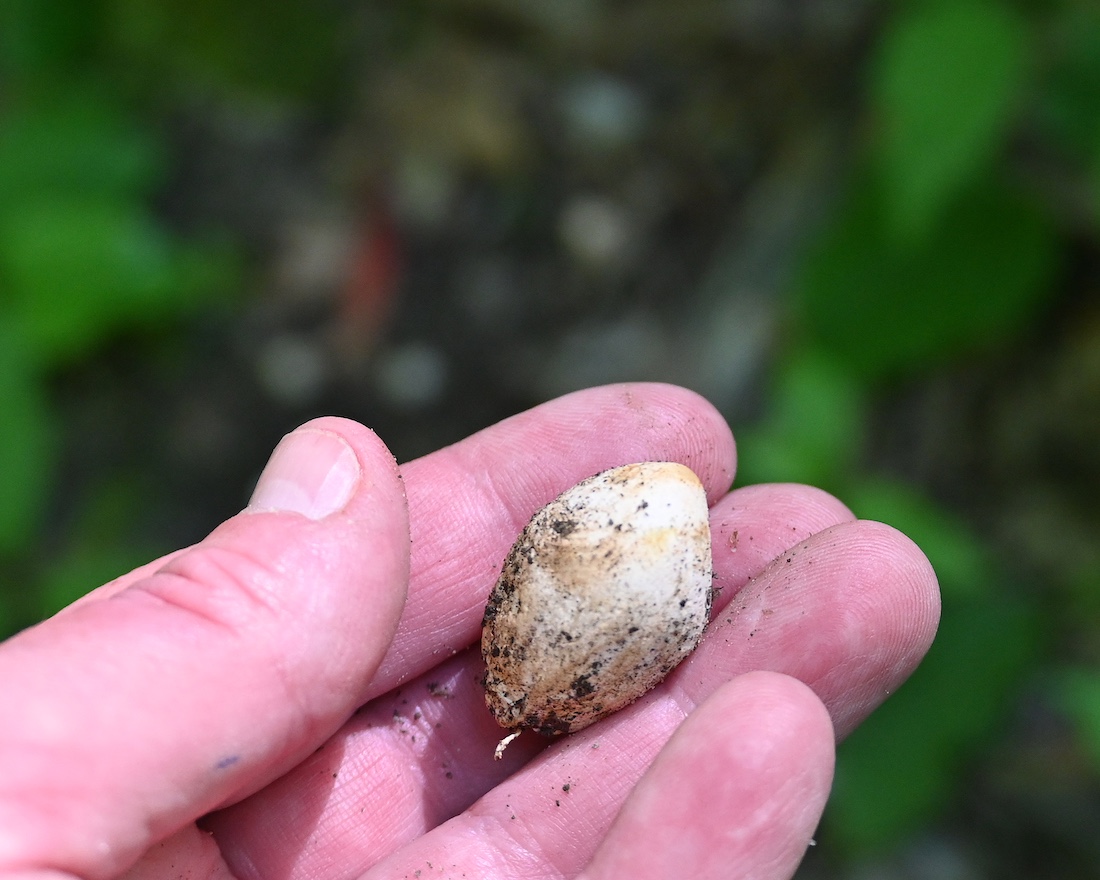
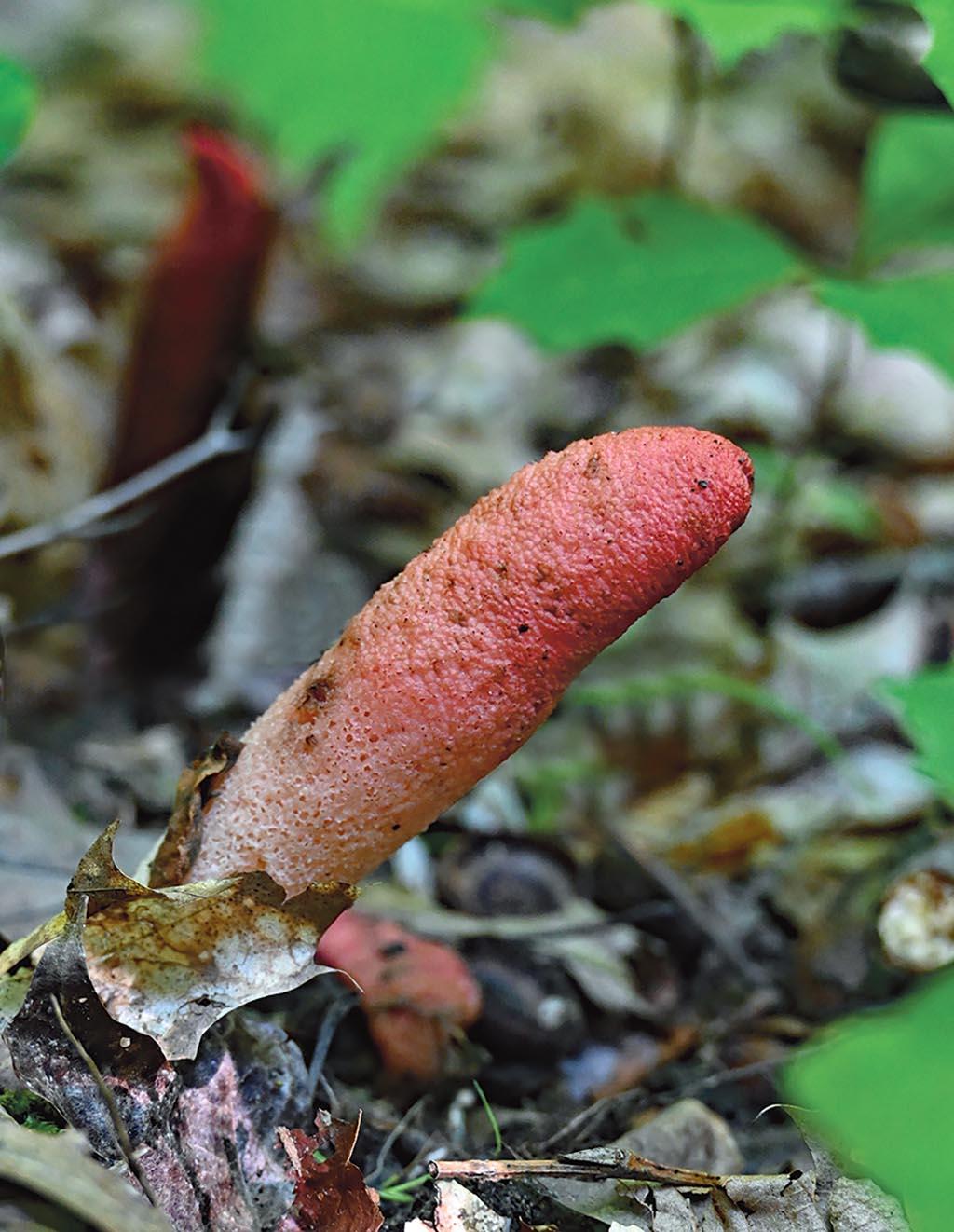
The stinkhorn begins as a white, oval structure known as a “witch’s egg” poking out of the duff. Resembling a puffball, the fruiting body eventually elongates, splitting open to release a pinkish-orange stalk, hollow and wrinkled, cylindrical at the base and tapering to a pointed tip with a hole at the end. The stalk may be straight or curved and grows up to 7 inches tall in just a matter of hours.
Your nose knows
If you are wondering how to locate a stinkhorn, you need only use your nose, because as its name implies, you can certainly smell it long before you see it! Unlike other types of fungus, mushrooms that release their spores from gills to be carried by the wind, stinkhorns have their own unique method of spore dispersal. Shortly after the horn reaches maturity, it begins to secrete a slimy brownish-green substance on the upper half of its stalk. Known as “gleba,” this gooey matter is actually a mass of spores, responsible for giving the organism its distinct rank odor. This pungent hallmark has been compared to that of rancid meat, sewage or feces and has been known to cause nausea.
Yet it is this very feature that makes the stinkhorn successful at reproduction. The fetid stench attracts flies and a variety of other invertebrates that are drawn to the odor. As they step upon the gleba to feed, they pick up the sticky spores on their bodies. These are then dispersed as the insects move to new locations, depositing them as they travel along. It is interesting to note that stinkhorns are not poisonous, so if you can get them past your nose and into your mouth, more power to ya!
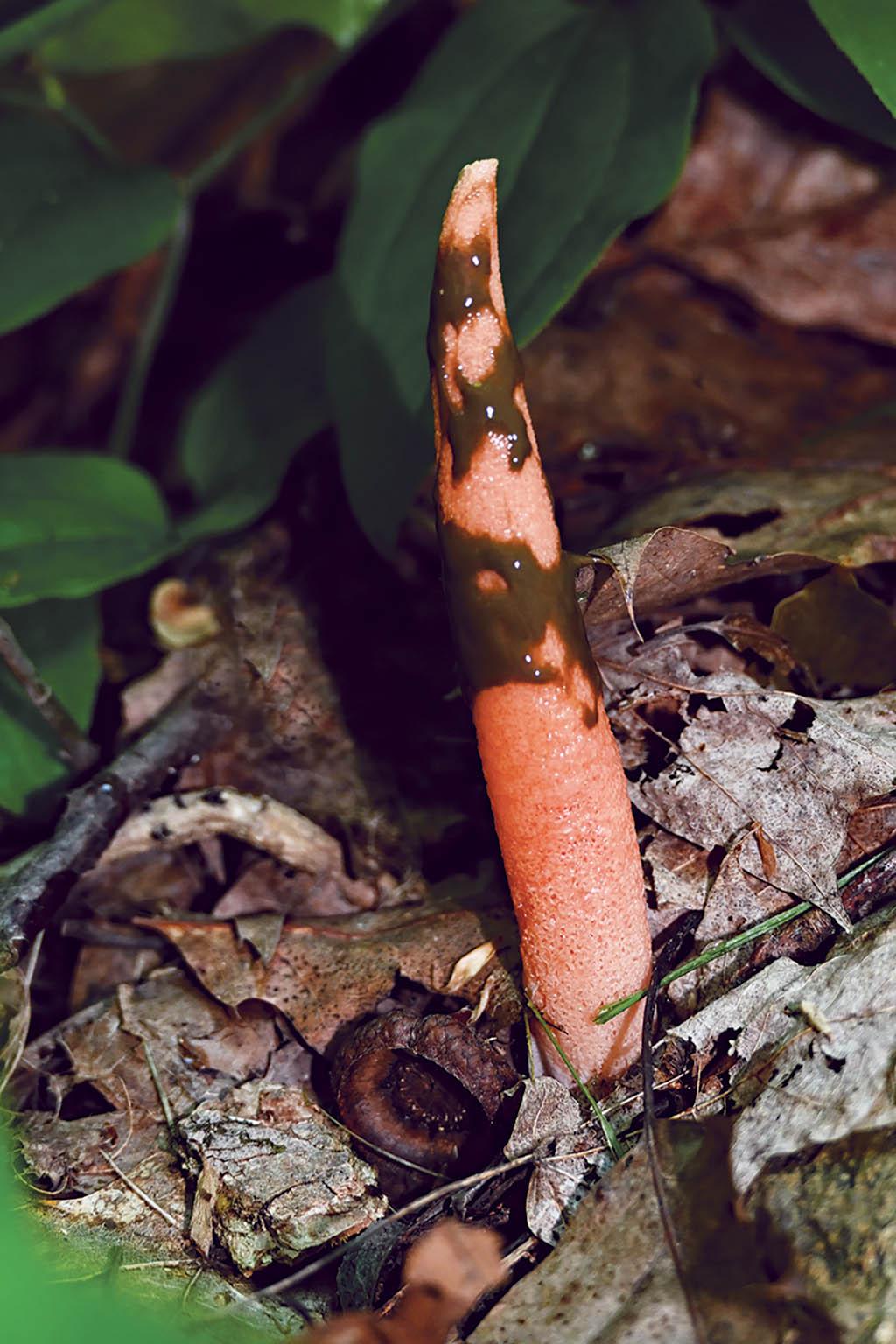
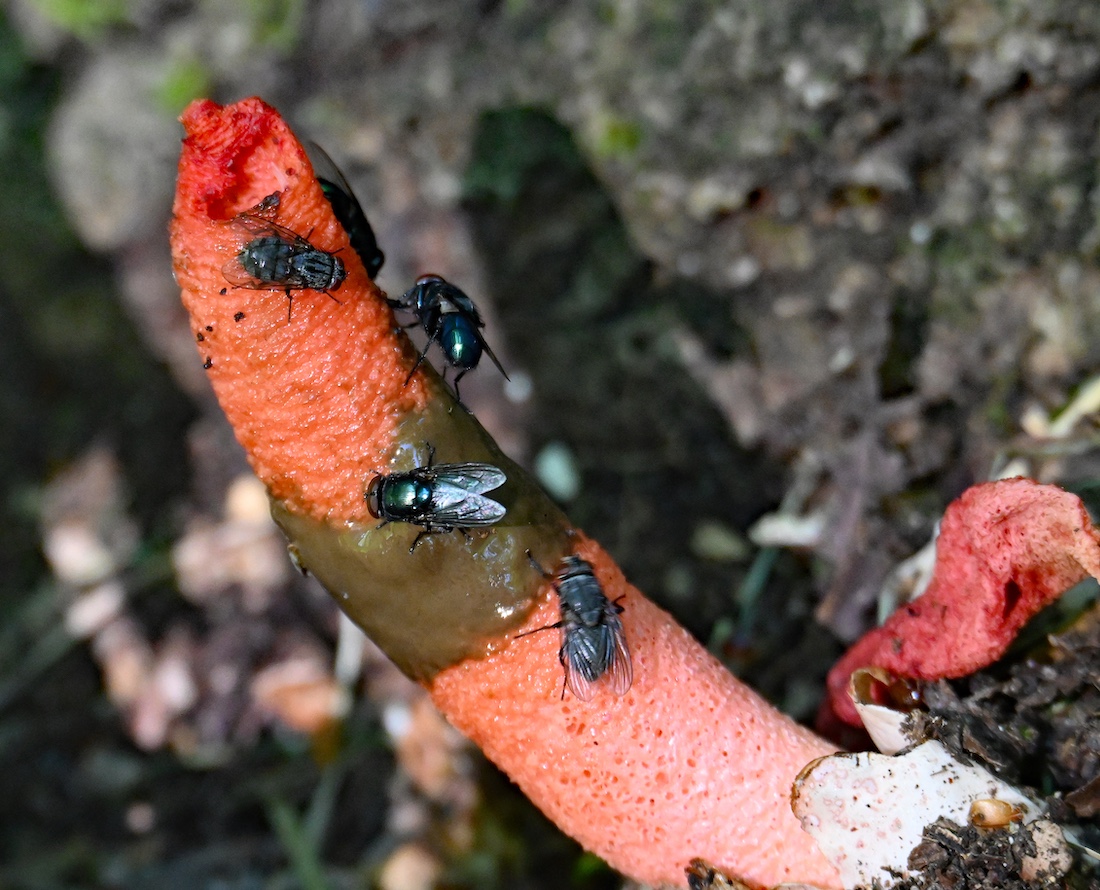
I visited this patch of elegant stinkhorn early in the morning and had the most unique experience. When I arrived, I could not detect any odor whatsoever, yet as I was taking photographs, I could literally see the gleba developing on several fresh stalks. Soon, there was a hint of unpleasantness in the air. Then the flies began arriving. I first noticed them sitting atop the leaves of nearby saplings. Then suddenly, they descended upon the glistening stalks, marching around in the goop and feeding frantically. I moved in for some macro shots and that’s when it hit me. Nearly gagging, I marveled at the overwhelming stench and quickly decided to back off. Not all the horns were actively attracting bugs. Throughout the patch, spent stalks, their job done, lay deflated and withered on the ground, the excitement of pollination having ended.
I’ve passed by patches of stinkhorn many times during my life and just never took the time to scrutinize them. As unpleasant as this became, I’m certainly glad I was able to experience it! Mother Nature has done it again with this amazing form of reproductive dispersal …and, as a result, the stinkhorns will rise again in new locations next year.





Tami, another great article. We had the human-looking ones in our mulch around the house a couple of years. We noticed the smell long before the visual. Of course, the jokes then prevailed. And you – “the excitement of pollination” – hilarious!
Thanks for the very informative, if not also humorous article!