
PENNSYLVANIA FURNACE, Pa. — In 2019, Matt Brake and his family members experienced a devastating fire that destroyed their barn. This tragic event would accelerate the family’s transition to using robotic ag technology on their dairy farm.
A year after the fire, Oakleigh Farm in Mercersburg, Franklin County, Pennsylvania, adopted new ag technologies, including robotic milkers, robotic feeders and a manure vacuum — an investment that has given the family more free time to be just that: a family.
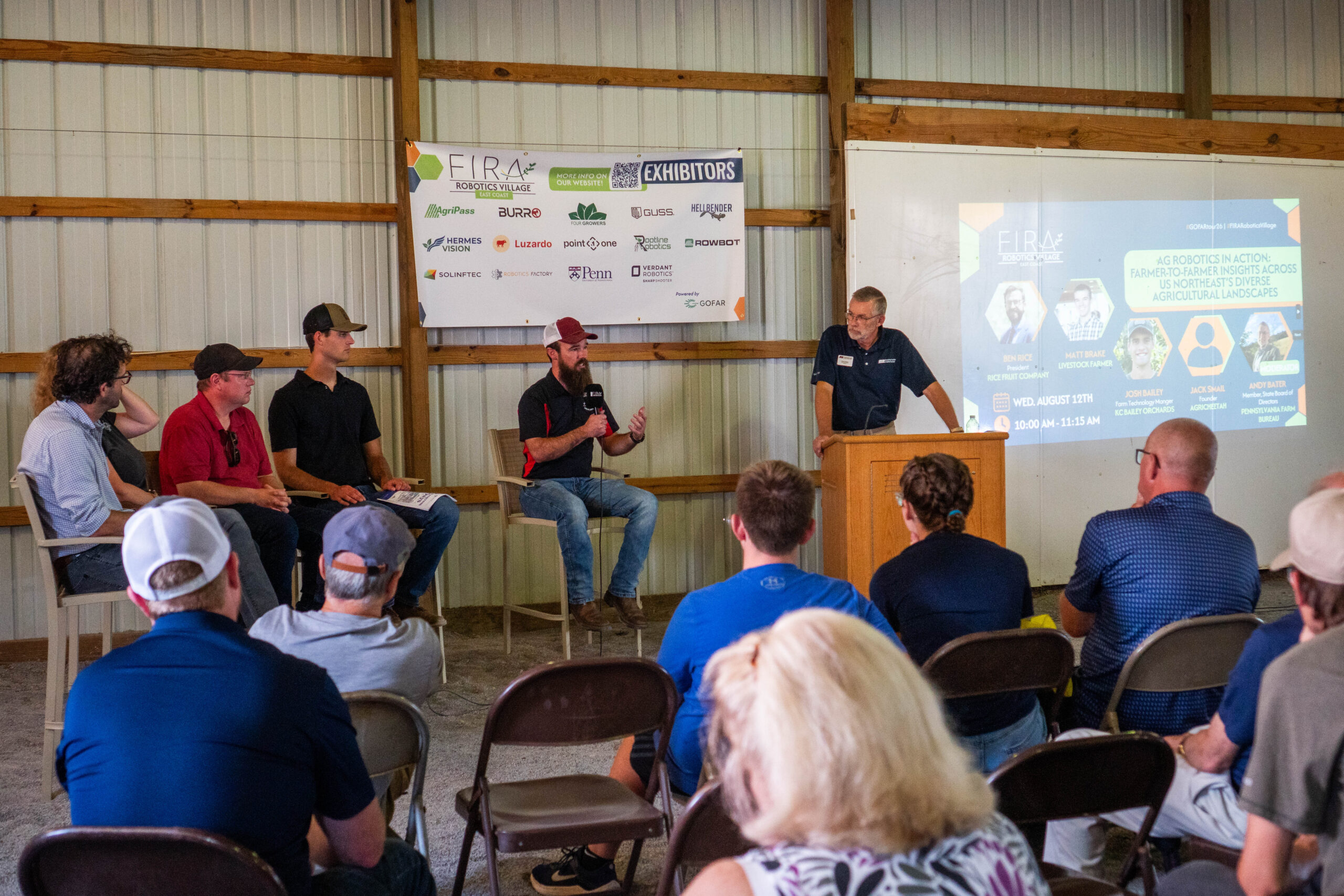
“The robotics has really eliminated the stress of all the family labor,” Brake said Aug. 12 during a talk on ag robotics at Penn State’s Ag Progress Days.
“With the flexibility, Dad can go be a grandparent more, and go to the softball games or the t-ball games that happen at 5 in the evening, whenever, before we were in the middle of chores.”
Robotics took center stage at the annual outdoor agricultural exposition, hosted Aug. 11-13 by Penn State’s College of Agricultural Sciences. New this year was a Robotics Village that featured ag technology powered by artificial intelligence.
This year also marked the 50th anniversary the 3-day show has been held at the Russell E. Larson Agricultural Research Center at Rock Springs.
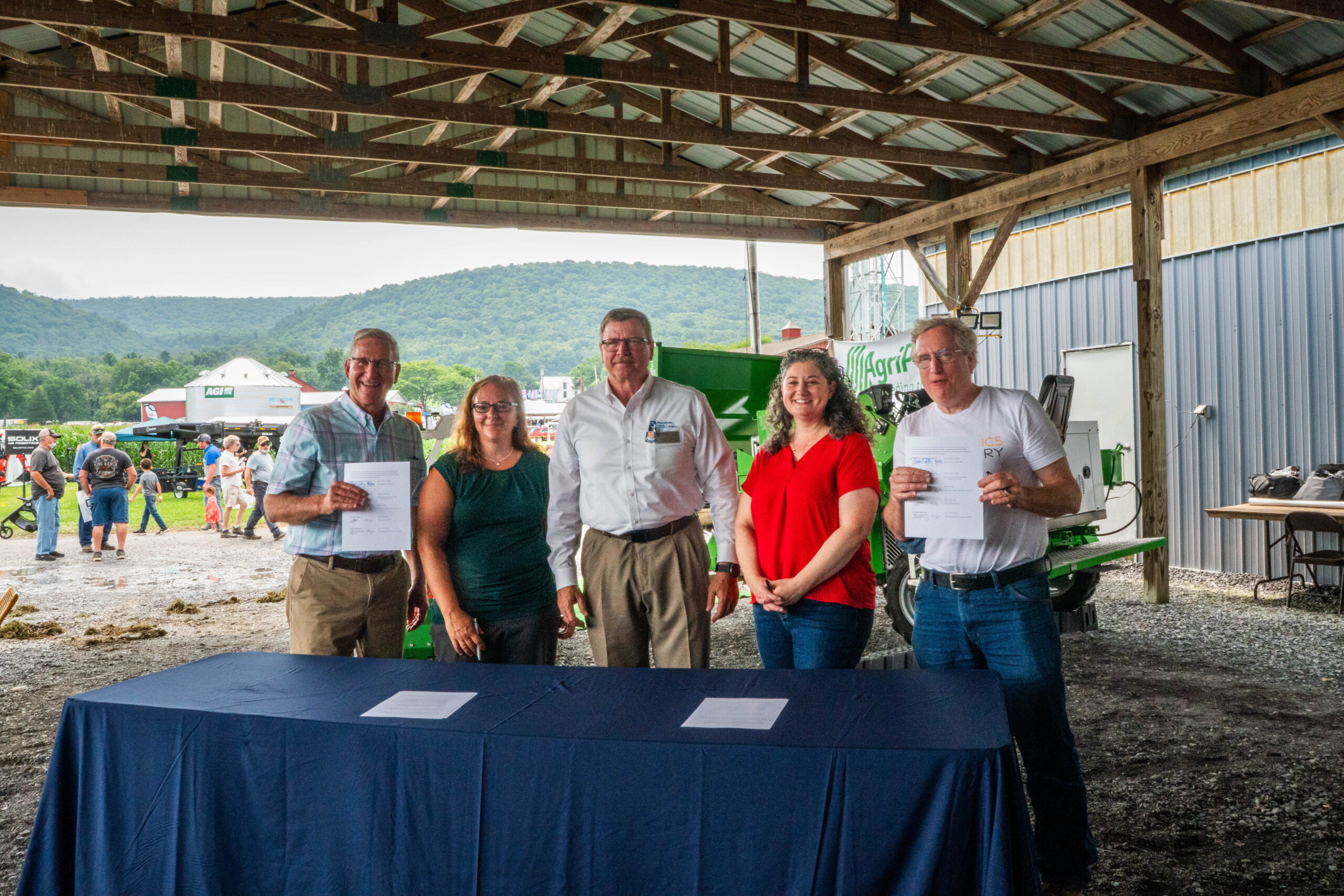
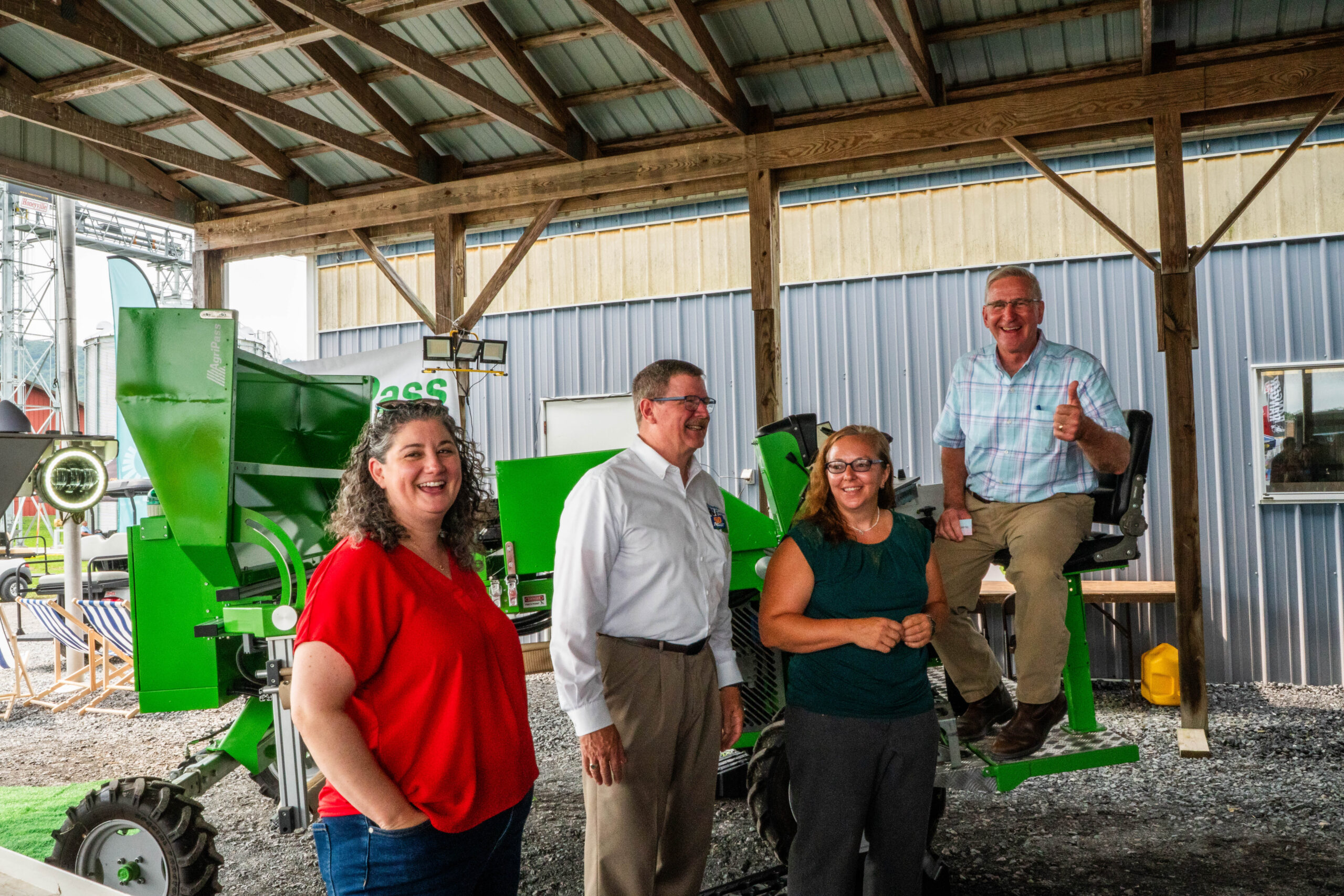
Officials from Penn State, the Pennsylvania Department of Agriculture, Team Pennsylvania and the Robotics Factory used this 50th anniversary backdrop to announce a new partnership, the Keystone AgTech Alliance, that aims to accelerate investment and research into the “technology of the future.”
“Let’s mark this as an occasion where we really enhance and take a big step forward in the way we advance technology for the next 50 years,” said Troy Ott, the dean of Penn State’s College of Agricultural Sciences, at the Keystone AgTech Alliance ceremony.
Keystone AgTech Alliance
The Keystone AgTech Alliance is a joint effort between multiple state agencies, economic development groups and Penn State’s College of Agriculture to bring farmers, researchers and industry leaders together to develop agricultural technology.
The idea for this partnership began in 2023, after several robotic summits were held in Pittsburgh and at Penn State University.
The alliance will entail listening to farmers’ problems and coming up with solutions via ag technology, conducting research and experiments on prototypes in the field and connecting with industry leaders who can make these investments possible. According to Ott, these partnerships are “an effort to put all the pieces together.”
At the announcement ceremony on Aug. 11, Pennsylvania Ag Secretary Russell Redding spoke about the agency’s role in identifying and addressing farmers’ most commonly held problems — something made possible through the PDA’s Agricultural Innovation Grant.
“There are two things that the farms are trying to address. One is labor issues, and the other is efficiencies, right? (The Ag Innovation grant is) deploying the robots or the technologies to really try to do those two things,” Redding said.
The grants, opening up on Aug. 24, “help farmers and other agricultural businesses implement new technologies, conservation and renewable energy technologies,” according to the PDA’s website.
A solution for a dairy farm
When a fire destroyed the Brakes’ barn in 2019, the family was at a crossroads: “Do we want to rebuild? Do we want to exit the dairy industry?” Brake said.
The Brake family entered the dairy industry in the 1920s, starting with 20 head of cattle. Today, Oakleigh Farm consists of 400 acres, raising 120 head of cattle and growing corn, soybeans, wheat, barley, oatlage, wheatlage and alfalfa.
The family decided to rebuild, using the latest agriculture technology: “Now we are a true 21st-century dairy farm,” Brake said. Before the fire, the Brake family had already been considering implementing ag technology, “but the fire definitely accelerated and made it easier to do that,” he said.
By August 2020, Oakleigh Farm was equipped with a robotic milking machine that the cows can access 24/7, a manure vacuum for the scrape alley and an automatic feeder that uses a laser to measure the height of the feed for refills.
These new technologies have produced multiple benefits for the farm, including solving the farm’s labor strain. As a family-run business, the employees consist of Brake, his father, his 91-year-old grandfather and his sister and brother, who work off-farm jobs.
“We essentially replaced about two full-time equivalent employees. Which anybody that’s been around a dairy farm, you know, you’re always short about three employees,” Brake said. “There’s definitely a lot less stress and a lot more flexibility on our side, and that’s where I can participate in other endeavors.”
The robots have allowed Brake to take up a part-time job selling robotic agricultural equipment. The robotic feeder, specifically, has made a “world of a difference,” Brake said.
On hot summer days, the cows tend to eat less food, making pushing feed more important. But most of the time Brake and his family are out in the field, taking advantage of the good weather, leaving feeding until later in the day. The robotic feeder has helped with this.
It also has allowed the farm to be more efficient with its feed usage, saving them money: “I know every day how much my cows ate. So it’s helping our inventories as well, where we actually, in a sense, we’re better utilizing the crops that we grow,” Brake said.
While robots have improved operations on the farm, not everyone was initially on board, like Brake’s 91-year-old grandfather. That was until he started seeing the benefits for himself when Brake’s parents had to travel to North Carolina when Brake’s sister was having a baby.
“Usually, anytime Dad left the farm, he’d be calling Pap and saying, ‘Hey, Pap, can you help milk in the mornings and everything?’ And (later) I walked in the robot room, and Pap was there watching the cow, and he said, ‘I’m actually starting to believe in these robots now.’ He said, ‘Your dad left away for a weekend, and you never once called me to come help you,’” Brake said.
His grandfather was especially pleased he wasn’t handling the cows when he saw them kicking the robots several times while getting milked, Brake said.
Addressing data center concerns
While some farmers have come around to ag technology, others are still skeptical, given the environmental impacts of artificial intelligence.
Proposed data centers to support artificial intelligence are popping up across the tri-state area of Pennsylvania, Ohio and West Virginia that consume millions of gallons of water, take up hundreds of acres of land and use large amounts of electricity.
Redding and Ott say they aren’t concerned, as there is other land to put data centers on besides farmland.
“(In Pennsylvania,) there’s 160,000 acres of reclaimed mine land. It’d be a wonderful place to put data centers. We just don’t want to put them on highly productive soils,” Ott said, adding he believes water will not be an issue due to the state’s abundant rivers and waterways.
Redding noted there’s a disconnect between people supporting artificial intelligence but not the data centers that make this technology possible.
“This evolution of agricultural production and this abundance that we enjoy, all of the technology that we have adopted from the seeds in the ground to the genetics in the barn and the equipment that’s in our fields, that all comes as part of our infrastructure of how you actually manage complicated systems,” Redding said.
“Whether those systems are animal systems, or plant systems, or human systems, that takes innovation, right? We have to be honest with ourselves that in the deployment of innovation, for that to be realized, it takes centers to manage that data.”
(Liz Partsch can be reached at epartsch@farmanddairy.com or 330-337-3419.)