
Nearly 30 years ago, Vernon and Carol Sloan, of Stryker, Ohio, started Foods Resource Bank when they decided to ship corn to developing countries.
But when the expense was nearly 15 times the value of the grain itself and providing free grain caused additional financial strain for the very communities they were trying to help, the organization pivoted.
The solution was to use the proceeds from crops raised and sold in the U.S. to fund agricultural development programs overseas.
Today, the organization, which was renamed Growing Hope Globally in 2018, has 102 growing projects across 21 states, providing financial support for 51 projects overseas in 30 countries.
Last year, they provided educational training to more than a quarter of a million farmers abroad with the goal of eradicating world hunger by teaching others how to grow nutritious and sustainable food in their area.
As it pivoted to its new mission, Growing Hope Globally began partnering with Christian development agencies to provide training and tools for sustainable farming. Those agencies, which Growing Hope Globally calls implementing organizations, include Catholic Relief Services, Church World Service, Covenant World Relief & Development, Lutheran World Relief, Mennonite Central Committee, Nazarene Compassionate Ministries, Presbyterian Church USA, United Methodist Committee on Relief (UMCOR), World Hope International and World Renew.
In the United States, Growing Hope Globally partners with farmers, churches, agro businesses, rotary clubs or anyone else who wants to raise funds.
“Those folks are all fundraising one way or another, whether it be farming, whether it be doing what the Archbold group is doing,” Veiock said.
Those funds then go overseas to support projects within this mission, and the person or group making the contribution can choose a specific implementing organization, a specific project, a specific country or just wherever it is needed most.
Archbold Beef Project
In Archbold, Ohio, project leader Jim Rufenacht said the idea for the project started in 2001.
“We were invited to a meeting with the Food Resource Bank at that time and Mennonite Central Committee (MCC), which is one of the implementing organizations, to talk about what a growing project looked like and whether we here in Archbold would be interested in doing one.”
Vernon Sloan was at that meeting.
“If you couldn’t get excited about this idea, you couldn’t hear or something,” Rufenacht said.
The ask was to donate some acreage for a project, but Cork Rufenacht, Jim’s brother, said that was hard for them to do at the time.
So he asked, “What if we did something with livestock? There’s empty cattle barns around.”
And so the project began. The duo grows feed and donates the proceeds to help support the Archbold Beef Growing Project.
The Archbold Beef Project and annual Burger Bash, in Fulton County, Ohio, have contributed $783,629.30 to Growing Hope Globally over the last 25 years.
From the start, Jim Rufenacht said that they made the project ecumenical, like Growing Hope Globally’s work. It’s that decision to which he credits the success. For example, while the Rufenachts are Mennonite, the local Lutheran church helps provide the food for the Burger Bash, the local Catholic Church helps serve it and other churches help in various ways.
“The Burger Bash is really what we consider a kickoff meeting for the year,” Cork Rufenacht said. “The idea is that the cattle are a visual entity that people donate grain to feed, and together between the two of them, we gather donations for feed, over and beyond that actually…That’s kind of the means to the end that the cattle represent the project, but they typically don’t make the money in total.”
Jim Rufenacht called the cattle only an icon for the project.
“They really, especially the last couple of years with cattle being very expensive, last year and this year we haven’t actually put any cattle in,” he said. “We just have a project because cattle are so expensive and the chances of making money are slim.”
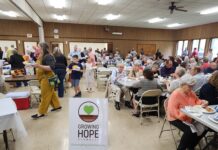
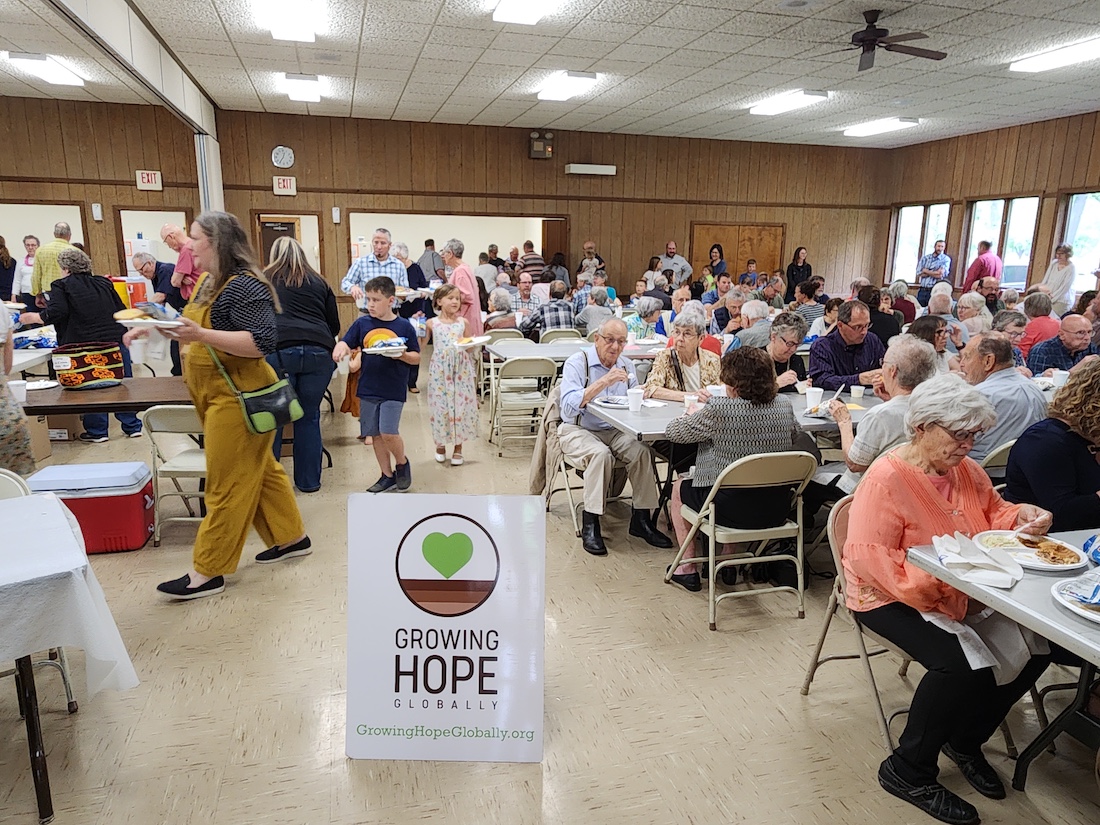
The annual Burger Bash, which takes place the Sunday before Mother’s Day, draws between 400 and 500 people and is sought after each year.
“It’s really kind of a community celebration for the funding that we raise. So being a beef project, we do serve burgers and beans and coleslaw and chips and ice cream and whatever,” Cork Rufenacht said. “But the Burger Bash is really the community celebration. The greater community’s involvement beyond the ones that are actually working it.”
Some of the food is donated so the meals can be provided with a free-will offering and increase the donation made each year to Growing Hope Globally.
Cork Rufenacht stressed that it isn’t just the two brothers; it takes the whole community to make the event and annual contribution happen.
“I think the success of it is… how many people can you get involved. The more people you can get involved, the more people you can reach. And that’s been the success of having more than one church involved in it,” Jim Rufenacht said. “A lot of growing projects just have a church. We’ve just got a whole community, and it’s been good for our project.”
Measuring the impact
The cost of providing the training for one farmer is $11 per year, with most training taking place over a five-year span, making the total cost per farmer abroad $55.
“We’re hoping that they received enough training to feel comfortable with it enough, and they’ve had enough time to kind of ask questions as it goes along to feel confident that they can do it themselves when we leave and that they can continue that on for life, for long-term,” Veiock said, adding that they still check in with past projects.
The goal is that each farmer who participates gets to the point where they can produce enough, healthy, nutritious, diverse food for themselves and their family.
“But what I call gravy is if that family grows in excess of food that they can eat,” he said.
This allows the farming family to make an income. But it has a ripple effect.
“But also the other family that’s receiving that doesn’t have to walk two hours to a market to get crops, so that’s kind of the ripple effect of that,” Veiock said.
He said they can document roughly 2.5 million people who have gone through their programs overseas.
Though each program looks different. He spoke about the two he has seen in person.
The first was in Cambodia, where they spent the first year of the project just trying to figure out what could grow at the top of the mountain given the elevation and growing conditions. In Zambia, the focus was on breastfeeding and pregnant mothers because of the high rates of malnutrition for children ages zero to two. The main food source for the area is maize or corn, which is starchy but does not provide nutrients.
The program there focused on cooking classes and growing items to make a common corn mash recipe more nutrient-dense by adding items that can grow in the area such as peanuts, pumpkins, lemons and okra.
“We’re in so many different places, and they’re all facing different issues. None of our programs are the same,” Veiock said.
Cork Rufenacht said that he likes that there is very little overhead in getting the support overseas.
“Growing Hope’s history will tell you that with $55 they can make a person food secure for a lifetime, not a day or a week or a year, for a lifetime. So I mean you can do the math on that but $800,000 has made a significant impact somewhere,” Cork Rufenacht said.
His brother chimed in.
“If you divide that out, we’re talking about 14,000-some people which is three to four times of what Archbold is,” Jim Rufenacht said, “so the impact has been humongous.”
For more information on Growing Hope Globally, visit www.growinghopeglobally.org or call 888-276-4372. Donations can be sent to P.O. Box 5628, Carol Stream, IL 60197-5628.