





COLUMBUS — The Ohio Department of Natural Resources Division of Wildlife reported strong production in white oak trees and moderate production in red oaks during its 2026 acorn mast survey.
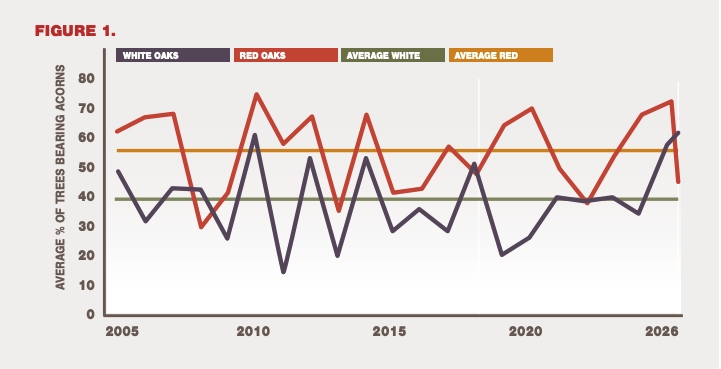
The survey found this year, an average of 45% of red oaks and 60% of white oaks on 22 wildlife areas bore fruit.
A single oak tree can produce thousands of acorns, feeding a diversity of wildlife such as white-tailed deer, wild turkeys, blue jays, ruffed grouse, squirrels, raccoons, woodpeckers and foxes. Wildlife seeks out and eats acorns throughout the fall and winter.
Each summer, Division of Wildlife employees scan the canopies of oaks at select wildlife areas to determine the percentage of trees that produced acorns as well as the relative size of the acorn crop. This was the 22nd year the Division of Wildlife completed the mast survey.
Red oak results
2026 average of red oaks bearing acorns: 45%
2025 average of red oaks bearing acorns: 72%
Long-term average of red oaks bearing acorns: 55%
White oak results
2026 average of white oaks bearing acorns: 60%
2025 average of white oaks bearing acorns: 56%
Long-term average of white oaks bearing acorns: 39%
Acorn abundances vary by region. All results, including tables and historical numbers, are available online here or at wildohio.gov.
Deer hunters can use acorn survey information to improve their chances. In areas where acorns are an important part of the deer’s diet, mast availability can affect deer movements and ultimately hunter success.
In poor mast years, deer are forced to use other food sources, and travel distances between feeding and bedding areas may be longer. Hunters may key in on travel corridors and alternate food sources. In regions with a strong acorn crop this fall, either from red or white oaks, hunters may find success hunting in or near oak stands.
As a critical food source for many forest wildlife species, acorn abundance has been linked to body condition, winter survival and reproductive success.
Acorns come in two basic types: red and white, coming from the red and white oak tree groups. Red oak acorns take two years to develop and the acorns are bitter. White oak acorns take one year to develop and have a sweeter taste for wildlife. White oaks tend to drop their acorns in late summer and early fall. Red oaks often drop their acorns later than white oaks, even into winter.