





BURTON, Ohio — By 1864, the Union was bone‑tired. Three years of war had emptied farmsteads and factory floors, regiments had been massacred and amassed and massacred again, and disease killed more men than enemy fire. Families were sending their second and third sons to the front, and still the Confederacy clung to its vision of a slaveholding republic, gambling it could outlast the North’s will to fight.
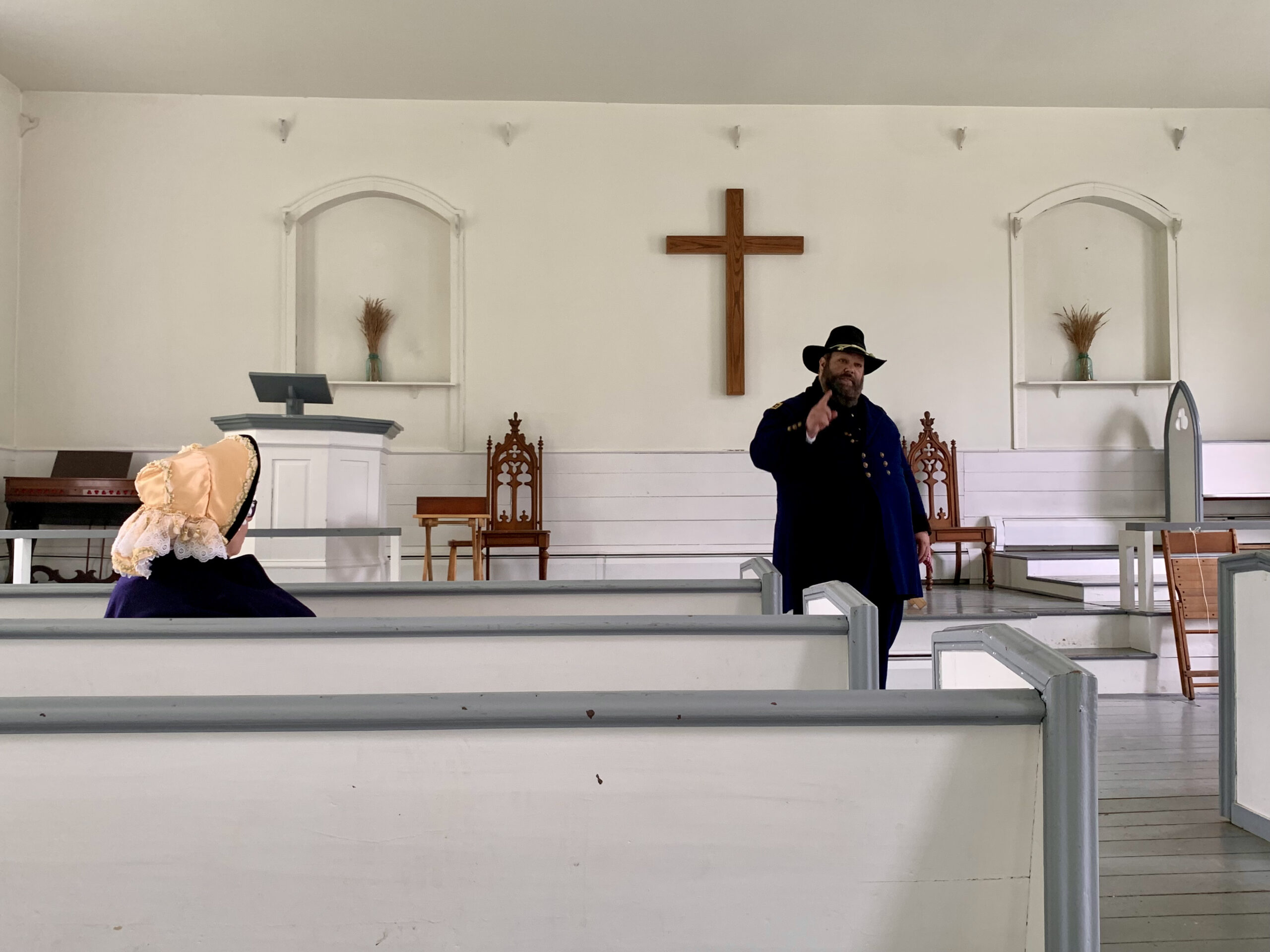
At Century Village Museum’s May 25–26 Civil War reenactment, now in its 41st year, reenactor Benjamin Frayser, in the role of a weary but impassioned Major General James Garfield, did not mince words.
“This war has been terrible. It has gone on too long,” he told a small crowd, in an impressive monologue loosely drawn from Garfield’s writings and speeches. “We have sacrificed much, we have lost too much, but if we don’t see this through, the blood of our soldiers that has been spilled upon the ground will cry out with righteous fury — if we do not bring slavery to its end.”
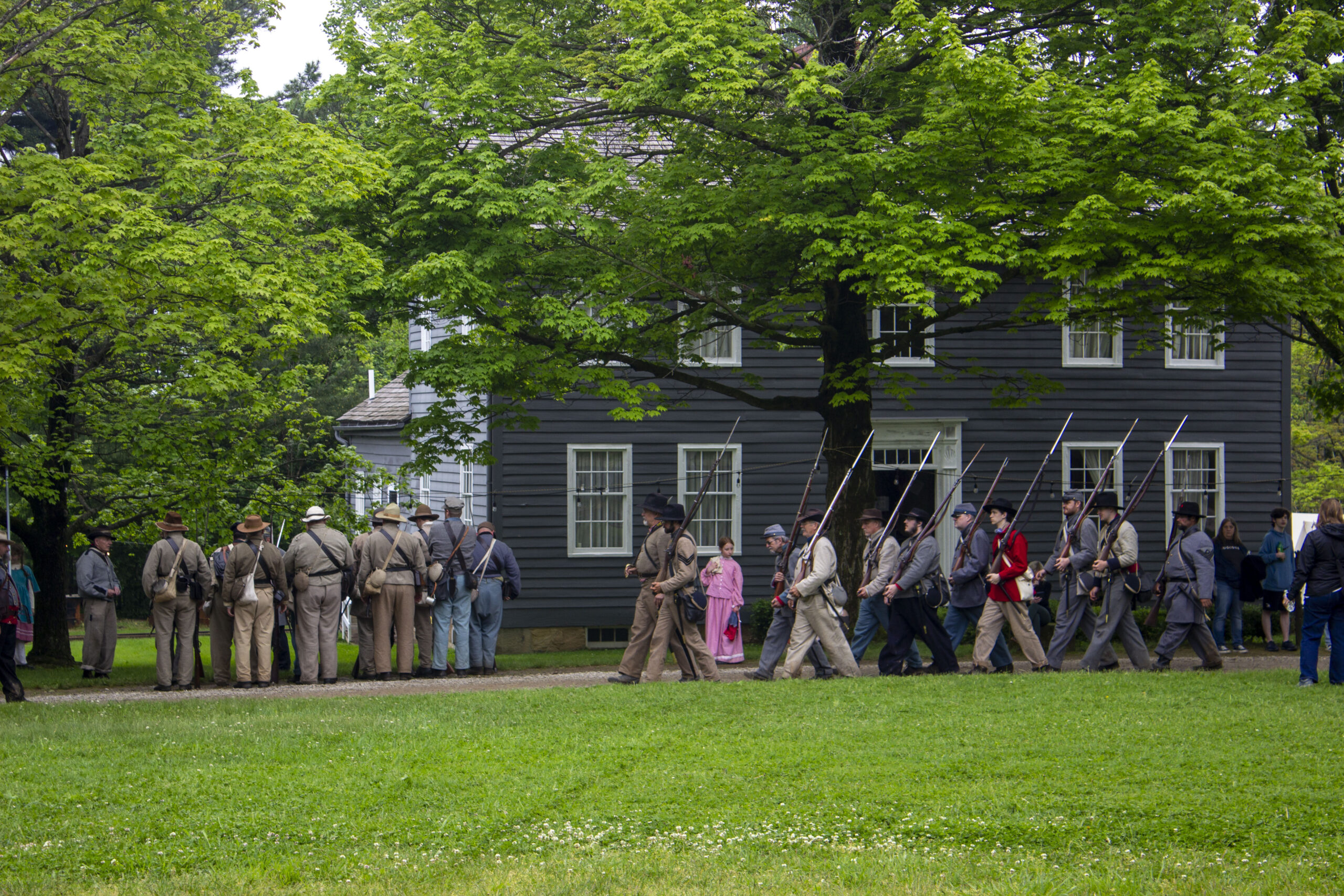
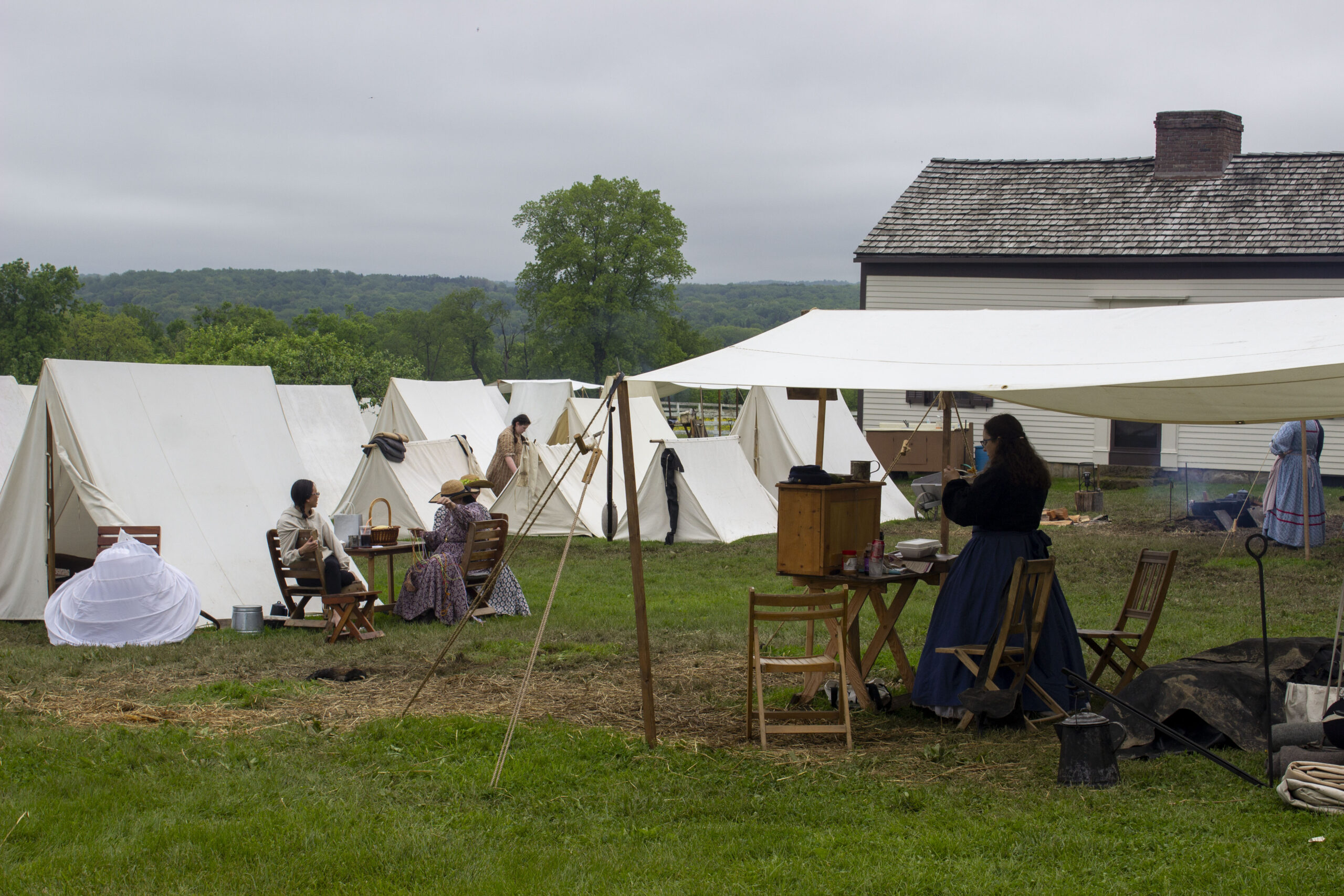
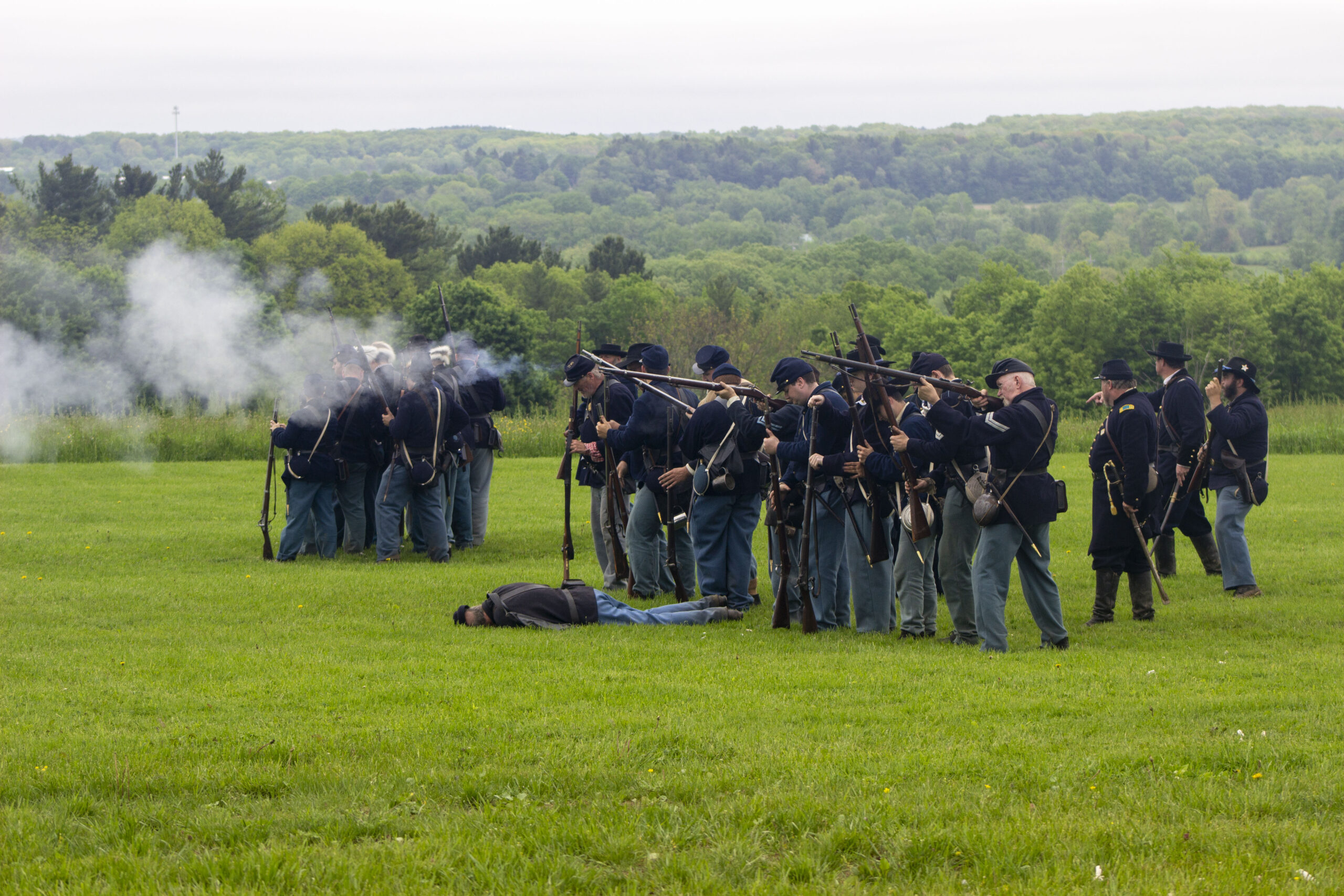
This tracked neatly with my Massachusetts public‑school understanding of the war: that the Confederacy fought to preserve slavery and lost. Amid the clap of blank musket fire in the distance and the smell of spent powder, reenactors in Union blue and Confederate gray marched, fired and fell while blacksmiths hammered iron, women modeled 19th‑century dresses in a fashion show and officers discussed flanking maneuvers with attendees. There were 800 or so guests who passed through the museum grounds during Memorial Day weekend.
In that setting, Frayser’s speech sounded like common sense: the war had a clear moral center, and I assumed most people agreed on what it was.
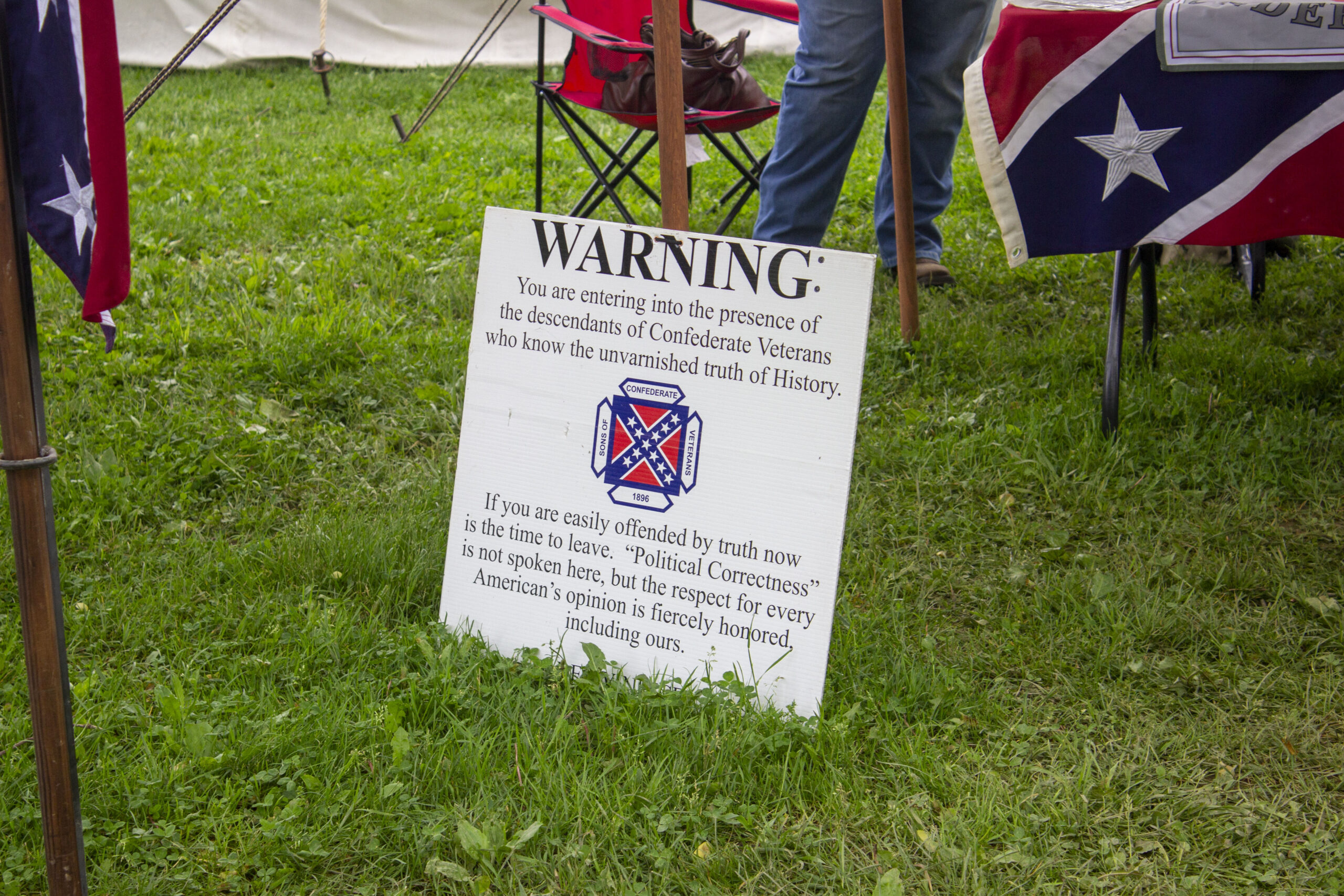
Then, I came upon a large tent in the middle of the village, its long table draped in a Confederate battle flag and fronted by a banner for the Ohio Division of the Sons of Confederate Veterans (SCV). The banner named it Quantrill’s Raiders Camp #2087, after William Clarke Quantrill, a native of Dover, Ohio, and carried slogans about patriotism, honor and “the unvarnished truth of history.”
Later, in a talk about Quantrill, Jim Crowl, a reenactor who also serves as Ohio Division Commander for the SCV, described him as “one of the most vastly misunderstood and victimized, vilified, demonized individuals in the entire Civil War.”
When I asked what kind of example a man like that offers today, Crowl cast him as a brilliant guerrilla commander who wasn’t interested in slavery or even in war.
“He became part of it because it came to him,” Crowl said; for Quantrill, “it was kind of a God‑given calling.” His attacks on Unionist towns and outposts, most notoriously the 1863 sack of Lawrence, Kansas, which saw his men kill around 200 men and boys before burning much of the place, were framed as a desperate defense of border families rather than savage butchery.
Pulling up Quantrill’s Wikipedia page on my phone, I found a far less forgiving portrait than the one I heard: he was a bushwhacker — that’s a term for a guerrilla fighter who led hit‑and‑run raids — indelibly linked to breathtaking atrocities “who roamed the Missouri and Kansas countryside to apprehend escaped slaves.”
I had never before heard of the Sons of Confederate Veterans. I wondered if they were simply tending a votive flame of a postwar story that recasts the Southern cause as a noble fight for honor and “states’ rights” or whether it was shading into something darker. Historians usually shorthand that impulse to sanitize the past as the Lost Cause, a romanticized narrative that downplays slavery and redeems the Confederacy. On the internet, I imagined people would strip away those bits and label them as something more nefarious. And I had the mind to join them.
But I had been wrong on one count already, thinking I was there to witness some completely innocuous historical theater; suddenly, the whole thing felt more like a referendum on how we remember the war and maybe even what kind of nation we insist it made us.
“All history is complex”
In search of a historian’s perspective, I spoke with Mark Holbrook, who spent more than a decade with the Ohio History Connection and has been giving public talks on the Civil War for 16 years. Our conversation eventually turned to Quantrill; I asked Holbrook if he was as bad as I suspected.
“William Quantrill was probably the most violent, evil man in the Civil War on both sides,” he said. “He loved to kill Black people, and he would hunt them down during the war, and he would treat the white Union troops the same way. There was nothing good to say about him. Nothing at all.”
For Holbrook, even Nathan Bedford Forrest comes off somewhat better by comparison: Though a brutal Confederate cavalry commander, slave trader and early Ku Klux Klan leader, Forrest later tried to disband the organization, whether out of political calculation, weariness or some desire to move on after the conflict. In Holbrook’s telling, Quantrill, on the other hand, seemed driven solely by a love of killing and stands out as “one of the worst of the worst.”
But like the figures at its center, the war itself, Holbrook stressed, resists simple explanations.
“All history is complex,” he said. “And none more complex than the Civil War.”
But how much did slavery have to do with it? Holbrook said there’s little confusion there. After Lincoln’s election, white Southern leaders treated the new administration as a direct threat to the institution of slavery and chose to leave the Union rather than risk federal abolition. Their intent, he pointed out, was written into the Confederate constitution, which made slavery a permanent, irrevocable feature of the new government.
“Not only that,” he continued, “but Mississippi, Texas, Georgia and South Carolina’s secession declarations cited the protection and expansion of slavery as the primary reason for leaving the union.”
He also underscored what he sees as a central contradiction in states’ rights arguments about the war. The Confederate Constitution made slavery a permanent fixture for all member states and prohibited them from changing it.
“If they were fighting for states’ rights,” he asked, “why would the Constitution prevent an individual state from making its own decision about something?”
Holbrook then offered his compressed version of what the war was about from the Southern side.
“Here’s what it all comes down to. For the South, slavery equaled power, politically and economically. They were an agrarian society, so the plantations were their single largest economic force. Without slavery, their agriculture economy collapses. They’re not industrialized like the North. They don’t want to be industrialized like the North. They want to preserve what they have, and what they had was a slave-based economy.”
When I asked why some people still insist the Civil War was fought over something other than slavery, Holbrook pointed to the Lost Cause. He described it as a story Southerners told themselves after defeat.
“The Lost Cause developed as a means to justify four years of war and getting nothing out of it, and losing over 300,000 soldiers from the South, and as a way to honor that sacrifice without admitting that they did anything wrong, so there was no admission of guilt … that slavery was at the core of it,” he said.
Holbrook was careful, though, to distinguish between hate groups marching under the Confederate battle flag today and the many reenactors he has known out on the battlefield.
“In my 20-plus years of reenacting … not one time did I ever hear any of them express anything like these hate groups do. It was always about, you know, ‘We’re here to portray a part of history, so that people don’t forget,’ and they were proud of their ancestors, but it didn’t go beyond that.” The difficulty, he said, is that the symbolism and intent have diverged.
“The Confederate battle flag has been usurped by these hate groups, and so now really you can’t blame anybody for seeing it as representing white supremacy, even though for Southerners who have those ancestors, it doesn’t mean that at all.”
Heritage fights
Chuck McMichael, a retired high school social studies teacher living near Shreveport, Louisiana, was the SCV’s former top officer: The HCIC, or Head Confederate in Charge, if you will. In a phone interview, he told me he is deeply invested in genealogy.
“As far as lineage, I’ve got like seven of my great-great-grandfathers that served in the Confederate Army,” he said. “And when you get into uncles and stuff, I’ve got 53, because they had big families back then.”
The SCV, he explained, is one branch of a broader world of American hereditary organizations where membership is based on ancestors who served in historic conflicts. It was founded in 1896 by former soldiers and their sons to preserve their history, sacrifice and legacy. Harry S. Truman, the Democratic 33rd president of the United States, was a member. On its homepage, the SCV describes itself as a patriotic and educational heritage organization devoted to history and memorial work, not politics. The group says it rejects racial and religious bigotry and condemns the use of Confederate symbols by extremist organizations. Today, the SCV maintains cemeteries, marks lost war graves and engages in what McMichael calls “heritage fights, trying to protect Confederate memorials and monuments and things like that.”
In recent years, that mission has included the construction of what he proudly described as “the National Confederate Museum” at the organization’s headquarters in Columbia, Tennessee, a complex that includes an antebellum house called Elm Springs and, more controversially, the reinterred body of one Nathan Bedford Forrest, the Confederate general.
The SCV’s relationship to the Confederate flag — and to the extremist groups that also fly it — is more fraught. Asked whether he hears challenges about the organization promoting white supremacy, McMichael was measured in his response.
“First of all, in our statements, we have nothing to do with somebody that wants [to be] promoting that.” He said the group has even explored whether it could trademark the old Confederate battle flag bearing the blue cross and stars. “Since we are the inheritors of the actual Confederate veterans, we should own the rights to it, and that way we can prohibit hate groups from using it.”
Trademark law, he noted, has thwarted that plan.
“The courts have ruled that at this point it is public domain, so all we can do is denounce those groups and say they’re not using it for legitimate purposes. Unfortunately, we can’t control what other people do sometimes.”
“A more perfect Union”
For Jim Vinecourt, who serves as Century Village Museum’s treasurer, history is important. While McMichael understands the past as something to defend as much as honor, Vinecourt talks about it as something people are in danger of losing.
“I just think they need not to forget history; just always remember what (all those) people died for,” he told me. Then he brought it back to the present day. “I don’t personally think the schools are teaching history very well right now, so I think we need to just keep history flowing out there, so we don’t repeat ourselves.”
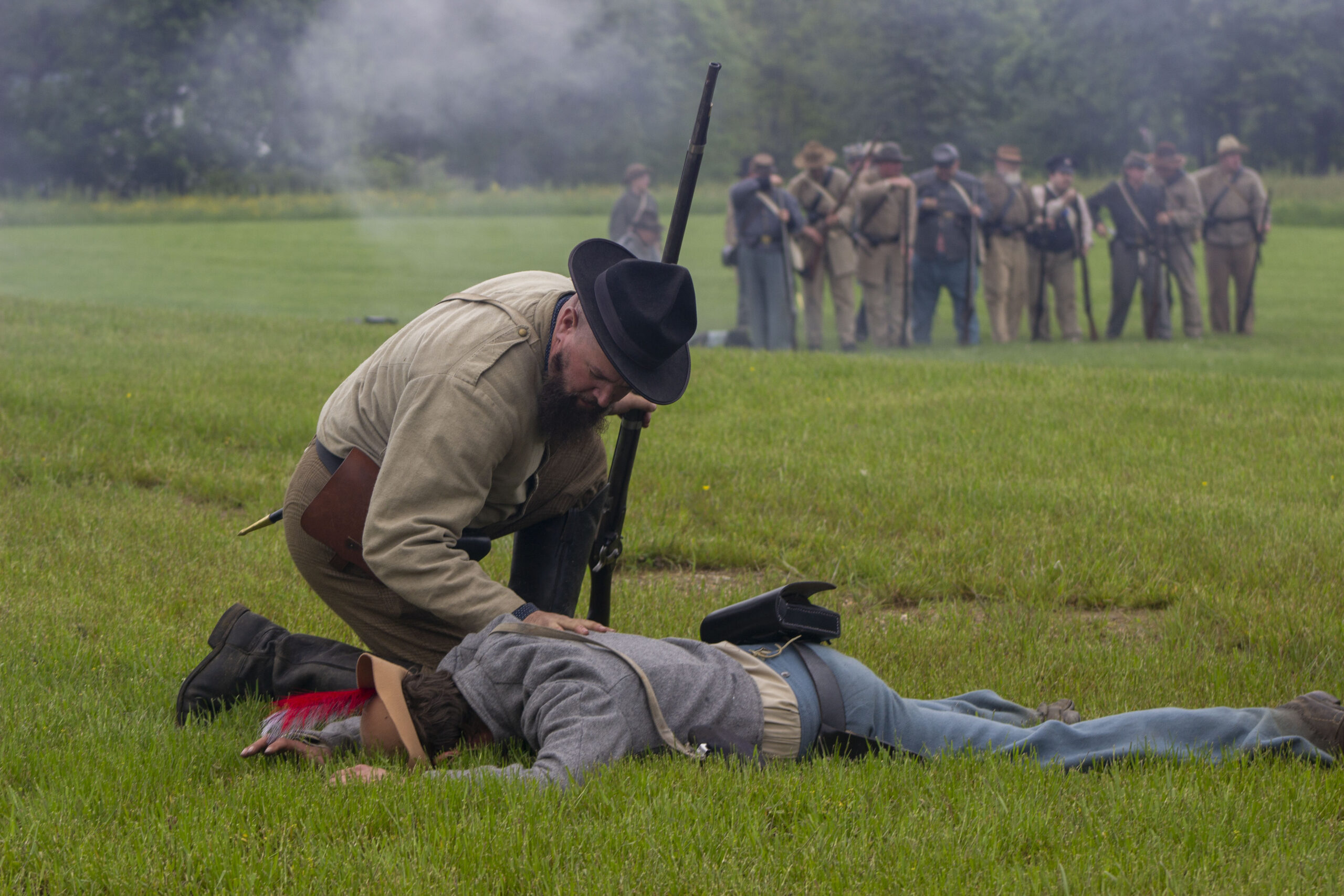
Frayser, as Garfield, was doing his part. When I asked if the experiences of the Civil War could teach us anything about the challenges we face in today’s world, he was cautiously optimistic. “Any problems that you all see today, and you try and think back, like, ‘Oh, it was so much easier back then,’ I can tell you it wasn’t easier back then,” he said.
Frayser believes the modern struggles Americans have inherited echo many of the ones faced by past generations, repeating again and again. “Nothing changes; the problems are always there. If we can just remember that we’re all Americans, we’ll actually get through them, and will continue making efforts towards a more perfect Union.”





A decent read–thank you, Paul.
Noted Civil War historian, Shelby Foote, was once asked what he thought an average Confederate soldier would say about why he was fighting. Foote’s answer was: “Because you northerners are here on our land without our permission.” Seemed to me it was a “private property” issue–whether enslaved people or land.
Nowadays I’ve seen a meme that offers some thought. It’s a large picture of Lincoln’s face with the words under it: “Don’t leave me, or I’ll kill you.” That, I believe, goes to the Southerner’s argument that they viewed the Declaration of Independence as well as the Constitution to be a consensual agreement. That is–states freely agreed to join the Union and thus could freely leave the Union.
Six hundred thousand lives settled that question.