



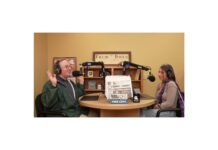
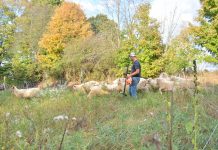

SALEM, Ohio — When the pandemic exposed how vulnerable her family was living on their isolated Ohio homestead, with spotty internet, unreliable cell service and long distances between neighbors, Polly Givens started thinking about what would happen if everything went dark.
“If things had really gotten bad, we would have no idea what was going on, no communication outside of our area,” said Givens, a retired registered nurse and lifelong farmer in Jefferson County, Ohio.
So, she turned to amateur radio.
Givens quickly moved through the ranks and earned her amateur extra license 2 years ago, joining a local club where camaraderie and mentorship helped her navigate a world of electronics she had been totally unfamiliar with when she began her radio journey.
“I had to learn the vocabulary first. You know, it would be like if you didn’t know anything about medicine, and all of a sudden they threw you in the hospital,” she said.
Now, with the call sign W8PIK — once her late father-in-law’s — Givens operates from her 500-acre property, a mix of hardwoods, livestock and homesteading projects. She keeps multiple radios on hand, from handheld UHF and VHF units for local communication to high-frequency rigs capable of reaching Belgium at dawn.
“Getting my signal out was a challenge. But the first time I did, I was trying to be real professional while I’m talking to the other ham, and I was making an ass of myself, you know, like I said the wrong things and I was nervous. He was very gracious. And I got off, and I put down my mic, and I told my husband, ‘Oh my gosh, I just talked to Indiana.”
For Givens, ham radio is about more than long-distance signals. It’s about connection, especially in rural areas where neighbors are miles apart. She participates in weekly “nets,” virtual check-ins with other operators, and events like the popular Parks on the Air program, where operators set up temporary stations in state parks and wildlife areas to contact other hams across the world.
“It’s so superficial on social media and other things,” she said. “The ham radio, it’s a much more intimate type of communication, even if it’s over the air.”
“When all else fails.”
She’s hardly alone. Across the country, from rural farms and small towns to emergency shelters and even the International Space Station, amateur radio — often called ham radio in reference to old slang for an operator with a poor or heavy-handed keying style — connects people without relying on the internet, cell towers or power grids, blending technical skill with public service and community.
The American Radio Relay League, or ARRL — the national organization for amateur radio — counts about 160,000 members exploring communications, technology and global connection. The organization coordinates licensing, works closely with the Federal Communications Commission and trains volunteers who step in when conventional communication systems fail.
“The emergency communications, that’s our number one responsibility,” said Bob Wilson, a longtime ARRL section manager from eastern Pennsylvania. That role, he explained, has defined amateur radio for more than a century. After World War II, the government recognized the value of having trained operators ready for emergencies. Today, tens of thousands of licensed hams participate in the Amateur Radio Emergency Service, or ARES, supporting emergency managers, shelters and relief organizations during hurricanes, winter storms and power outages. When the sky falls and cell towers, internet and landlines fail, amateur radio still works.
“Our motto in the amateur radio emergency service is, ‘When all else fails,‘ Wilson said.
For Wilson, it’s more than just the mission: Decades earlier, as a teenager just discovering the reach of radio, he experienced firsthand the quiet thrill of realizing how far a signal and his voice could travel. In 1978, after receiving his novice license, he climbed onto the roof of his family’s row house outside Philadelphia to install a simple antenna. Using a three-watt Morse-code transmitter he built from a kit, he sent out a call.
“CQ,” he tapped out. Is anyone there?
A reply came back from Kentucky.
“The first time you hear your call in Morse code coming back to you, it’s like you don’t believe it. You are really shocked. I think that most people probably will never forget their first contact.”
Benjamin Murray knows that feeling well.
Born prematurely in 1989 at just 1 pound, 10 ounces, Murray grew up legally blind with mild cerebral palsy and other challenges doctors once believed might limit his future. To help cover his medical bills, his parents founded People Works of Northwest Ohio, a family-run livestock farm and service organization where he still lives and works, anchoring his life to this day.
From the beginning, Murray gravitated toward sound and found the power in his own voice.
“When I was 4 or 5, my parents got me my first tape recorder,” Murray said. “I wore that thing out within a month.”
He discovered ham radio almost by accident. In 2002, colleagues at his county EMS headquarters, where he was volunteering, gave him a police scanner for Christmas. He began listening, learning voices and jotting down call signs long before ever speaking on the air. At 17, he joined the Fulton County Amateur Radio Club.
“I became obsessed,” he said. “I bought and sold more than I can think of, just to listen on.”
Murray earned his technician license in 2008, his general license in 2010 and his amateur extra — the highest level — in 2012. That same year, he helped establish a local testing program. Today, he works part-time as a board operator at WBNO-FM radio.
“Just to walk this earth and be part of something so magical every day as far as PeopleWorks, and then doing the ham radio stuff on the side, and making friends because of it, and working in radio; I love communications dearly, and there’s plenty of ways to do it,” he said.
In a time when communication systems seem more complicated, fractured and fragile than ever, ham radio endures for its simplicity: just one person calling out, hoping to hear an answer back.
When radio reaches The Final Frontier.
Radio is even powerful enough to connect a small Midwestern city to the farthest reaches of human exploration. On Oct. 25, as the International Space Station streaked across the sky 265 miles above Terre Haute, Indiana, at 17,000 miles an hour, a young voice spoke into a microphone and crackled across the airwaves.
“NA1SS, this is W9UUU. Do you copy? Over.”
At first, there was only static. Then a voice answered back.
“I hear you, I hear you. Loud and clear. Over.”
It was astronaut Michael Fincke, standing in for planned speaker Jonny Kim, who was busy making space station repairs. With views stretching across North America and both oceans, Fincke had just made contact with students, museum staff, guests and a state senator gathered at the Terre Haute Children’s Museum.
The moment was the culmination of more than a year of work that began when Laurel Tincher, the museum’s program manager, noticed a brief line in a NASA email inviting organizations to apply for ARISS, or Amateur Radio on the International Space Station, a collaborative program with the space agency.
Tincher said her love of space started young, watching episodes of Star Trek on TV.
“I thought about what it would have meant to me if I had the opportunity to connect with someone directly involved in space. That would have made my entire childhood right there; that would have been like a dream come true,” she said.
The museum had just hosted its first amateur radio day with the Wabash Valley Amateur Radio Association.
“They’d actually been looking into it already,” Tincher said. “They just didn’t have an organization to partner with.”
What followed was a yearlong crash course in radio, space and logistics. The application required educational plans, sponsors, partnerships and letters of commitment. Once accepted, NASA and ARISS assigned mentors and required regular reports, meetings and photos.
The radio club purchased new equipment with their own money, practiced satellite contacts and chose the more complex route of building a direct end-to-end radio link instead of using a remote telebridge.
“It was a whole learning curve of being able to hit those satellites,” Tincher said.
Organizers carried antennas, plywood, horse mats and sandbags up to the roof, clocking an estimated 80 hours of labor just to outfit the building and make the contact possible.
The kids had their work cut out for them, too. To even submit a question, they had to participate in educational programs at the museum or the local planetarium. They rehearsed, learned how radio waves propagate, and how materials for spaceships and spacesuits behave in space.
Tincher said she didn’t fully exhale until the final transmission faded. By then, she couldn’t wait to get on the air herself. Over the course of the past year, she went from knowing very little about amateur radio to earning her own ham radio license and stepping into a leadership role as secretary of the Radio Association. What started as a museum program had become a bold leap forward. She now owns a handheld radio and an older Kenwood transceiver she picked up secondhand. Her goal, she said, is to tune in, listen and eventually start making contacts well beyond Indiana.
“I just want to be able to tune it,” she said, “and hopefully start talking to people overseas, all over the world.”
That sounds a lot like Kevin Berlen’s story. He is the outgoing president of the Wabash Valley Amateur Radio Association in Indiana, having been involved with the organization for about 40 years.
“Amateur radio has been a big part of my life,” he said. “Got started when I was in my teens. It’s led to basically my lifelong career. I’ve been involved in communications electronics since I graduated from high school.”
He called the collaboration with the Terre Haute Children’s Museum “a once-in-a-lifetime experience” that highlighted the versatility and relevance of ham radio in today’s world.
“It’s not an outdated hobby,” he said. “It continues to grow. With just a radio and an antenna, you can communicate globally without relying on the internet or cell towers. That’s incredibly powerful, especially in emergencies. But beyond that, it’s a way to connect, to learn and to inspire the next generation.”
To learn more about the American Radio Relay League, visit arrl.org.





Congrats to Polly and the others mentioned here!
73
N3GXQ
Great article! All the individual stories are compelling. I got involved with ham radio a little over a year ago when I started helping a friend who makes rooftop antenna towers, primarily for amateur radio operators. Ham radio is a wonderful field, full of interesting people and stories like these. And so important in emergencies!