


Montgomery County, Ohio, covers an area of 463 square miles and is home to over 600,000 people, with eight courts and 33 law enforcement agencies, a handful for today’s wildlife officer. That job seemed even bigger in 1987.
This look back at one officer’s efforts and his solutions is thanks to portions of a column written by Game Protector Tom Bowersox. It appeared in 1987’s autumn issue of Ohio Wildlife, a publication once offered by the Ohio Wildlife Officers’ Association.
Working in a county like Montgomery takes more than a desire to make wildlife cases. It takes skill in people management, a working relationship with other law agencies and positive interactions with the county’s conservation clubs. It also helps to have an edge on the equipment you use.
Kevin O’Dell, the State Game Protector assigned to Montgomery County in 1983, received the standard issue of equipment for his job. Like most, he wished that he had access to that extra piece of equipment or burgeoning techno-gadget.
O’Dell’s connections with local sportsmen’s clubs provided him with the opportunity to acquire equipment that was beyond the reach of other county officers. His success was in no small part due to the hunting and fishing license writing fees that went to those clubs for the purpose of helping improve a wide range of public-service-type projects. As O’Dell progressed through learning the ins and outs of his job, he began to recognize certain equipment shortfalls.
Shallow water special
His assignments included several major streams — such as the Great Miami, Stillwater, Mad Rivers, Wolf and Twin Creeks — which meant that fishing and litter violations accounted for a large part of his 200 arrests per year. Sometimes, working these streams was troublesome. Stretches could be shallow and gravel-bottomed, making them difficult to maneuver using a conventional boat and motor combination. With O’Dell’s encouragement, one of the local clubs purchased a 12-foot shallow-run Jon boat with a special five-horsepower Go-Devil motor. This long-shafted, hand-controlled motor made shallow water operation easy. Many unlicensed anglers and litterbugs were left wondering, “How did he ever find me?”
Dayton had long been an industrial city, and large cities with industry near streams have often meant pollution problems. Montgomery County has had more than its share of extensive fish kills, situations that the Division of Wildlife and the EPA investigate. Once during Odell’s time in the county, a train derailment caused a tank car containing phosphorus to ignite and burn adjacent to the Great Miami River. Over 30,000 people were evacuated to avoid the noxious cloud that extended for 30 miles. In a futile attempt to put the flames out, water had been pumped on the tanker, which washed substantial quantities of the chemical into the river. As expected, fish were killed for miles downstream.
In another situation, PCBs (polychlorinated biphenyls) entered Wolf Creek and then the Great Miami, contaminating many fish in the river. Bottom-feeding fish were especially affected, testing well above the EPA standards. As a result, the health department banned fishing in Wolf Creek and a large part of the Great Miami River. As O’Dell faced these issues, one local conservation club provided him with a digital dissolved oxygen, temperature and pH meter. It proved to be a handy item to have during fish-killing pollution investigations.
Night aid
While fishing remains a big sport in Montgomery County, hunting occurs on the west side of the county. The most commonly hunted critter was the raccoon, which translated to night work for game protectors. A human’s ability to see in the dark is marginal at best. To solve this problem, O’Dell approached a club, which purchased him a Litton handheld night scope, a relatively rare and expensive item — at that time most often seen in the armed forces and specialized civilian law enforcement units. This compact night technoscope caused many an illegal raccoon hunter a trip to court, as well as plenty of back-road litterers who tossed their trash.
In those days, camera equipment issues plagued most of the division’s officers. Considering that during this period, an officer’s primary camera was a Polaroid, you’ll start to get the picture. While it had the advantage of instantly kicking out a finished photo, the film was expensive, bulky and prone to fading and smearing, and the camera wasn’t suitable for distance photography. The more versatile 35mm gear was restricted to the division’s investigators. For O’Dell, it wasn’t a problem. A club had given him a fully automatic Minolta Maxim 7000 with a wide array of lenses for every possible need. While it was a great camera for its time, a current officer’s smartphone does just as well in most circumstances, including the ability to be attached to a spotting scope
K9 assistance
O’Dell’s relationship with neighboring enforcement agencies was exemplified by the Magnum at his hip. The Montgomery County Sheriff’s Office agreed to train Magnum (a chocolate Labrador retriever) free of charge if they had access to his occasional emergency use.
Accompanying Officer O’Dell during patrol, Magnum assisted in finding hidden and tossed guns, game and fishing tackle and stood between his partner and serious threats. Magnum also corralled several fleeing felons and one prison escapee, found one suicide victim and recovered articles of stolen property. Magnum was retired due to a division policy change that disallowed K9 units. Over the last few years, dogs have returned to duty, patrolling with natural resource and wildlife officers in Ohio’s parks, woods and waters.
Computers
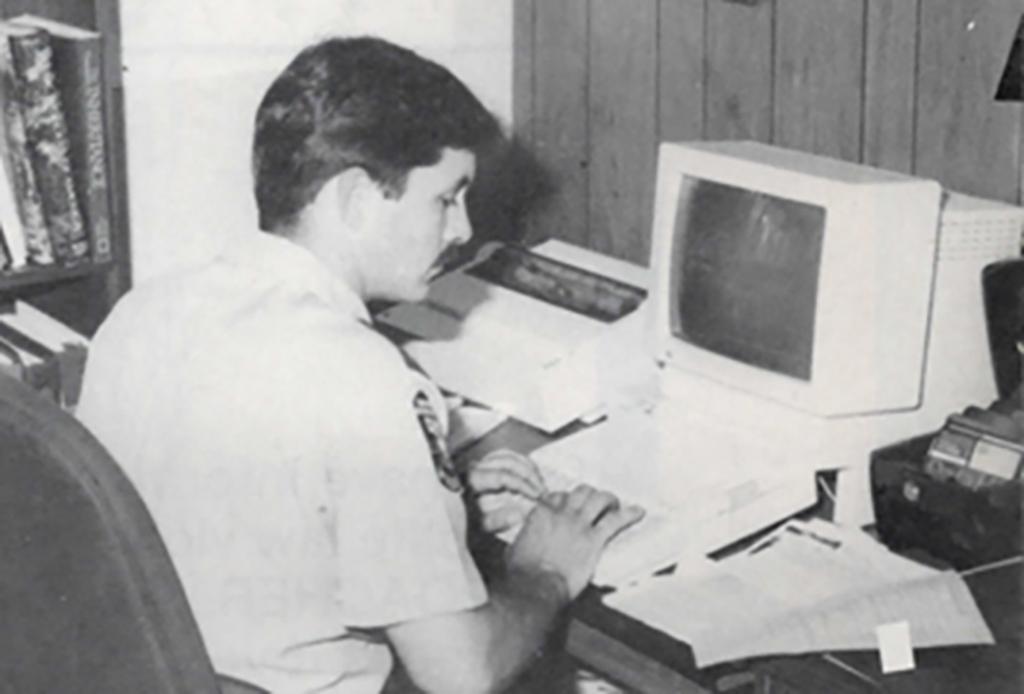
Nothing is more dreaded and has caused more grief to a game protector than paperwork. It consumes more time than most thought possible when first hired, and their deadlines are never-ending. Probably the most useful piece of club-purchased paraphernalia O’Dell received was an Apple IIc computer with a printer and extra disk drive. Large and prehistoric by today’s standards, this one item allowed an organizational ability that could not then be imagined, even if it had less computing power than today’s officer’s smartphone. While O’Dell was learning about computer operating systems and storage, nearly every division office was still operating with electric typewriters and steel file cabinets.
O’Dell’s professional relations with his 14 conservation clubs allowed him access to equipment that aroused envy in other officers. Lest you think these clubs spent all their money outfitting the Montgomery County Game Protector, O’Dell was also encouraging them to use those writing fees to invest in everything from gravel for wildlife area parking lots to hosting hunter safety courses, purchasing supplies for hunter safety instructors, stocking fish and hosting special youth activities and events.
Doing the job of game protector in 1987 required a very special individual with skills and talents no other job requires. Every game protector used these acquired skills daily, but for O’Dell, many of the normal problems faced by a game protector were made a little easier due to the extra equipment, allowing him more time in the field to do his job safely and efficiently.
Nearly 40 years later, the name “Game Protector” is part of conservation history. Now called “Wildlife Officers,” these men and women still find themselves wrestling with many of the same issues O’Dell had faced. Thankfully, technology has caught up with these officers, and they seldom need to seek outside sources for their gear. They travel with on-board mobile computing stations, the internet connectivity we all now take for granted, linked-in smart phones with excellent cameras, the ability to call in a K9 or specialized investigator for assistance and a far superior state-linked radio system.
Oh, and speaking of cameras, they of course have their digital cameras in their gear bags, but you will also notice them wearing body cams on their uniforms, ready to record every contact they make. Another change has been in the amount and quality of in-service training offered to each of the officers, which helps them understand and perform their jobs at the highest standards.
One thing remains especially important. Building and maintaining the positive relationships that ODNR and the Division of Wildlife cultivate with the people of Ohio and the conservation clubs they support.
“We are stuck with technology when what we really want is just stuff that works.”
— Douglas Adams