




Editor’s note: The story was updated April 22.
PAULDING, Ohio — Doug Goying is the first to endorse technology on the farm.
The grain farmer has always been a technology-forward operator and an early adopter of strip tillage, electronic solutions and efficient cash-flow systems. You will even find a fleet of Tesla electric cars in his driveway.
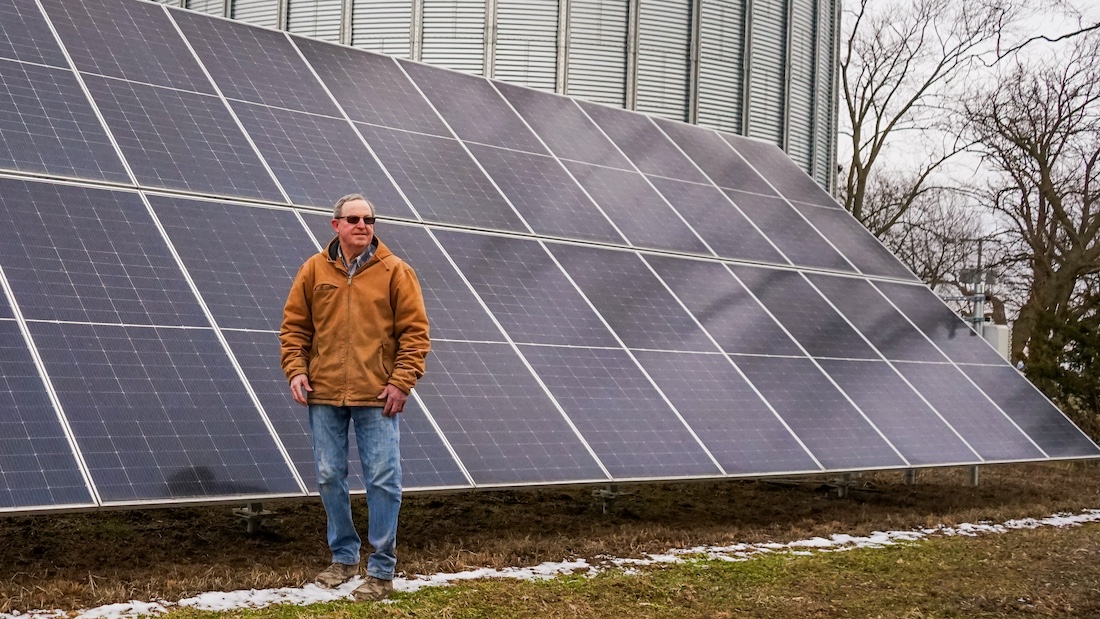
On his Paulding, Ohio farm, Goying’s solar panels are out of sight, yet close enough to be helpful. Powering his grain operation, the 158-kilowatt solar array was expected to be a cost-saving investment.
The project was the poster child for the U.S. Department of Agriculture Rural Development funding in Ohio — a grant from the Rural Energy for America Program in 2023 subsidizing solar projects on farms.
Now, Goying’s connection to the grid is costing him more than he benefits from the generation of energy, prolonging what was expected to be a five-year payback investment in clean energy.
Rising energy costs, via distribution and transmission fees charged by utilities, are eating into the generation credits he receives from a payment process known as net-metering. Additionally, rule change proposals from AEP over the years have threatened rooftop and farm solar, which could make his solar investment worse.
“If you want us to continue to add solar power units or green things, you got to make them cash flow, and you can’t charge more for transmission and distribution if it doesn’t cash flow,” Goying said.
It’s a jolt of power he regrets adding to the farm, caused by Ohio’s energy crisis that is built on mistrust, information gaps and utility litigation earlier this year from American Electric Power that tried to cut generation rates for those who produce power.
What you earn, what you pay
On-farm solar is promoted as a way for farmers to generate their own power, offset grid use and send excess electricity back to the local utility distribution grid. Once systems are paid off, producers often see it as free power.
Dale Arnold, director of energy, utility and local government policy at the Ohio Farm Bureau holds hundreds of meetings each year pushing back on that assumption, guiding landowners on the realities and opportunities of solar.
An Ohio energy bill is typically split into three main components: generation — the cost of producing electricity, and transmission and distribution, the cost of transporting that electricity and delivering it at usable voltages to homes and businesses.
“You’re probably not going to pay a lot of generation because you’re making your own.” However, for local distribution circuits and transmission charges, which make up 70% of a total electric bill, “You are going to pay a service charge to do that, because all customers pay a charge to do that, you’re not going to get that for free,” he said.

Under Ohio rules, solar customers using net metering still pay fixed transmission and distribution charges that apply whether electricity flows to or from their property.
It’s a process called net metering, allowing commercial and residential solar operators to receive credits for extra electricity at the end of the year, sent back to the grid at the retail rate.
Goying said he could be credited almost five cents for each kilowatt of base generation, but then be charged 12 cents for distribution and transmission fees, even during months when he has no generation.
For energy producers like himself, less solar generation on his farm lowers distribution and transmission costs, but as solar production increases, costs rise — driven by interconnection requirements.
“Your public utility is ultimately responsible for ensuring that distribution and transmission services remain intact, and power generation, when needed by a customer is done,” Arnold said.
However, solar makes sense for only a portion of operations, a concept not always communicated by renewable developers. “One out of every three farms, regardless of size, has a usage pattern or a load profile that warrants being able to use an on-site power generation system to save the money,” he said.
Usage patterns at Goying’s grain drying and storage site have caused payment imbalances that were not expected or clearly communicated by the support team Goying relied on when installing the custom-designed rack. These imbalances are compounded, paid directly to the utility’s pockets.
On the opposite scale of production, commercial solar developers qualify for the Investment Tax Credit (ITC), which subsidizes 30% of project costs. Large solar farms also do not rely on net metering; instead, they sell electricity through a Power Purchase Agreement, receiving payment for each MWh of electricity they generate. Ohio is also one of the few states with Solar Renewable Energy Credits, although it has some of the lowest payment rates in the nation, $3 per MWh.
Too expensive for AEP
The Public Utilities Commission of Ohio (PUCO) has now had to figure out multiple times whether to maintain current rules or adopt a less generous framework solar generation rate, proposed by AEP. In effect, AEP wanted to include distribution costs in net-metering calculations, reducing the compensation for excess rooftop solar generation for producers like Goying.
They argue the standard should change to reflect rising distribution costs and energy demand, now impacted by data center growth. But Arnold notes, “None of the other utilities have made similar comments with regard to wanting to do the same thing as AEP.”
The Ohio Supreme Court defines net metering based on the utility’s cost of generation — what they pay for power. That sets the credit customers receive.
The proposal is part of PUCO’s five-year review and if done administratively through state code, through the Joint Committee on Agency Rule Review (JCARR), a slow process involving public comment, decisions and potential appeals.
The outcome, which concluded this year, could have reshaped farm-scale solar economics, potentially extending payback periods as electricity demand and costs continue to rise.
Goying calls it a “loophole law” — one of many that have changed Ohio’s energy protocols, amid the largest energy corruption scandal in American history, which has put Ohio politicians on trial this month.
AEP Ohio prices paid by consumers have already increased, with the company’s latest transmission rate, announced April 1, increasing a residential monthly bill by $10 for those who use 1,000 kWh by 2028.
The same set of committees that deny solar projects would also be responsible for approving changes to net metering. While farm organizations never had a position on the intended outcome, the rule-change process both in PUCO and the Ohio Power Signing Board is endorsed by Ohio Farm Bureau, the largest farm lobby in the state. They cite the opportunity for public comment and its judicial fact-finding ability as a strong asset for an advocacy-based organization like their own.
“The process is being done right here. Nobody is listening to one party and saying, ‘We’ve come down with this rule.’ This is one idea, a number of people are commenting on, and rightfully so. We’re glad that’s going on. That’s why we advocate the power siting work process,” Arnold said.
Caution: contracts ahead
Goying Farms started with veal calves when Doug first took over the operation from his father in 1975, expanding to crops years later. The decision to go solar began in 2020 through conversations with the local USDA office. The REAP grant he moved forward with covered one-third of the system’s cost.
It’s a renewable energy transition more farmers have been willing to make. In 2024, 88 Ohio farms received REAP grants covering almost 50% of project expenses, totaling $12.5 million.
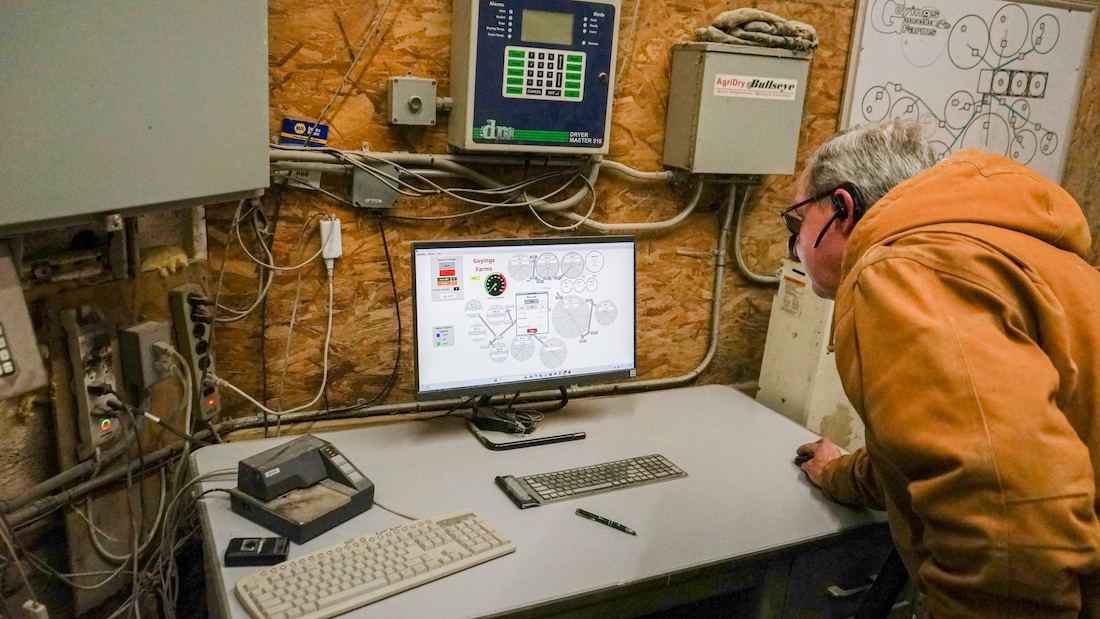
Goying understood his grain storage and drying facility would have a high peak load. “We make it (energy) all year, but we need it in October, and that’s what kills us.”
But Goying says no one warned him that solar producers pay the same grid connection fees as non-generating customers simply to stay connected. “My generation was -$1,100 but they charged me almost $800 for distribution, transportation, and I had all this credit,” he said.
The terms were written into the contract, but he said neither the USDA, his service provider, nor renewable advocates flagged them clearly when promoting the system. “I didn’t hear anything about them until when the bill started coming in.”
Unless paired with battery storage, solar systems remain tied to the grid, requiring infrastructure to move electricity both to and from the property. Those costs remain even as on-site generation increases.
Solar projects do have oversight. Any panel connected to the grid requires an interconnection agreement with the local utility — in this case, AEP — reviewed by the Public Utilities Commission of Ohio.
Sitting on the farmer’s side of the table, advocates like Arnold advise starting with a review of energy bills, then asking all questions — such as what projected energy bills will look like once the system is installed and how they may change if transmission and distribution charges rise.
An ethical service provider will provide this to customers, Arnold says, and those who do not will not make it onto Ohio Farm Bureau’s vetted list of verified solar service providers, who help farmers ask the right questions without creating compromising situations.
Decisions involving energy infrastructure require the same mindset as making major financial commitments — whether signing a home purchase, buying a new car or combine or even signing a marriage certificate, Arnold advised.
Goying Farms wants to step away from all of it, looking at going offline. “My son will have something at some point, where he goes offline to meet the generation, because we got natural gas here,” he said.
A self-reliant battery power wall could eliminate their need to stay connected to the grid but would increase outage risk and require an additional $100,000 investment, Goying said.
Energy costs are still lower on his farm with the solar investment, but looking back, Goying says the decision required more scrutiny. “I haven’t sat down and figured out what to pay back on a date, because I don’t have any choice. I’ve tried. You just gotta pay your bill, go on.”