


“A new broom can sweep the floor, but an old broom knows where the dirt is.”
— Paul Mooney
“Never let the guy with the broom decide how many elephants can be in the parade.”
— Marlin Noon
“I think we are all frightened a little bit when a new broom starts to sweep.”
— Steve Bruce
Whether we think much about them or not, brooms are and have always been an integral part of life in America.
As a matter of fact, brooms are one of mankind’s oldest inventions, going back to when bunches of branches and herbs were gathered together to sweep out caves. Brooms are even mentioned in the Bible.
And so it was that when the earliest settlers came to the Ohio country, they found a need for brooms to sweep up their cabins and barn houses. But with no hardware stores or big box emporiums to be found, where were they going to get brooms? They might have brought along one from the east, but that would have taken up valuable space and added unnecessary weight to their already overburdened Conestoga wagons.
So, the question was: How did settlers make brooms? And the answer is: With great labor, patience and skill, just like everything else they did.
The best way was to make a broom out of a hickory stick. How to do that?
First, a hefty, straight-grained hickory stick about as long as a broom was cut. The stick, or small log, would be as free of knots as possible. Then it was laid on a flat surface and beaten with a heavy wooden club to loosen the annual rings of which the stick was composed.
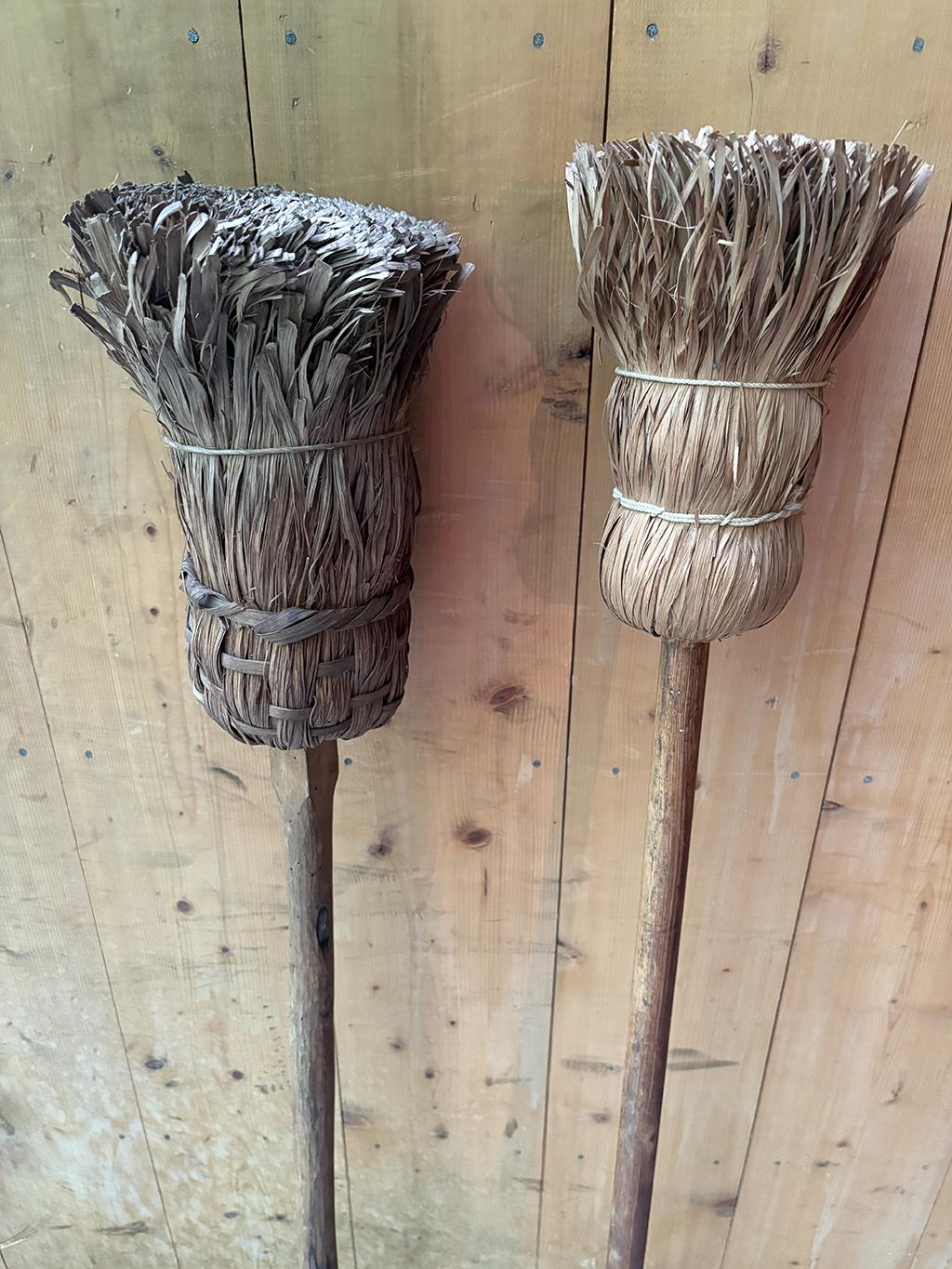
After that came the laborious part, which was taking a sharp pocketknife and peeling down most of the length of the stick — one layer after another — the individual fibers that would compose the sweeping head of the broom.
Starting at the top of the stick, the maker would position the blade of his knife under one of the annual rings and then run it straight down almost to the bottom, forming a flat bristle about a quarter of an inch wide. Turning the stick as he worked, the broom maker would make hundreds — even thousands — of such cuts until he had enough bristles to form the desired broom head, or until the resulting handle was of a diameter to fit comfortably in the hand of the user.
Once the fibers had been cut, the future broom was soaked in water overnight to achieve the best pliability. At that point, all the bristles were bent over to form the broom head, and the resulting bundle was bound with tough pieces of splint, small sapling withes or even braided splints to keep the elements of the head in place.
Finally, after drying out in a warm place for a period of time, the sweeping edge was trimmed off with a sharp knife to make all the bristles the same length.
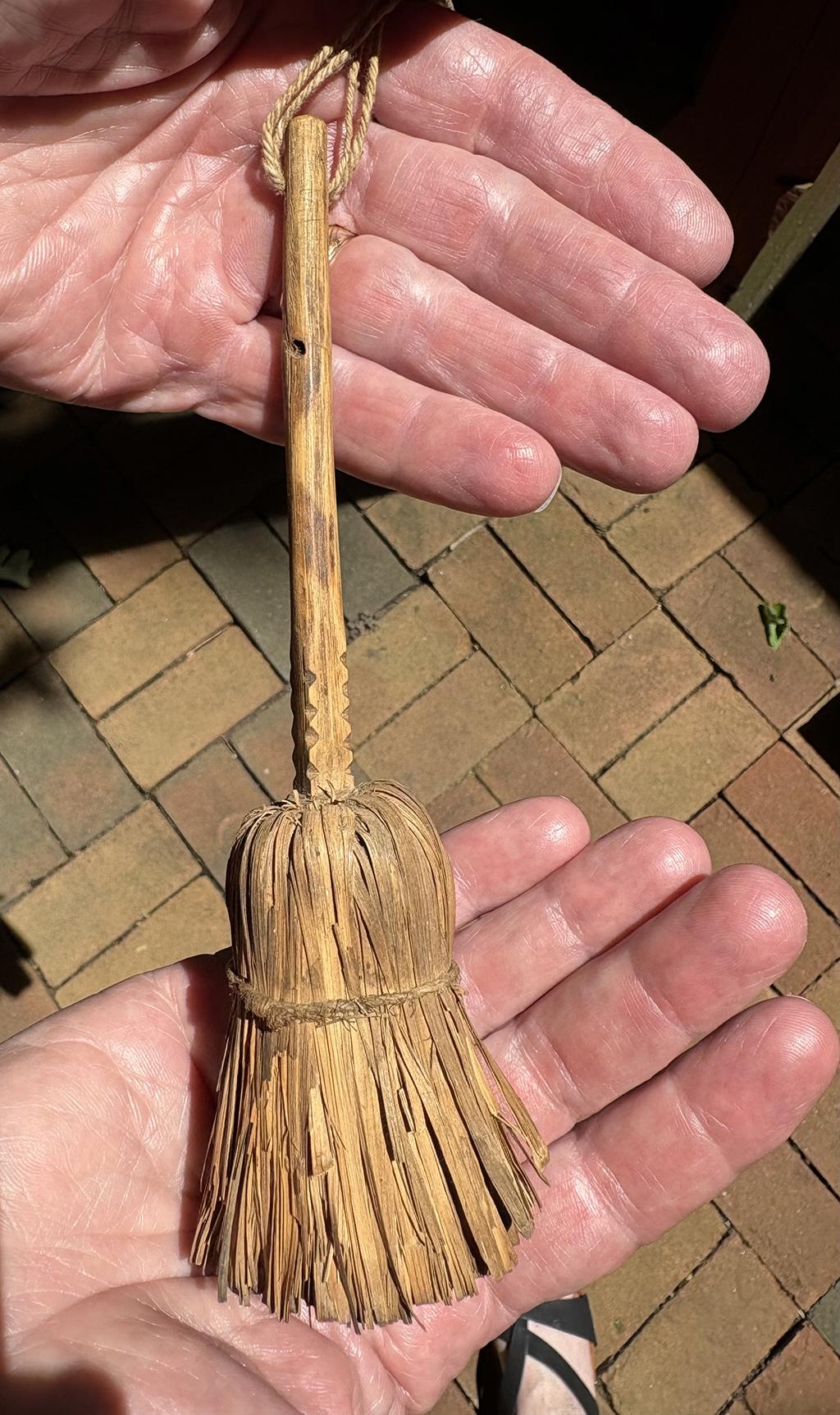
In addition to regular size sweeping brooms, smaller whisk brooms were created in the exact same manner, but on a smaller scale.
Today, early splint brooms are understandably rare, but do make occasional appearances at antiques shows and auctions. When good examples show up, they are typically offered at jaw-dropping prices, and it is not unusual to see tags on them beyond the $2,000 mark. This is possibly the best tribute to the early craftsmen who turned even the most mundane of household items into extraordinary works of art that continue to be appreciated.