




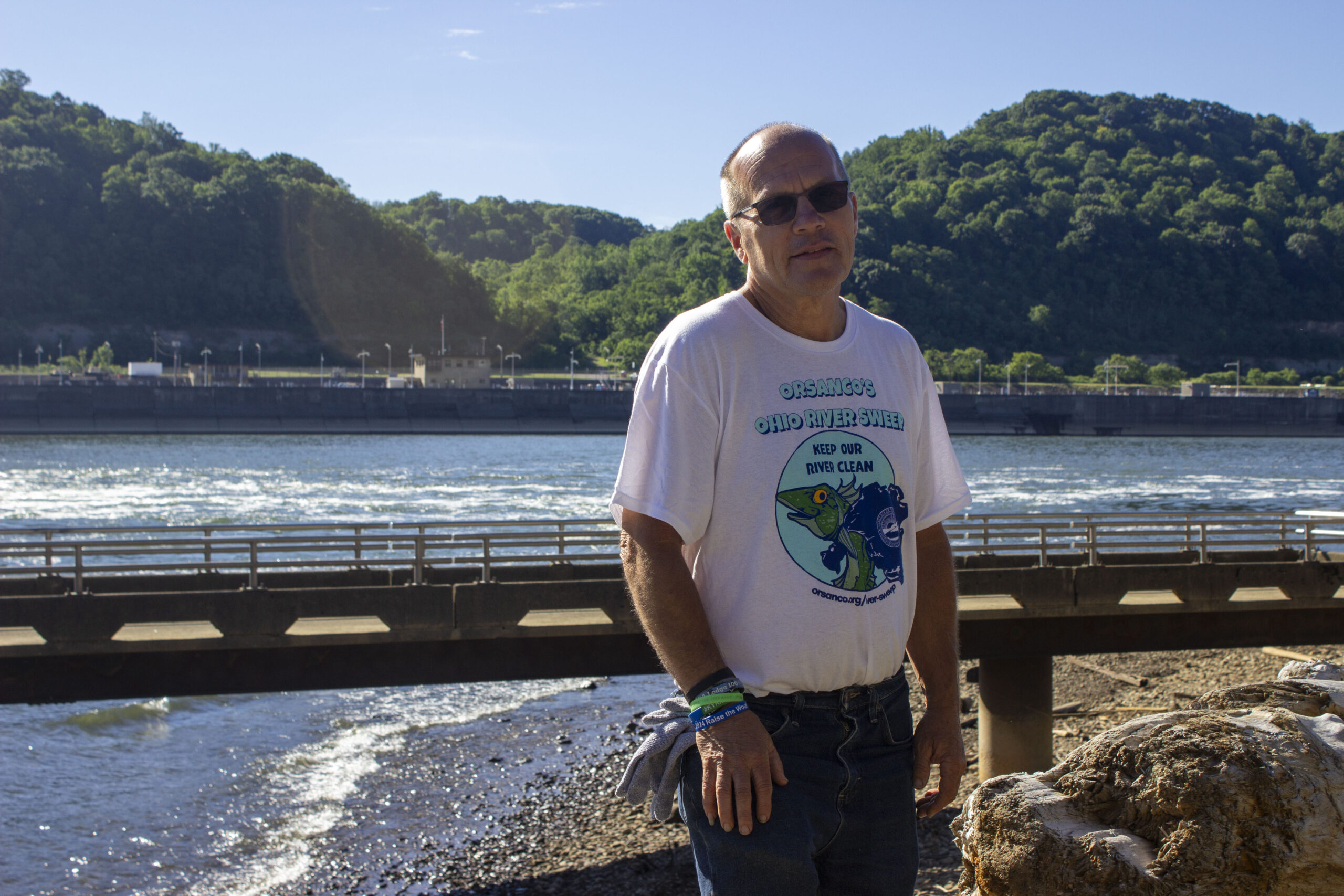
YORKVILLE, Ohio — Tim Smith never meant to become a river steward.
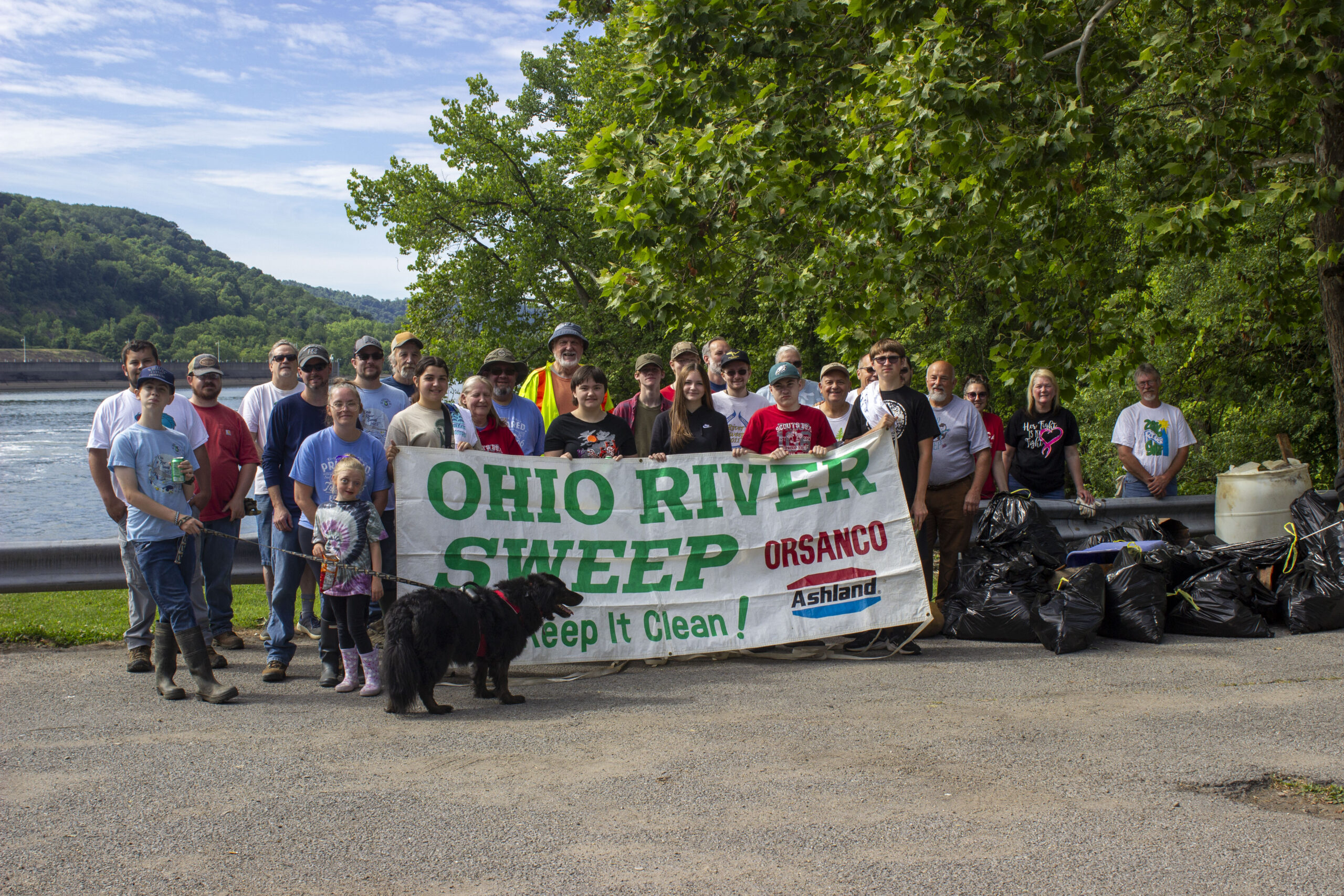
Thirty years ago, the longtime Boy Scout leader got drawn into the local Ohio River Sweep when a fellow Scout leader asked him to help with the event. It’s part of a basin‑wide volunteer cleanup effort led by the Ohio River Valley Water Sanitation Commission spanning from March to October each year. The sweep is supported by thousands of volunteers along the river’s 981 total miles and its tributaries as they pull litter from the banks.
Smith, for his part, has kept showing up. And over time, in the Village of Yorkville, population 1,000 or so, the cleanup turned into a kind of annual tradition, with responsibility for the river passed down from one generation to the next.
“Some of these boys I had when they were Cub Scouts,” Smith said on June 20, watching volunteers fan out along the riverbank in Yorkville, Ohio. “And they’ve continued to come the whole time. Now they have their families. Their families are coming, and their boys.”
Year after year, locals have done the unglamorous work of pulling trash out of the water, from tires to plastic drums, bottles, cans and “just anything about anything you can imagine.” Then a local garbage service, Agnew’s Refuse, hauled it all away without charging the town.
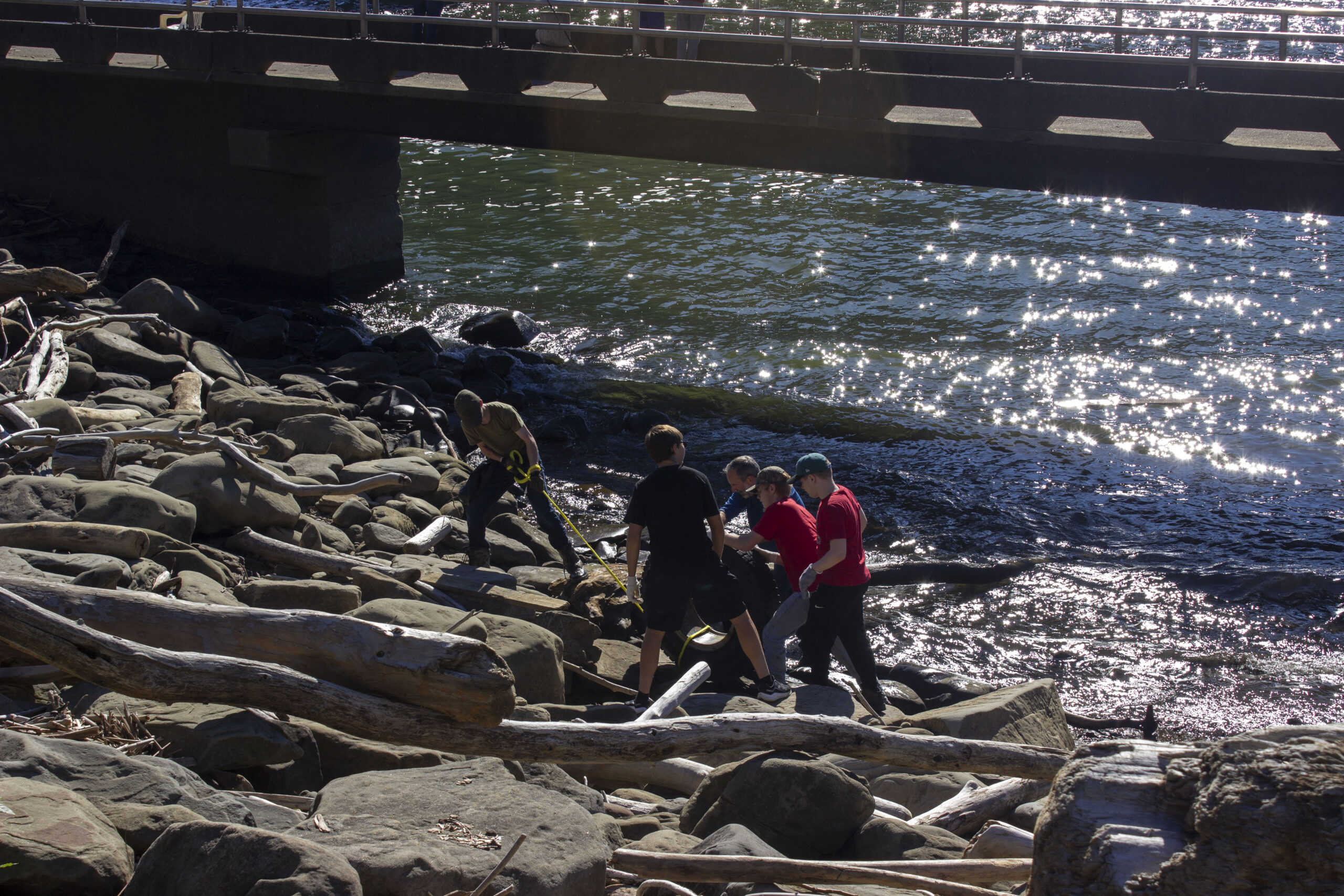
Smith shrugged off the scale of the effort, but the ethic behind it was clear.
“Everything that we can do…for us and for the fish and all the wildlife that are out there, you know, God gave us a gift, (and) we got to take care of it,” he said.
The headwaters of the Ohio River are located at the confluence of the Allegheny and Monongahela Rivers in downtown Pittsburgh, Pennsylvania. The river flows southwesterly to its mouth on the Mississippi River in Cairo, Illinois. But a century of industry along its banks saw business interests flourish at the expense of the health of the 25 million residents who live in the watershed. Now they must contend with pollution, including PFAS “forever chemicals” leaching into drinking water from industrial and chemical sources.
Now, a new bill could provide the kind of support from Washington that Ohio River communities haven’t had for decades, even as they’ve been looking after the river themselves.
“A big help”
The Ohio River Basin, spanning 55 congressional districts across 15 states, is the nation’s largest body of water without dedicated federal funding or a stand-alone EPA program office for pollution cleanup and habitat restoration.
The bipartisan Ohio River Restoration Program Act, introduced in February by the U.S. Sens. John Fetterman, D‑Pa., and Todd Young, R‑Ind., is seeking to change that. It would support habitat restoration, farm conservation and invasive‑species control in the river. Now in review, the legislation would also invest in pollution prevention and expand monitoring and data collection to better manage the river and its tributaries. The bill would also back workforce development tied to restoration work, help communities prepare for extreme storms and flooding and emphasize public engagement so that residents along the river have a formal seat at the table.
For places like Yorkville, the Ohio River Restoration Program Act could provide money for creek clean‑outs and lead pipe replacements, help shore up eroding banks and aging sewers and give the community a real say in deciding what happens first.
Yorkville Mayor Sandy Reasbeck remembers the long summer days her family spent on the river boating and water skiing, even as she has watched how small river towns like hers can slip through the cracks politically and financially.
“We are at the end of two counties, Jefferson and then Belmont. So nobody cares about me, nobody cares about my little village. When I go look for help and everything, they look at me like I got two heads,” Reasbeck said. “If we could just get some help with some of the stuff that we have, it would just be a big help for us.”
And yet, Reasbeck said that when she has pushed for fixes, she hasn’t always been met with help. She recalled a bid to have a crew dredge a local creek — it runs orange and yellow with drainage from upstream coal mines — to stem recurring washout and keep it from backing up into mud and floodwater, only for the EPA to halt the work over concerns it might further pollute the stream. It was a call she saw as “behind the desk” rule‑making rather than real help on the ground.
But the Ohio River Restoration Program Act holds out the possibility that, for the first time, federal agencies might be pushed to understand the river as fully as the people who live beside it and to partner with them instead of working at cross‑purposes.
Long overdue
On June 9, the Ohio House of Representatives adopted House Concurrent Resolution 40, urging Congress to enact the Ohio River Restoration Program Act; the Senate adopted the resolution the next day. The resolution was cosponsored by state Rep. Monica Robb Blasdel, who represents Carroll County and most of Columbiana County, which hugs the Ohio River. In a written response to questions, Blasdel said the most pressing problems in the Ohio River Basin include worsening water quality, harmful algal blooms, toxic pollution, flooding and aging infrastructure, all of which, she said, put drinking water, public health and the region’s economic vitality at risk.
“By supporting the Ohio River Restoration Program Act, we can help secure federal investment that benefits Ohio’s rural communities and farmers through stronger watershed resilience and infrastructure improvements, while also protecting the natural resources that drive recreation, commerce, and quality of life for millions of Ohioans who depend on the Ohio River and its tributaries every day,” she wrote.
For basin‑wide advocates, the restoration act would finally put the Ohio River on similar footing with other waters that already have dedicated federal programs.
“We know programs like this work. They’ve worked for the Great Lakes, they’ve worked for the Mississippi Bay, they’ve worked for the Everglades,” said Chris Lorentz, chair of the Ohio River Basin Alliance. “The Ohio River Basin is just overdue for these sorts of things, and it’s our time to get those same sorts of federal investments and benefits for it.”
In Ohio, he pointed to votes in favor in both chambers as evidence that lawmakers see the river as a shared asset. On the ground, he said, the program could fund everything from wetlands and riparian buffers to sewer upgrades, septic fixes, lead‑pipe removal and new access points for boaters and anglers. The bill could also underwrite basic infrastructure work, from upgrading urban wastewater systems and fixing failing rural septic tanks to replacing lead drinking‑water lines, investments Lorentz framed as central to protecting public health.
Stormwater and runoff, he warned, are likely to be front and center.
“Managing stormwater is probably the number one threat to our waterways,” he said, noting that while the country has made progress on major point‑source pollution since the 1970s, “we’ve hit a plateau and backslid on nonpoint source pollution, and that’s an issue.”
Underneath it all, Lorentz said, are the same kitchen‑table concerns about work and financial security. Residents are anxious about jobs and the broader economy, but similar initiatives around the country have consistently delivered strong economic returns.
“You could call it an economic stimulus package as much as you could call it a restoration initiative,” he said.
People power
If anyone has a stake in whether that promise holds, it’s the people whose livelihoods depend directly on the basin’s land and water.
Farmers who work along the basin’s tributaries see both the risks and the stakes up close. “Taking care of our environment is never a bad thing. That’s the truth,” said Todd Stacy, whose family has farmed along the Muskingum River since 1890 downriver from Yorkville in Marietta, Ohio. “We’ve had flooding events, but that’s part of farming right next to the river.”
Stacy said his farm has already shifted its operation to lessen flood risk and runoff, moving high‑value crops away from the river and relying on deep wells instead of river water for irrigation. Like many growers, he’s wary of federal overreach and “micromanaging of water” but insists farmers aren’t cavalier about a resource that’s so vital.
“We are, as farmers and the entire ag industry, trying to protect one of our natural resources, the water,” he said, noting that farmers rely on a range of conservation tools, including extensive use of cover crops on his own operation. “We’re not just trying to suck the earth dry and kill everything.”
For Meagan Niebler, the community democracy program manager with Fair Shake, an environmental law and justice nonprofit that provides low‑ and no‑cost legal help to communities across the Ohio River Basin, the restoration bill’s real test won’t be how much money it brings, but who gets a say in what it’s used for.
Fair Shake has spent years helping residents and grassroots groups navigate permits, challenge pollution and push for local laws that match what communities actually want. From that vantage point, Niebler said, much of the basin’s environmental damage stems from the same pattern: decisions made about communities, not with them. Any new federal effort, she argued, has to reverse that.
“Anytime there are opportunities for communities to be driving priorities and funds and making decisions, that is one of the core components of environmental justice,” she said.
What matters most, she added, is that the right people have a seat at the table, with real decision‑making power and a clear line of accountability back to the broader community.
But for a region that has, for so long, been left out of the conversation, she said, the work now is to build power across towns and counties, so that neighbors show up together when decisions are made.
“People power is real, and the more people that you are connected with who also have the same goals and dreams that you do, you have a much louder voice together than you do by yourselves,” she said.