


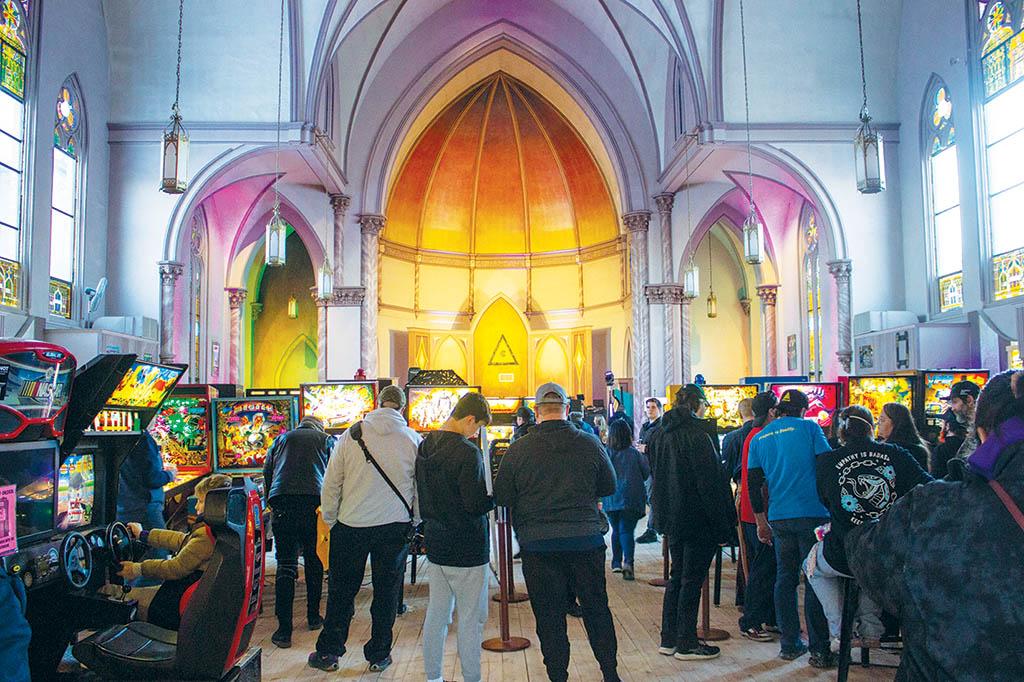
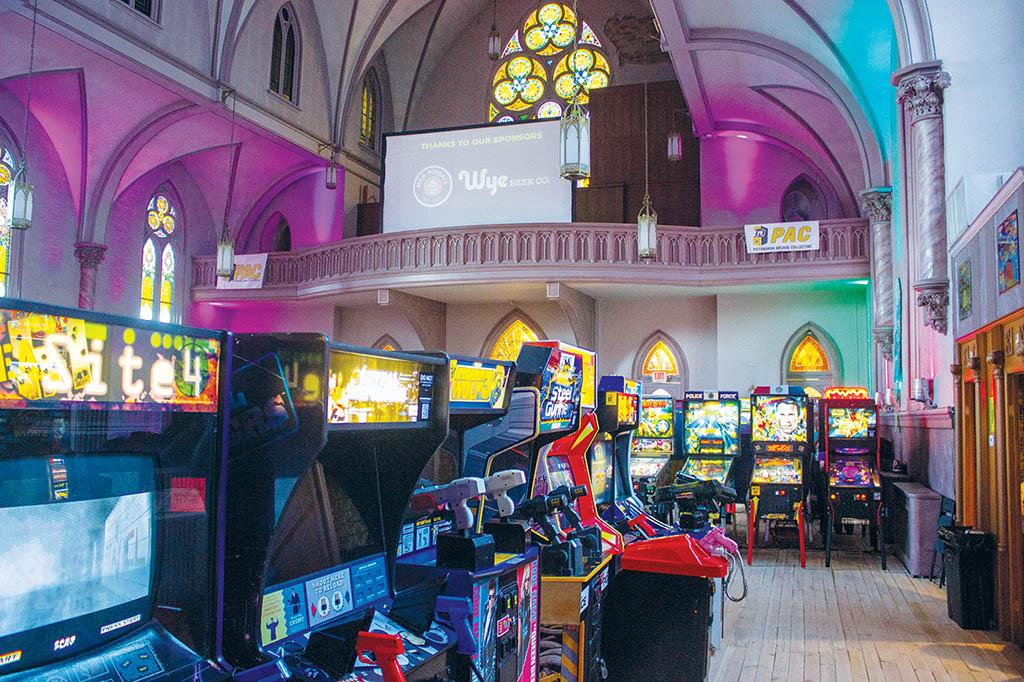
DUQUESNE, Pa. — The former Holy Name Catholic Church, built out of sandstone bricks in 1899 and complete with a bell tower, breathtaking stained glass windows and soaring ceilings over 60 feet high, opened to a new kind of congregation Jan. 31. And their liturgy is filled with flashing lights, joysticks, pinball flippers and the hum of classic arcade jingles.
The last mass was held in 2023. Now the building is home to the Pittsburgh Arcade Collective, a group of local arcade and pinball enthusiasts who formed in early 2021. What began as a loose network of collectors looking for ways to play together outside their private game rooms has grown into a permanent space housed inside one of Duquesne’s most recognizable and beloved landmarks.
“We had never really considered a retired church, but the price was right, and for the number of square footage, it was about as great a deal as you can imagine,” said Mike Hough, one of the collective’s founding members. “Now, we laugh because we can’t imagine it being anything other than a church now.”
Finding a home
The collective has leveled up over the years from loose gatherings at various local arcades and coming together around the Pittsburgh Gaming Expo each October. Over time, storage and space became an issue for members whose cabinet collections continued to grow. Then, about a year ago, founding member Jon Snow — yes, like that Jon Snow, namesake of the Game of Thrones hero — set out on a quest of his own: finding a place the collective could finally call home, a building large enough to house their games and bring the group together year-round.
It’s not quite Westeros; his search led him to a retired Catholic church in Duquesne.
Snow, who has been involved with the Pittsburgh Arcade Collective for the past three years, said his own collection alone grew to roughly 30 games, with cabinets filling basements, warehouses and borrowed storage spaces as the group prepared each year for the expo. The annual cycle of hauling machines up basement steps, repairing worn components and selling games after the event to avoid storage costs eventually became unsustainable.
“We realized that we needed to buy a place to store stuff and also to be able to play them throughout the year,” Snow said. Without a permanent home, machines would sit unused for months, leading to more repairs and last-minute scrambles before conventions.
Snow initially searched for warehouse space, but most buildings large enough to hold the collection were priced well beyond the group’s means. The church — discovered almost by chance on Facebook Marketplace — offered something few other listings could: size, accessibility and uniqueness, all within reach financially. The building was purchased in March 2025 for $95,000.
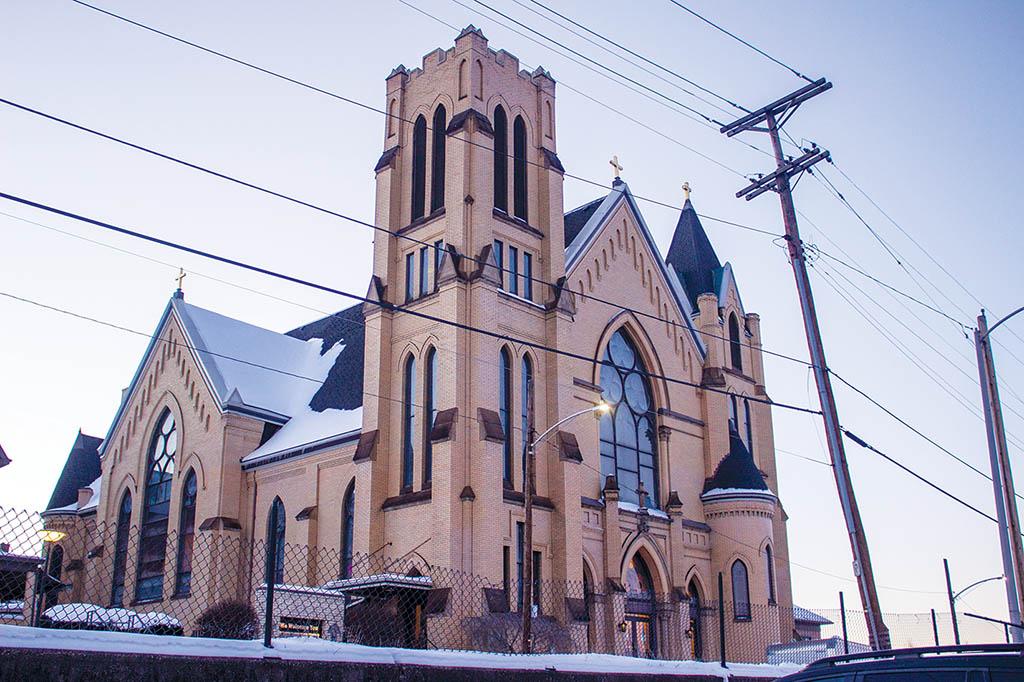
The building had been vacant for about two years when Snow purchased it. While it required extensive cleaning and mechanical work, its core infrastructure was intact, and there were no major structural issues.
“The Catholic Church really kept up on the building,” Snow said.
Once the pews were removed and sold to a Christian school in Chicago, the sanctuary floor opened up into a space surprisingly well-suited for arcade cabinets. Ramps originally designed for accessibility made it possible to move heavy machines in and out with relative ease, and a parking lot across the street simplified loading and unloading.
“We didn’t search out a church,” Snow said. “We searched out a building that would fit our needs, and that would be in our price range, and that also looked cool.”
In a lot of ways, it’s actually lent itself rather well to the collective’s needs, save for a few bigger projects. All the mechanical systems had to be brought back online. The building’s electrical system was a key consideration for powering the numerous arcade games; a number of new 20-amp dedicated electrical circuits were added, which draw significantly more power than the church’s original electrical setup was designed for. Fortunately, the building already had a large, commercial-grade electrical panel that was largely underused, making the additions straightforward. Meanwhile, the subtle slope of the floor, similar to that of an older movie theater, proved to be something of a challenge.
“That would create a bit of an issue with leveling games, especially pinball machines,” Hough said. The solution was to build a floating subfloor on top of the original, finished with rough-sawn pine to preserve the old-world aesthetic so true to the church’s character.
In fact, much of Holy Name’s original style and spirit remains intact. There are those gorgeous stained glass windows, minus the religious iconography, which was removed when the Catholic Church retired the building. Other decorative elements and the church’s architectural details still abound throughout, cutting across all the bustle and noise in what was once the holy sanctuary. The eye still tends to track upwards.
“It’s a beautiful architectural and structural building,” Hough said.
Rather than operating as a traditional arcade with regular hours, the Arcade Church will open primarily during advertised events a few times each month. Those events may include tournaments, community days or all-you-can-play sessions.
The grand opening weekend featured four tournaments — pinball and arcade competitions on both Saturday and Sunday — alongside casual play. The lineup spans decades, from early arcade classics and 1990s fighting games to modern pinball machines. Some cabinets, such as Lucky & Wild, offer experiences that can’t be replicated outside their original hardware.
“You can’t really emulate that on, like, a computer nowadays or anything,” Hough said.
The collection also emphasizes multiplayer games, including four-player cabinets like The Simpsons and Teenage Mutant Ninja Turtles.
Anchor of the community
For Hough, there’s a sort of throughline he can trace from Holy Name’s founding to now.
“The idea of people playing games together and enjoying that moment together and making those memories together,” Hough said, “that’s essentially why Pittsburgh Arcade Collective and why the church exists to begin with.”
While the transformation of a former church into an arcade has drawn some criticism online, Hough said the response within Duquesne has largely been positive. Neighbors frequently stop to ask questions, and community members have expressed excitement about having a new attraction nearby.
“Everybody that we’ve ran into in the community so far seems to be really supportive of the idea that this building will be used for something that is community-focused again,” he said.
Hough acknowledged that some former parishioners have mixed feelings, especially those with personal memories tied to the building.
“We’re sensitive to the idea that a lot of memories, fond memories, have happened there over the years,” he said. “And we really hope that more fond memories will continue to be able to happen there.”
For Snow, the decision to open the space to the public was about more than finally having room to store and maintain a growing collection of cabinets. It was also about preserving a building and a sense of a place that had already served as an anchor of the community for more than a century. It’s what sets the Arcade Church apart.
“The thing that makes this different from anything else is the architecture of the building,” he said. “It’s the vibe you get from there … a destination place to go and be in.”
That sense of destination, Snow believes, fits naturally within Duquesne, a city he says has been unfairly characterized over the years.
“I feel like maybe Duquesne has got somewhat of a bad rap,” Snow said, pointing to declining crime rates and the strong support the Collective has received from neighbors since moving in. The church sits near a police station, a daycare and residential buildings, and Snow said he’s never had a negative interaction, even during late nights spent working inside with the doors open wide to let in air.
“All we’ve met is great people since we’ve been there,” he said.
Snow hopes the Arcade Church can become something Duquesne has lacked in recent years: an accessible place for people, especially local kids and families, to gather and do something together. The idea of shared experience is also what Snow hopes visitors feel when they step inside for the first time. While the arcade cabinets now glow beneath the vaulted ceiling, Snow said care was taken not to erase the building’s past. The confessional booths remain, for example, though you’ll be reconciling with Ms. Pacman (there are lessons to glean from the catechism according to Ms. Pacman: eat well, avoid ghosts) and the glorious altar is just as impressive to this fellowship as any that came before it.
“It’s going to be a church,” Snow said. “And though it’s not a religious building anymore, it’s still always going to be a church.”
Ultimately, Snow sees the project as a continuation rather than a replacement of the building’s original purpose.
“Realistically, that’s what churches are about,” he said. “They’re a place for people to gather.”
For more information, visit thechurcharcade.com.