


HERMITAGE, Pa. — For firefighters, accidents on the farm couldn’t be more different from the array of other emergencies they respond to. For farmers, it’s just part of the job.
“My family, both sides of my family, have been farming for generations. So I mean, if you’ve been farming, you’ve had accidents. It happens,” said Lander Fire Chief Chad Jespersen.
Firefighters have plenty to contend with as it is, responding to blazes, medical emergencies, industrial accidents and more. They’re essential at car-crash scenes, too, incidents that rarely happen in a vacuum. With witnesses, the call often comes no more than a few moments after a collision happens. By contrast, a farmer working alone can be trapped beneath a rolled tractor for hours before anyone hears about it.
Then comes the rescue itself. Firefighters are equipped to mash and cut their way through wrecks in order to reach trapped passengers. But when a farmer is pinned beneath a machine he relies on, every move first responders make carries another consideration: what will be left when the rescue is over? Can a farmer be saved without destroying equipment he may need to keep his operation going?
“Because while it may be necessary to destroy something, we also have to balance that with [how] that tractor sitting right there is $175,000, $180,000,” Jespersen said. “So do as little damage as you can while you’re doing what you need to do to get them out, because great, you saved the guy’s life, and now he has to sell everything because he’s out of business.”
It’s such a precise line to walk for something that can go so wrong at a moment’s notice, especially when rescuers are facing machinery they’ve never encountered before.
That’s why Watson’s Inc., a farm-equipment dealership, hosted a Tractor Machinery Rescue Class Nov. 14 and 15, provided by RescueTechs, LLC, based out of Rehrersburg. The session brought 25 emergency responders from 11 departments in Mercer County together to practice adapting rescue techniques to the hazards of farm machinery.
Ready for anything
The course had been a long time coming: the last training like it that anyone could recall was held about 15 years ago, if not longer. That’s mostly because specialty classes are expensive, though this one was made possible by grant funding from the Community and Economic Assistance Program.
It’s money well spent, as the tractor is the leading cause of death on the farm. In 2025, there were 19 known agricultural fatalities in Pennsylvania, according to Penn State Extension.
How often do crews respond to such calls in rural Mercer County?
“It all depends. You could have a streak where it could be a couple years before you get one,” said Jerry Heckman, chief of the Jackson Center Volunteer Fire Company.
But a long gap between farm emergencies is sure to mean the next rescue won’t be any easier.
The two-day training at Watson’s Inc. combined classroom instruction with hands-on scenarios, including tractor rollovers, machinery entrapments and incidents involving equipment such as corn pickers and silage blowers.
“It’s adapting the tools and techniques that we’re taught in our normal classes to the agricultural environment, and also understanding that while we’re doing this, we’re not only looking to help save the farmer’s life, but also their livelihood,” said Jespersen, who served as the lead instructor for the course. He knows that injuries often go unreported on the farm, especially when producers can’t afford to take time away from work.
Jespersen recalled that his crew successfully rescued the same farmer twice; for his part, the farmer could only try to move forward.
“He was back and milking cows the next day. You just don’t have the time to take it off,” Jespersen said. The farmer was ultimately killed in a rollover accident.
According to the Centers for Disease Control and Prevention, in 2022 there were roughly 18 deaths per 100,000 full-time agriculture workers nationwide. That’s at least four times higher than the number of fatalities across all other U.S. industries, which see an average of roughly 3 to 4 deaths per the same number of workers.
During the training, in each scenario firefighters worked at, rescue depended on a series of coordinated moves: crews stabilized the machinery caught in motion, worked with the tools they had and kept communicating as they tried to reach the victim.
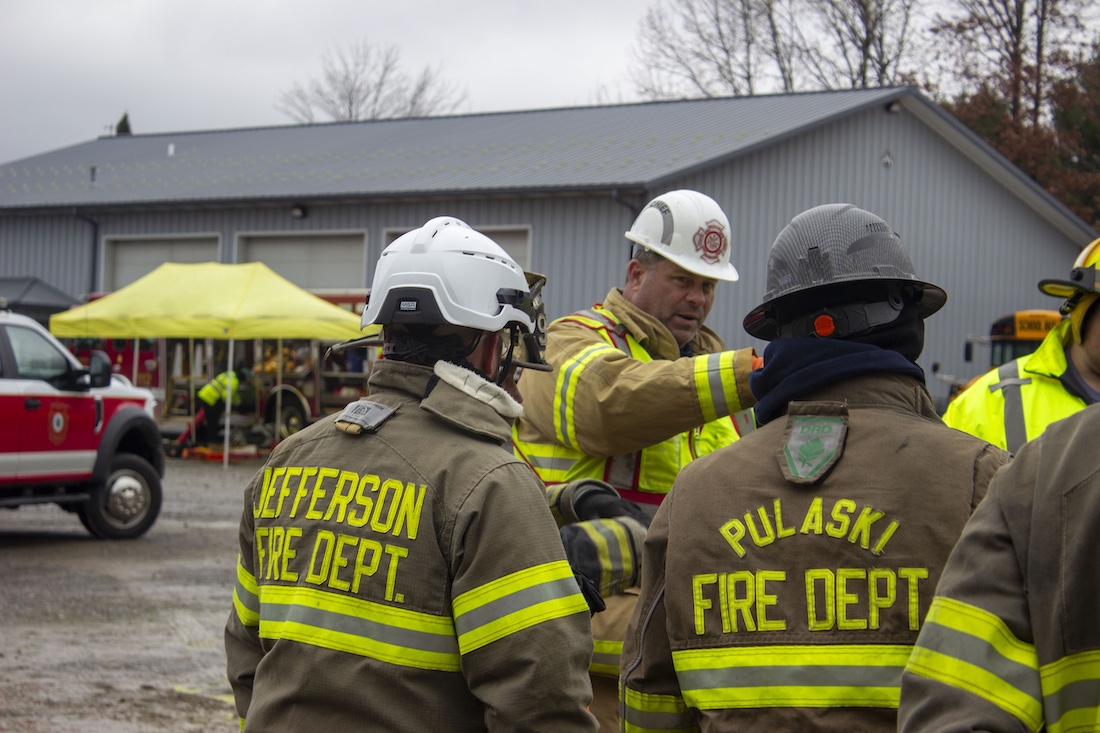
“No one department is equipped to handle this by themselves,” Jespersen said. “In this day and age, with a shortage of volunteers, we’re reliant on having multiple departments to effectively rescue someone. So it’s getting them used to working with other people and understanding that it’s going to take a lot of resources to get this done.”
“The next thing you know.”
Jon Laird, president of the Mercer County Fire Chiefs Association, has spent 23 years in the fire service, and to him, the training is invaluable, not only for rescuing farmers pinned beneath big equipment, but for the dangers that can lurk even in the middle of an ordinary day.
“I see some people with the compact tractors trying to lift stuff and do stuff that they shouldn’t be doing with it,” Laird said. “It could be something as simple as them trying to pull a stump out, and the tractor flips over.”
Mowing a hillside when the grass is wet can turn just as treacherous, he said. And no amount of experience will spare anyone from chance. Some farmers may function on autopilot, accustomed to a certain way of performing a rote task that’s never been any trouble before, or fighting a time crunch, Laird said. That’s when they’re most vulnerable.
“You just get into where you’re used to doing stuff all the time a certain way,” he said, “and you just skip a step and don’t pay attention as much, and next thing you know, you’re in trouble.”
All the more reason to keep rescue skills sharp.
“It’s something that’s been needed to be done in this area for a while now. Because if you’re not staying up on stuff, you lose different techniques,” Laird said.
“It just takes time.”
If they didn’t appreciate them already, fire crews would soon understand how important those techniques were. Before attempting a rescue, responders first needed to understand how the equipment worked. Then they tested their resolve and ingenuity by solving all sorts of challenges, such as how to free an individual from a corn picker.
The premise: a small rock had worked its way into the machine and become lodged between the rollers. Clearing it wasn’t up for debate, but it meant risking a hand to reach it. Responders worked around the machine, methodically removing parts such as gears and bearings to free the trapped dummy. As they went, they had to coordinate, keep the machine stable and protect the victim.
“Don’t get overwhelmed by what you were working on. Get it down to what you know. Stabilize it and take care of it,” said Jespersen.
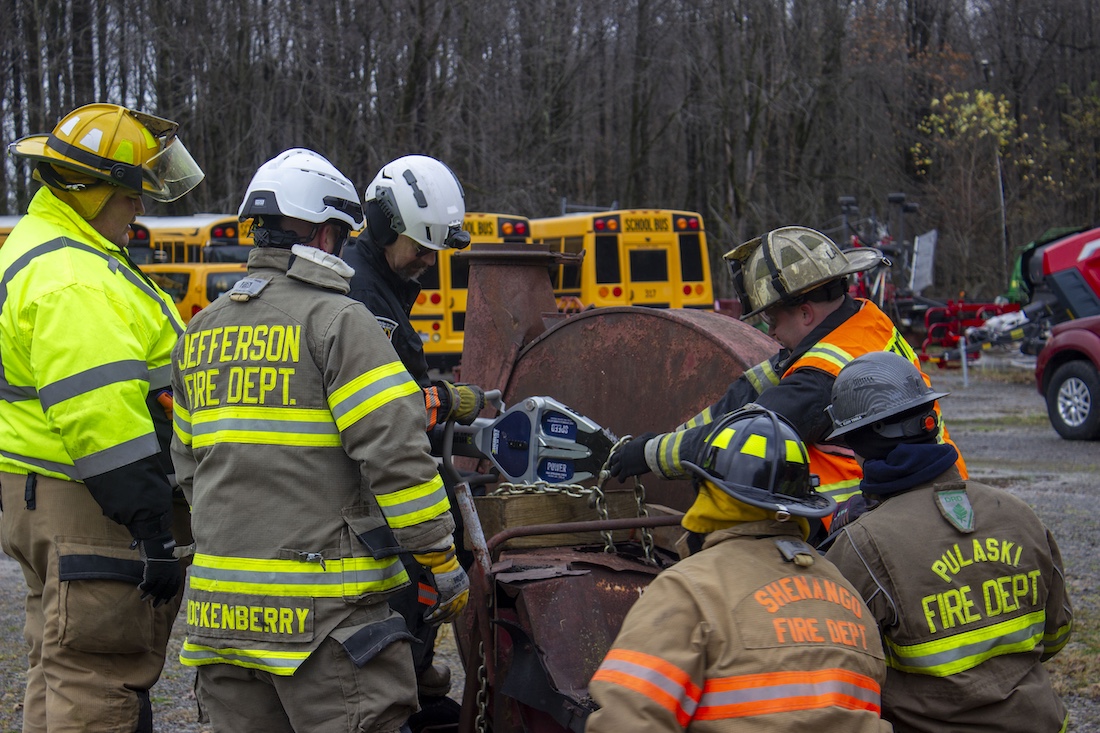
Another exercise involved freeing an individual caught in a silage blower, which uses a large fan to blow chopped corn into a silo. Sticks or other debris can get into its intake. Instructors explained how someone reaching in to clear a jam could accidentally power on the machine’s feeder instead, pulling a hand or arm in the path of grinding machinery.
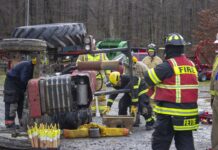
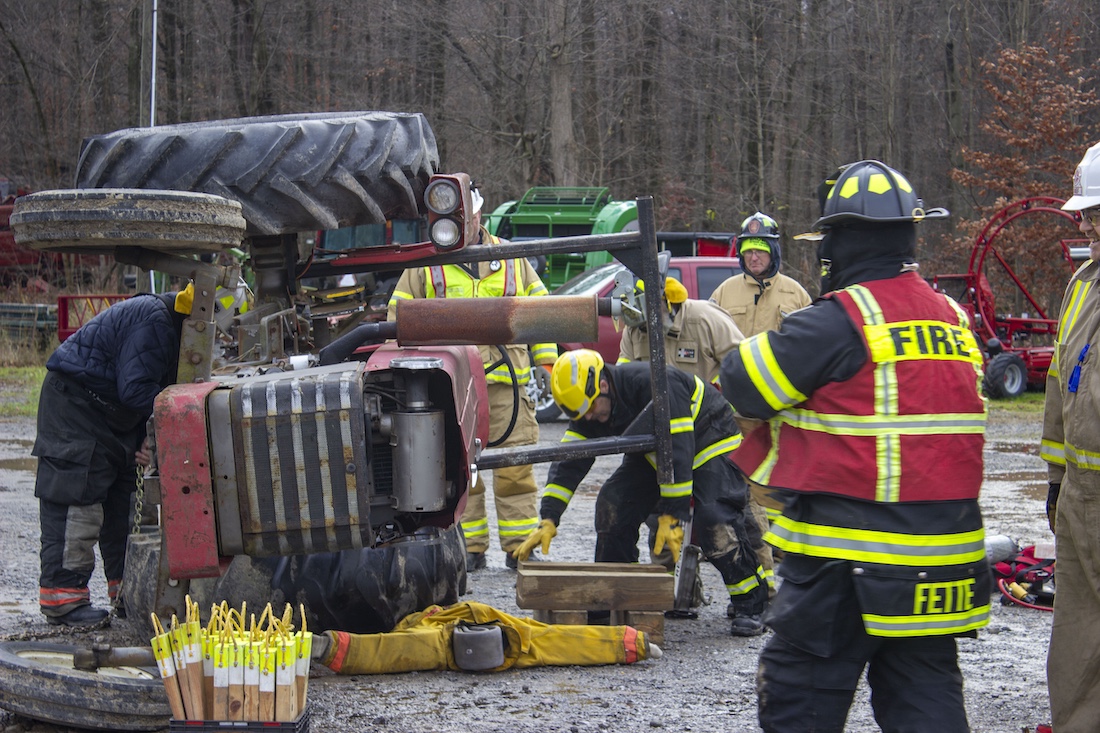
The final drill was the most demanding: a farmer pinned beneath a rolled tractor. Rescuers used inflatable airbags to raise and tip the heavy machine, adding wooden cribbing — or blocks stacked beneath it — to support the tractor and prevent it from shifting. Every movement mattered: if the tractor shifted or its axle pivoted, it could worsen the victim’s injuries or put rescuers at risk.
The simulated farmer did not survive that run. In the debrief, instructors reviewed the need to better stabilize the tractor with cribbing before rescuers entered the scene again. But communication between the teams had gone well. The goal was to learn from every attempt, not just push ahead with the same plan until they got it right. They reset the scenario, putting the dummy back beneath the tractor, and tried the rescue again.
“Agricultural stuff isn’t going to be two-minute rescues. Stuff like this, it just takes time. There’s no two ways about it. It just takes time,” Jespersen said.