





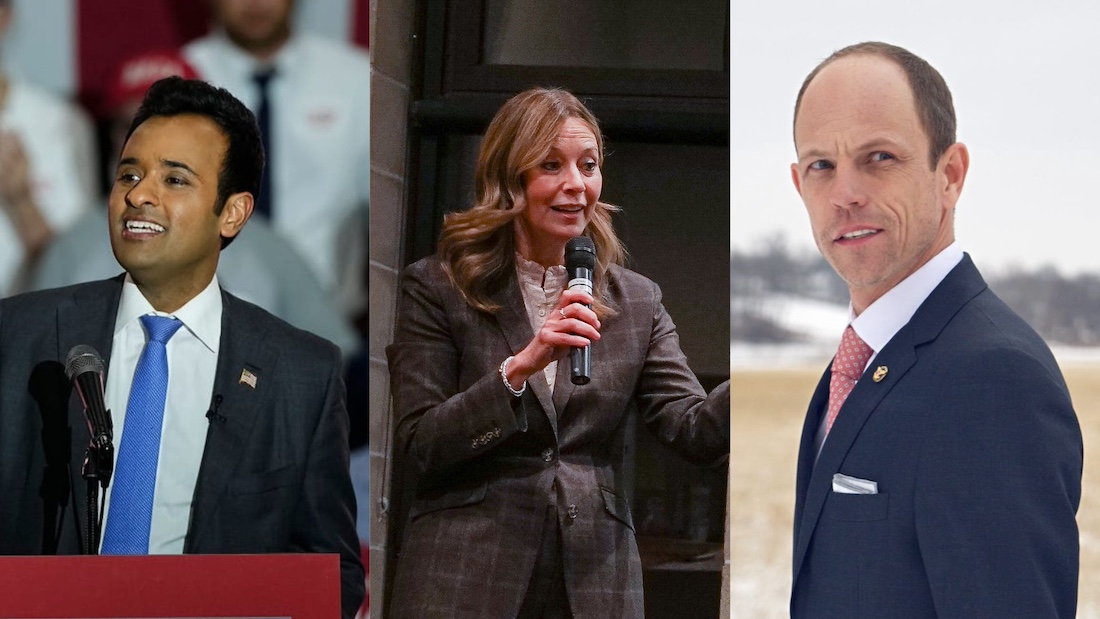
CINCINNATI, Ohio — A businessman, automotive entrepreneur and doctor are front-runners in Ohio’s 2026 gubernatorial race. From Cincinnati, Vivek Ramaswamy, the Republican Party’s early-endorsed candidate for the May primary, is being challenged by Casey Putsch of Perrysburg. Democratic candidate Dr. Amy Acton is challenging the GOP stronghold for governor.
Their platforms and views have been slowly rolled out on the campaign trail, but that hasn’t stopped two statewide agricultural groups from giving Ramaswamy the nod. Ohio Corn and Wheat announced in August 2025 a historic decision to endorse Ramaswamy, a first-of-its-kind decision in 30 years, citing that doing things the same way is not going to help the struggling farm economy.
“We believe he is someone who will listen, seek input, and take bold, strategic action on the issues that matter most: water quality, ethanol expansion, and agricultural policy,” Ohio Corn and Wheat said in a statement.
The Ohio Cattlemen’s Association followed in November 2025, citing Vivek “shares the values that matter most to our beef family farmers, and his policies align with OCA’s longstanding policy.”
Tadd Nicholson, executive director of Ohio Corn and Wheat, said in a podcast episode regarding the gubernatorial race, “I don’t expect the governor sitting in that office to be a farmer or grow up on a farm when they were young, but I do expect them to look at Ohio like an ag state.”
Endorsements notwithstanding, the candidates share a platform of lowering energy costs, continuing the H2Ohio conservation program and the purposeful development of Ohio’s farmland.
Their views on agriculture, the environment and land use are rising as top priorities for Ohio’s population, according to exclusive interviews with Farm & Dairy. Roughly 89% of the state’s land area is defined as rural, but only one-quarter of residents reside there. Exiting the seat is Gov. Mike DeWine, who has served two four-year terms. His tenure extended a 16-year history of a Republican governor, along with the legislature’s supermajority.
Amy Acton – the Democratic challenger
Acton, 59, grew up in Youngstown, Ohio, escaping poverty and working her way through an Ohio education to become a medical doctor. Her experience and campaign are grounded in public health. Her lieutenant governor running mate, David Pepper, is a lawyer, author and former Democratic Party chair.
“One of the first things I did, and this was well before I submitted my paperwork, is I sat down with women who own farms,” she said. What Acton heard from that meeting were three top concerns: healthcare, education and community hate. “Healthcare because somebody has to work a second job off the farm, health care because the rural hospital situation is a mess. Healthcare…because safety on the farm also comes up a lot,” she said.
In her role as director of the Ohio Department of Health under Republican Gov. Mike DeWine (2019–2020), she worked during the COVID-19 pandemic, supporting DeWine in making decisions about pandemic response. Her role also meant serving on the Ohio Lake Erie Commission during the rollout of H2Ohio. Regarding the Great Lakes, she said, “These are assets; access to nature is a huge part of our well-being.” The statewide agriculture conservation program would continue and be championed in conjunction with the legislature under her leadership, she explained.
In 2025, with 2.5 million acres enrolled and $270 million invested, the program was defunded by 40% in the biennial budget. Acton criticized the move, saying, “This legislature, they took back the funding, and federally, they’re taking the funding in the labs, out of the lake,” – referring to appropriated research dollars federal agencies froze last year and the Great Lakes Restoration Initiative, which has failed to renew in Congress last year.
A long-term water bond has been considered in recent years, but state leaders and agriculture groups have questioned the political will to put the issue on the ballot. She also pointed to Grand Lake St. Marys as a high-priority area of concern, protecting properties around it and addressing its toxicity.
When asked about the expansion of biofuel for Ohio’s corn farmers, Acton responded, “Traditionally, you tend to think a Republican might do better on identifying markets for agricultural products.” She countered, explaining her plans to get “world-class” talent in her cabinet and agencies that are going to solve problems, not make them. “I’m committed to developing a diverse energy mix to support Ohioans, including robust investments and innovations for our biofuel industry,” she added.
Her platform is quick to point to data centers as the cause for increased utility costs for consumers. Acton’s reforms to address it are detailed. According to a post made last year, they include appointing commissioners to the Public Utility Commission of Ohio (PUCO) who focus on consumer costs and tough oversight for utilities. She also called for strengthening and better funding the Ohio Consumer Commission and promoting the use of more off-peak consumption. She also called to reexamine zero marginal-cost generation such as wind and solar and the wider use of batteries for energy storage. Finally, she demands that PJM Interconnection, Ohio’s regional transmission organization, undertake needed reform to enhance transparency and lower costs.
Also on her list of priorities: property taxes. “It’s time for a working families tax cut that benefits the rest of Ohio,” she said. “Ohioans are struggling, and we need common sense solutions to offer our communities some relief, from a tax cut to initiatives like the Homestead Exemption Act.”
Along the campaign trail Acton has mentioned free school lunch access, the need for more large-animal veterinarians and mental health support for farmers.
Vivek Ramaswamy
Ramaswamy said his biggest asset on his agriculture agenda as governor was selecting Senate President Rob McColley as his running mate. “I wanted to select somebody who was deeply familiar with the issues and opportunities that our farmers face, who has represented them well in the legislature, and who comes from, I would say, probably one of the top agricultural districts in Ohio,” he said.
Ramaswamy, 40, was raised in Ohio by legal Indian immigrants, went to Harvard College and rose to the seat of a biotech chief executive officer. In 2024, he ran for President in a crowded bid. McColley, an 11-year legislator from Napoleon, joins the ticket as lieutenant governor.
The campaign is committed to continuing the H2Ohio program. “Our plan is to keep it, and our plan is to build on that as a foundation.” Additional players in the program, he said, will be urban runoff, chemical and industrial waste sectors. While the additional forms of accountability are unclear for other water system polluters, Ramaswamy said, “It should not just be farmers who bear the burden of water quality.”
In July 2025, Ohio Corn & Wheat endorsed Ramaswamy early in the gubernatorial race, citing his potential leadership on water quality, biofuels and farmer profitability.
“I’m a guy that, in first principles, believes in greater choice at the pump,” Ramaswamy said. A federal solution could allow year-round sale of corn-based ethanol, but in a recent bipartisan push in Congress, that effort was delayed until February, when a commission is expected to take up the issue.
Without a federal solution, that issue falls on Midwestern states. Gov. Mike DeWine declined to pursue an EPA waiver allowing summer E15 sales in 2025, citing concerns from the state’s petroleum industry.
In a podcast interview, Ray Van Horn, chairman of OCW’s political action committee, said Ramaswamy “was very upbeat about ethanol,” adding that “he knows it’s a major industry in Ohio” and that he is “definitely on board.”
However, after directly asking Ramaswamy and Ohio Corn & Wheat, the candidate did not commit to signing a state waiver that would allow summer sales of E15 fuel if presented to him as governor—a central issue tied to the group’s historic endorsement.
“I’m open-minded to whatever approach makes most economic sense for Ohio,” Ramaswamy said. OCW followed up in a statement saying “We believe he appreciates the vital role ethanol fuel has in broadening consumer options,” but did not confirm a stance was provided in the endorsement process.
Questions about that commitment from politicians, and those running, come as corn growers criticize House Speaker Mike Johnson for failing to advance year-round sale legislation in a recent spending bill. Five congressional leaders on both sides of the aisle have been vocal with their support, criticizing their colleagues.
Ramaswamy’s campaign emphasized three goals if elected: lowering property taxes, decreasing consumers’ electric bills and lowering income taxation. For energy bills, he explained that if we produce more energy, Ohioans will see costs go down. Ramaswamy said Ohio is not taking full advantage of natural gas reserves and coal. “Fossil fuels are a requirement for modern human flourishing & we shouldn’t apologize for that,” said Ramaswamy during a visit to the Little Buffalo coal mine in Noble County. He hopes to reduce permitting timelines for new power plants to come online.
Energy costs in Ohio are rising as demand increases, reflected in higher transmission rates for consumers. When asked about data centers driving additional grid infrastructure costs, he said utilities may be over-forecasting demand tied to AI data centers, in part because companies are holding capacity in multiple jurisdictions, and called for “common-sense reforms that ensure customers aren’t footing the bill for projects that may never come, ” Ramaswamy said.
Other energy reforms his campaign mentioned include supporting efforts to increase peak capacity utilization at existing plants, ensuring that utilities are not double or triple-counting demand forecasts and then passing on higher costs to the consumer.
Entering politics during a presidential run in 2024, then helping to co-lead government efficiency efforts at the federal level, commonly known as the Department of Government Efficiency, many of the ideals that he started there would continue in Ohio’s agriculture-related agencies.
“We have many layers, overlapping jurisdictions that create all kinds of permitting timelines and other failures that really, that could at once both reduce cost and improve effectiveness of government in one stroke,” Ramaswamy said. Permitting challenges that have created discourse include livestock environmental permitting and the Agricultural Pollution Abatement Program.
Along the campaign trail, he has also mentioned increasing veterinarian employment, bringing agriculture education to K–12 schools and in an interview at Farm Science Review, leaving current agriculture use value alone. “It’s working, if it ain’t broken, don’t fix it. Leave it intact. While also bringing down property tax burden in other ways,” he said.
Farm groups hope farmland taxation reforms, including process and eligibility changes, are still on their way. House Bill 575 hopes to streamline CAUV by eliminating annual renewals, enabling electronic filing, allowing single applications for multi-county operations and clearly listing CAUV savings on tax bills. Eligibility would be expanded to include disaster-idled land and non-contiguous parcels that together make up a single farming operation.
Casey Putsch
Casey Putsch is challenging the Republican Party endorsement of Ramaswamy. The Perrysburg, Ohio resident, 44, is an auto engineer, YouTuber, and youth car-racing nonprofit leader who will be the ballot opposition in May’s primary. His lieutenant governor is conservative activist Kim Georgeton.
Raised in Tiffin, Ohio, he draws parallels to agriculture from his time managing 120 acres of golf course grounds, a business his family managed. “I do know firsthand many of the struggles that farmers have to deal with, obviously relating to equipment and tractors and the strife related to weather and all the great difficulties and unforeseen circumstances that come because of it,” he said.
Now leading an auto-racing shop, a unique policy platform he has in state politics is views on right-to-repair. “In every way, shape and form that I am able…protecting the right to repair for all people to be able to work on and service their own private property, whether that’s a car, sports car, truck, motorcycle, a computer or tractor…is hugely important,” Putsch said.
Around the country, 16 states have introduced right-to-repair legislation to allow farmers and consumers to fix their own technology without restrictions on data, parts or knowledge needed to do it. Ohio introduced Senate Bill 176 last year to do just that, but it exempted farm machinery.
He expressed concern that the government and big corporations, citing John Deere and Monsanto (now Bayer AG), will make it impossible to farm individually. “I just want to push back in every way so that families that farm have at least a clear runway to be able to make their own destiny and be successful,” he said.
Those views extend to Ohio’s classrooms as well. “Damn it, we’re bringing back shop class,” Putsch said enthusiastically. While Ohio’s career technical education boasts 225,000 students around the state, Putsch said, “Cultivating and building things for the trades, for agriculture and vocations at a younger age is something that’s very important to me.”
He positions himself as the alternative, someone that will improve the state and project citizens’ liberties. “This year, Ohioans have choices,” he noted. His vision for the food system carried a similar tone.
When asked about biofuels in Ohio, Putsch challenged the ethanol market, questioning whether it is “really the smartest thing for us to be using our food supply and industry to augment fuel,” adding that the issue “needs to be looked at freshly for the sake of the best interests of the nation, people, energy and farmers.”
Putsch, an avid sailor and fly-fisher, spends summers on nearby Lake Erie.“There are many ways to increase the ability to utilize Lake Erie as a place of shipping, transport and transit without causing undue stress to the environment,” Putsch said. Regarding farmers’ relationship with Lake Erie and H2Ohio, he said, “I need to look into it in detail to make sure it’s being done effectively, so that it’s good for the farmers that choose it, and that it’s having the right effect on Lake Erie.” This issue, he wants to see firsthand.
Addressing farmland preservation and development, Putsch views everything in terms of net gain for the community. Projects like data centers, he said, “have massive tax abatements, not paying tax. They use an absurd amount of electricity.” He’s deeply concerned about their impact on aquifers and freshwater needs.
To fuel economic development, Putsch said, “there is value to having diversity of electricity, electric and energy generation.” Coal still has a role in production, but nuclear is where investments should occur. “I care about creating actual cheap energy that works.”
Across the board, he is pushing back on government reach, which Putsch said currently is endorsed in the state. “The last time I checked, the state comprises the people, not corporations and billionaires.”
Watching from the sidelines
OCW’s endorsement was intended to spur other commodity groups to follow suit, despite a historical reluctance to engage in statewide races, multiple people familiar with the matter told Farm & Dairy. Leaders later expressed frustration that only one other group joined the effort so far.
The Ohio Soybean Council said to Farm & Dairy in December that they do not endorse statewide officeholders. “Our political action committee has been much more focused on informing farmers, getting the messaging out about elections and who the candidates are and what they stand for, and supporting them.”
Ohio Farm Bureau’s Friend of Agriculture endorsement does not traditionally engage in statewide executive races like governor, only legislative and judicial seats. Other groups like Ohio Poultry Association, Ohio Pork Council and Ohio Agribusiness Association have remained consistent in only endorsing state ballot initiatives and legislative candidates, or funding candidates via a PAC.
Heather Hill is a third candidate in the Republican primary from Morgan County. The primary election is set for Tuesday, May 5.





I do agree with all the ideas you have introduced on your post They are very convincing and will definitely work Still the posts are very short for newbies May just you please prolong them a little from subsequent time Thank you for the post
Farmers who rely on AgCommunity status a.k.a. Ohio taxpayers might want to think twice about who represents their best interests. From the high level appointee to the high profile front runner, their interests and those of their fellow Buckeyes deserve a second glance. Gambling, poaching, and parental rights have been abused by plenty who do not stand up for anyone but themselves. Couple that with Big Pharma from India, and a born and bred successful Ohioan wins my vote.