



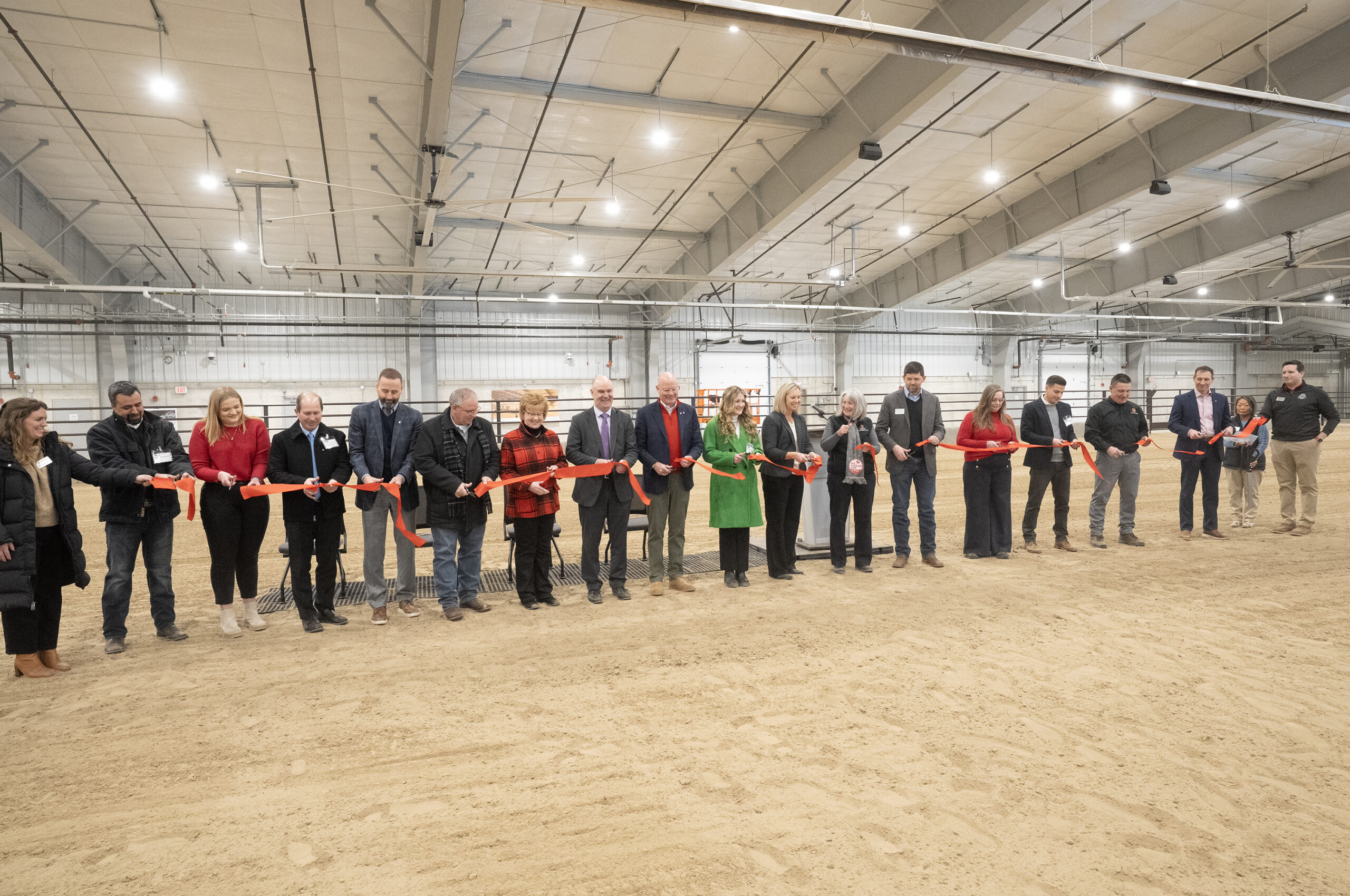
COLUMBUS — At Ohio State University, cutting-edge research spans fields ranging from engineering and healthcare to agricultural science and technology, uncovering answers to questions both old and new. But they’re pushing the envelope just as far in the Multispecies Animal Learning Complex (MALC) and dairy, unveiled during a ribbon-cutting ceremony Jan. 29.
The world-class facility will bring people and animals together under one giant roof to explore an issue that is not just food for thought for scientists, but one important to everyday people: How does what we eat end up in our grocery stores or on our plates?
“Education will be the center of this facility, with an opportunity for people who know very little about the food system to have a chance to learn more,” said Cathann Kress, vice president for agricultural administration and dean of the College of Food, Agricultural and Environmental Sciences, in remarks to 250 guests during the ceremony. The facility promises to advance education in essential STEM fields and strengthen workforce development for a wide range of careers related to animal agriculture.
The MALC is the second facility of three to be built at the Waterman Agricultural and Natural Resources Laboratory on main campus. The nearby Controlled Environment Agriculture Research Complex, where industry partners and scientists research sustainable indoor food production, opened in 2022. Inside the MALC, students will have opportunities to gain hands-on experience with swine, equine, poultry and more, and the public will have a chance to view the workings of modern livestock production and handling facilities. Through educational displays, tours and outreach programming, visitors will be able to learn about animal care, biosecurity, sustainability and modern food production practices.
What’s to come
Following the ribbon cutting, guests were invited to tour the facility and learn more about its role in shaping the future of agricultural education, research and community engagement in Ohio. Paramount to the days ahead in the MALC are the efforts to ensure safety through biosecurity, explained Maurice Eastridge, professor and extension dairy specialist in the Department of Animal Sciences.
The facility was intentionally designed with multiple, clearly defined levels of access. Visitors will be welcomed into public-facing commons and viewing corridors, but animal areas beyond that point will only be accessible through guided tours and strict sanitation protocols.
“We have animals that we want to protect, and then we want to protect you, the people, from disease as well,” Eastridge said.
Inside the roughly 155,000-square-foot facility, separate wings for poultry, swine, equine and other species are arranged to limit cross-contact and reduce disease risk. Poultry and swine areas follow a three-tier biosecurity system that includes controlled entry points, foot baths and the use of personal protective equipment. In some cases, movement between species areas requires a 96-hour waiting period.
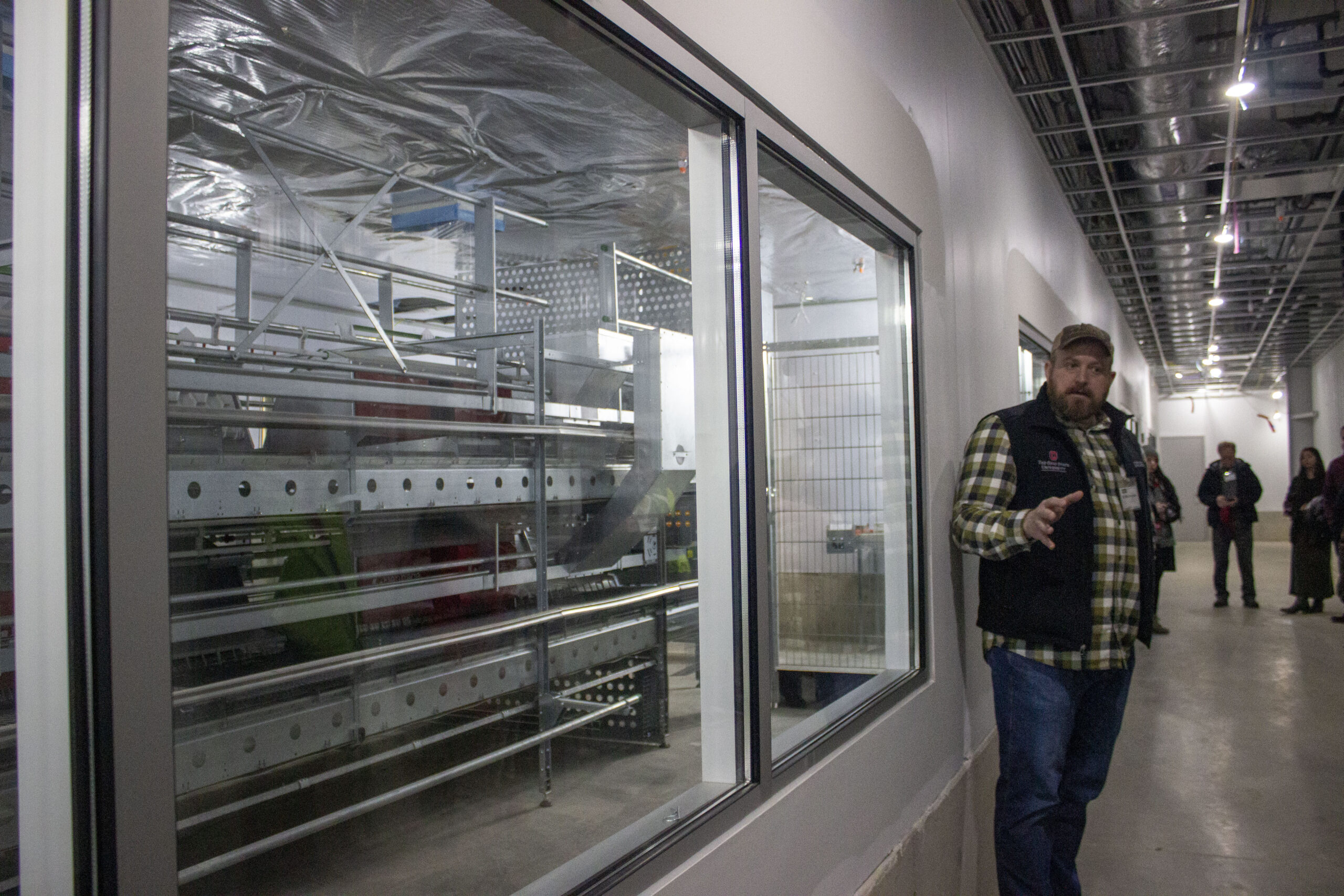
The poultry wing, one of the first stops on the tour, highlights how modern design supports both animal welfare and learning. The area operates on its own air-handling system, complete with hospital-grade HEPA filtration and positive air pressure to keep outside contaminants from entering. Students and visitors can observe birds from a viewing corridor lined with educational displays, while classes and research take place behind the scenes.
“What I do envision is creating kind of, like, little modular units within this room, so we can do feed trials,” Michael Cressman, associate professor, told Farm and Dairy, describing the forthcoming broiler room as having the flexibility to adapt to student work. “So if we can divide this room up into smaller floor pens, then different floor pens could have different diets. I think that’ll be a very feasible thing to explore with our students.”
Beyond poultry, guests toured the equine wing, where barn manager Kelly High described a space built with student access and safety in mind. With 16 stalls, foaling accommodations and access to indoor and outdoor exercise areas, the equine facility will support hands-on teaching for students, many of whom have little prior experience working with horses.
“A facility like this is going to allow us to teach those students in the safest way possible while maximizing our horses’ welfare at the same time,” High said.
As tours concluded, Eastridge emphasized that the MALC is not a finished product but a starting point.
“This is just the beginning,” he said.
Opportunities incoming
The Waterman complex already welcomes over 25,000 visitors annually; in her remarks, Kress said the MALC is prepared to welcome 100,000 more, including families, school groups, FFA groups and 4-H clubs.
“We’ve been dreaming about this facility for decades,” Kress said, “and to get to be here at the time when we’re cutting the ribbon on it is beyond exciting. Particularly because of what we know it means for Ohio agriculture, for our students, for our faculty and for all of those we reach through OSU Extension.”
The $60 million project was supported by a one-time, $10 million state appropriation included in Ohio’s operating budget, which Kress said reflects the state’s commitment to agricultural education and innovation. She specifically thanked Gov. Mike DeWine and members of the Ohio General Assembly for their support, along with state and local officials in attendance.
In addition to public investment, nearly $20 million in private philanthropic support helped bring the MALC to life. Nationwide and the Nationwide Foundation served as lead partners alongside numerous individual donors, commodity groups and industry partners whose contributions will help push research further, enhance student learning and deepen public understanding of Ohio agriculture.
Bringing the Multispecies Animal Learning Complex from concept to completion was both an intensive and highly collaborative process, according to Graham Cochran, senior director of operations for the CFAES.
The project has stayed largely on schedule, though some components, such as the poultry and swine barns, will take a bit longer to be completed due to their technical requirements.
“What people behind the scenes probably don’t realize is how complex putting a facility like this together is,” he told Farm and Dairy.
One example, Cochran noted, was the decision to locate both swine and poultry barns within the same building, something not typically done in commercial agriculture. To address biosecurity concerns, the barns were designed with highly specialized air-handling systems.
“Those two barns have air that’s HEPA-filtered in and HEPA-filtered out to individual rooms,” Cochran said. “It’s more like a medical air-handling system in some ways.”
That approach allows students and members of the public to safely enter biosecure viewing corridors, supporting MALC’s educational mission while minimizing risk to health.
Another standout feature is the new dairy barn, which incorporates three major robotic milking systems. Cochran said the technology has required close collaboration among OSU staff, architects and industry partners.
He also emphasized the broader context of the facility’s location. As a land-grant university situated in the 15th-largest city in the United States, Ohio State faces both challenges and opportunities in operating an animal agriculture complex as unique as this one in an urban setting. For students, the MALC consolidates learning experiences that were once spread across multiple sites, some located up to 45 minutes from campus. Now, they can access hands-on labs via the campus bus system, making experiential learning more convenient and more visible.
Cochran added that increased accessibility could also spark interest among students outside the college. When asked which parts of the complex he is most excited for people to see, he pointed first to the dairy.
“The robotic technology is something that really will draw people in and help us teach about all the ways that modern agriculture is using technology,” he said, adding that it can help counter outdated perceptions of farming.
He also highlighted the cage-free aviary system in the poultry barn, which houses about 700 laying hens.
“That will be a new opportunity for us to teach and do extension programs about the egg-laying industry, which is a big industry in Ohio,” Cochran said.
Both features, he added, reflect the strength of the university’s partnerships. One of the milking robots was donated as an in-kind gift by Lely, and the aviary equipment was provided and installed by a German manufacturer with support from the Ohio Poultry Association.
“It’s just another neat example of the agricultural community and the industry partners coming together in multiple ways to support something that we’re doing with our students and stakeholders,” Cochran said.
Looking ahead, Cochran said the true value of the MALC lies not in the buildings themselves, but in how they are used.
“At the end of the day, the facility is just a building,” he said, “I’m excited about seeing more students come into our college with an interest in animal agriculture, and then go out the door and be prepared to support all the things we’ve got available with our industry partners.”





Boy–with all this hoopla, sure looks like MALC will solve ALL farm and ranch issues, eh?
If MALC is explicitly preparing students for this future, where robotics are central to daily dairy operations, how does the small to medium Ohio dairy farm address: high upfront costs, the need for technical skills, dependence on reliable power and service technicians, and handling the cultural shift from hands‑on milking to data management?
Dairy robots start at $200,000.00 per unit. Where do you find the “whiz kids” to use, operate, and maintain these and at what wages will these high-end workers command?
AI, robots, automation–look what happened with modern tractors. They go on the blink and the Dealer, and his computer and high-priced Techies are the only ones to fix/repair them. Parts? Trade in your first-born prices are that high.
Sure–that is slowly changing, but only after a battle.