




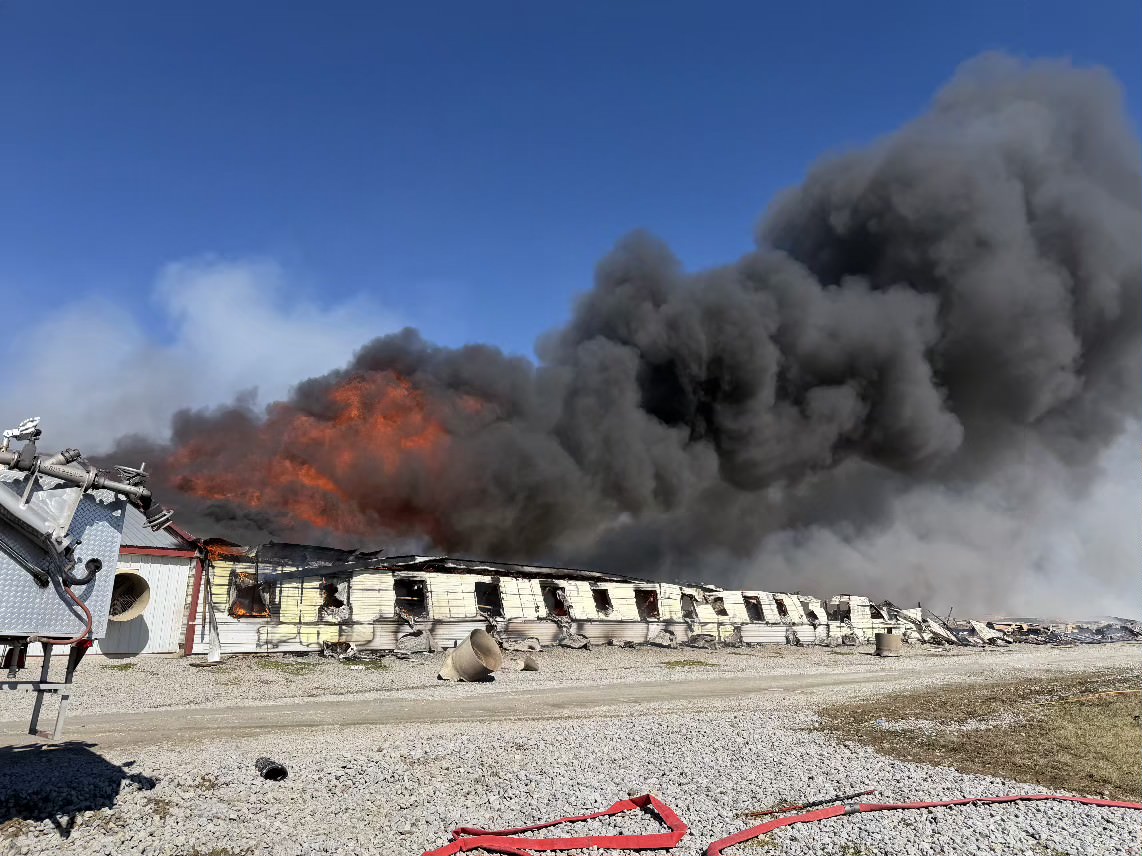
LONDON, Ohio — Fire Chief Brian Bennington was driving down State Route 56 in Madison County, Ohio, late on the morning of Feb. 25 when he saw it: a towering column of black smoke rising above the horizon.
Fine Oak Farms in Union Township was ablaze.
By the time the first firefighters arrived, flames were already billowing out of the central hog barn, a long, white building resembling a warehouse dotted with ventilation fans. Crews had to fall back as they scrambled to set up hose lines where they could safely attack the growing conflagration.
From his vantage point, Bennington, who’s been chief of the Central Townships Joint Fire District for the past 18 years, knew he would need more help, and called it in.
It ultimately took crews from 15 departments, using tanker‑shuttled water, to battle the wind‑driven inferno that killed about 6,000 hogs and leveled most of the operation.
“It was a losing battle from the get‑go,” Bennington told Farm and Dairy in an interview. “But that doesn’t mean we don’t show up for the fight.”
Despite the scale and intensity of the blaze, no civilians or firefighters were injured. Life safety was the top priority, Bennington said. While en route, he asked dispatch to confirm that all farm workers were accounted for. Within six minutes of his arrival, crews confirmed everyone was safely out. After that, the focus shifted to property conservation and extinguishment.
The department rarely sees fires this large; under normal circumstances, they’re able to knock flames down before wind can drive them out of control. This time, that wasn’t the case.
First responders at Fine Oak faced several challenges in making headway against the blaze. One was the sheer power of the wind, which Bennington estimated held steady at roughly 20 miles per hour, with gusts up to about 35. Crews had to reposition on the road‑facing side of the complex three separate times as wind shifts and intense heat threatened to damage their trucks.
“Once it starts pushing, it’s very difficult to fight a wind‑driven fire,” he said.
The barns’ design created another setback. They were constructed with centralized hallways and ventilation to keep hogs cool in the summer months. But once the fire started, that same system helped accelerate it, allowing heat and flames to race from one structure to the next.
A 2017 Columbus Dispatch article describes the innovation that was at work underneath the complex, where owner Dave Heisler had implemented a mass agitation system capable of pumping 7,000 gallons of water per minute into the pit beneath his latest constructed hog barn to manage waste and reduce odor for neighbors.
A novel setup, Bennington worried it might be trapping methane gas and become treacherous for crews once the fire took hold. There was a constant risk that should firefighters push deep into the burning structures, they might fall through the weakened floor into the pits below, one of several reasons they couldn’t safely proceed into the barns. That wasn’t the only danger. Hog barns typically have doors only at either end, with no side exits, making it nearly impossible to send firefighters deep inside without a safe means of escape. As flames tore through the interconnected barns, crews could hear hogs screaming inside but were powerless to reach them.
“It takes a psychological toll on you,” Bennington said. “We feel bad because we lost. And it’s not because we did a bad job. It’s because we lost. We never want to lose buildings. We never want to lose a life, whether it’s an animal or human or anything else.”
Heisler was not able to be reached for comment.
Because the fire was in such a rural area, there were no available hydrants, forcing firefighters to shuttle water in by tanker. Some carried between 2,000 and 3,500 gallons at a time. Even with that system in place, the sheer scale and size of the fire meant multiple trucks were operating simultaneously, straining the available supply.
But help was always within reach: Bennington said farm staff worked closely with responders, pointing out propane tanks and other critical features of the property. Additional farmers from the community brought in their own large‑capacity water trucks to assist with suppression efforts.
Radiant heat from the initial barn ignited another in the complex to the south; over the course of the day, flames consumed yet another barn to the north. In the end, four out of five barns were lost. Crews managed a final stand that saved one barn housing roughly 1,500 pigs, along with an open storage structure to the east.
According to statements from workers at the facility provided to first responders, the fire may have been caused by a refrigerator in a break room. The Ohio State Fire Marshal’s Office is conducting an investigation and has completed its on‑scene work. For now, the fire is being classified as an accident; investigators know the area where it started, but it’s too soon to say with certainty what the ignition source was.
Flare‑ups continued into the night. Crews returned four times overnight to extinguish hot spots and ensure the fire did not spread to the remaining barn.
In the aftermath, Bennington said fire prevention still comes down to fundamentals: working fire extinguishers where people can reach them, employees who know how to use them and a watchful eye on electrical systems before they fail. Those small steps could make the difference between a regular day and a calamity that changes lives, or worse, claims them.
“This is a large operation. It’s been in business for a long time out here,” Bennington said. “Madison County is strictly an agricultural community. So our community takes a fire like this to heart, because it hurts one of our own.”





Just asking: How could such a facility be built in Union Township without the three Trustees asking: “How will water be handled or brought in if a fire starts here?” Zoning laws?
The firefighters here worked a true miracle fighting this blaze in the wind with strong winds, no access to the structure, and limited water supplies, which nonetheless came.