


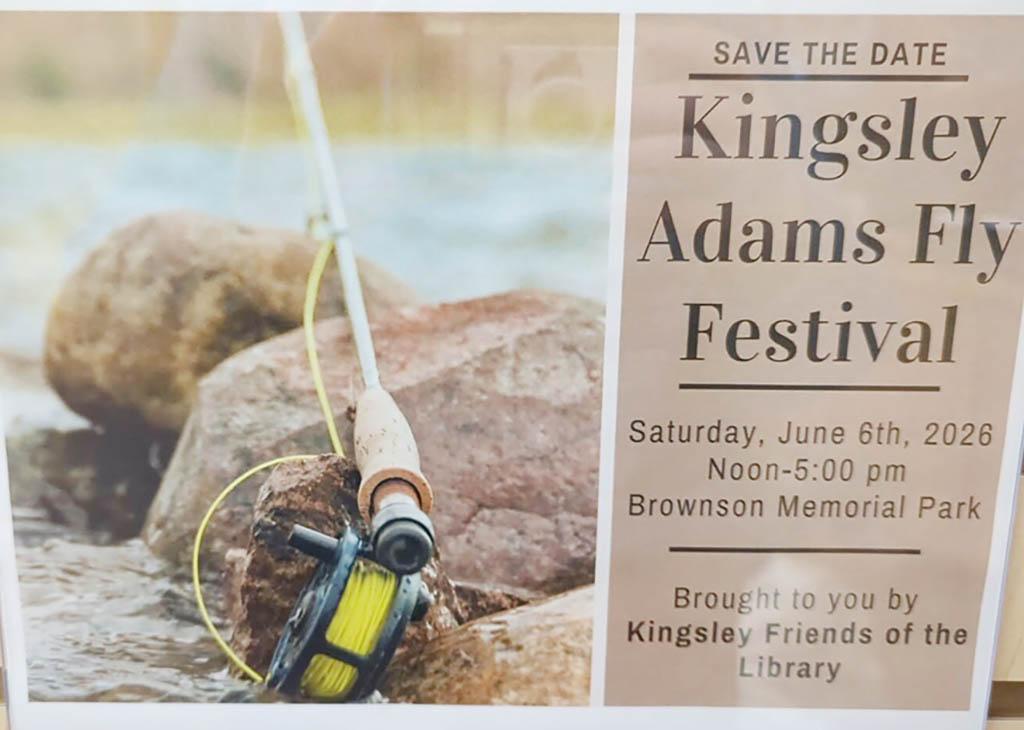
I was returning home from a fishing trip when I passed through the little town of Kingsley, Michigan. Stretched above the street was a banner that read “Adams Fly Festival,” and it really caught my attention.
You see, I just got done floating an Adams dry fly along the riffles and eddies of the Boardman River in the hopes of fooling a brook trout or two.
“Huh,” I thought…which, in my lexicon of post-cold-water wading, signifies deep thought.
The dates on the waving standard indicated that the event had finished up the day prior to my driving through the little town.
“Should have been here yesterday,” I could imagine some sharp-witted fishing guide telling me — like I’d never heard that one before.
I called the state’s natural resource service center in Traverse City, and my fisherman’s luck began to turn. Maureen Lajko answered and remembered selling me my fishing license. Not only did she know about the Adams Fly Festival, but she was from Kingsley and was one of the orchestrators of the event. She encouraged me to attend since I enjoyed the sport. Well, if you can’t trust those folks from DNR, who can you trust? I noted the June 1 date in my itinerary and headed home.
The indispensable Adams
Now, I realize that there are plenty of local festivals throughout Ohio. Why choose to venture to that state up north to support one of their events? There are several good reasons — it’s held at a time when the area offers some great trout fishing, which happens to be one of my pastimes. The spirit of the affair surrounds one of the most popular flies in any fly-angler’s box of tricks. And it benefits the local library and community.
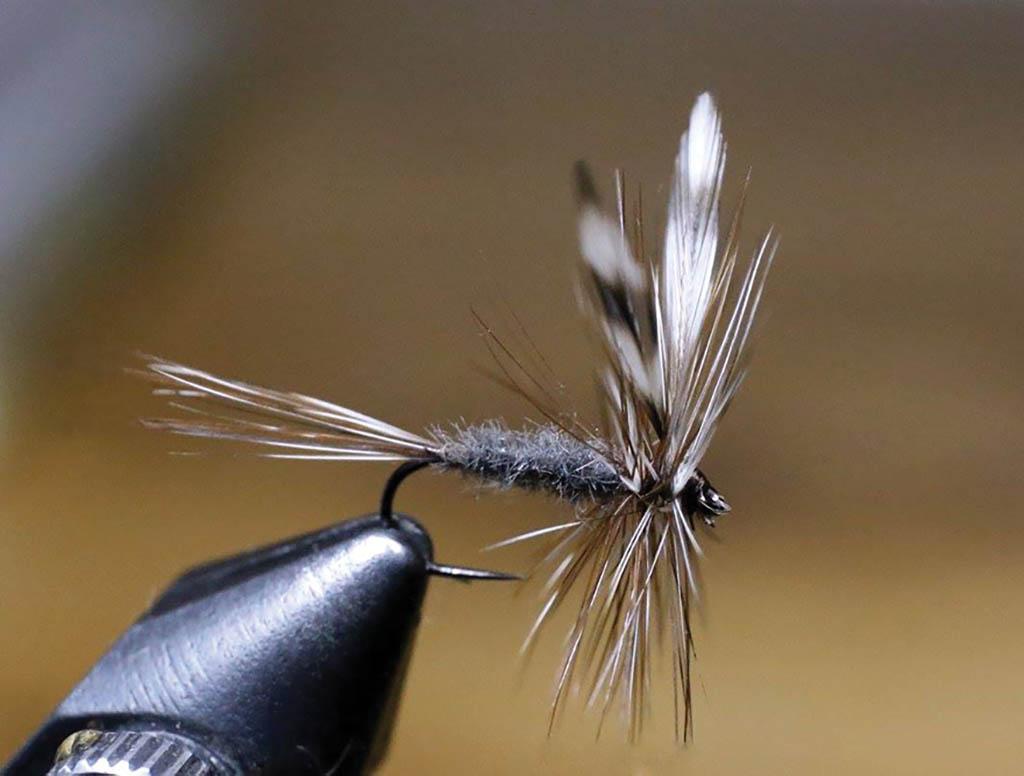
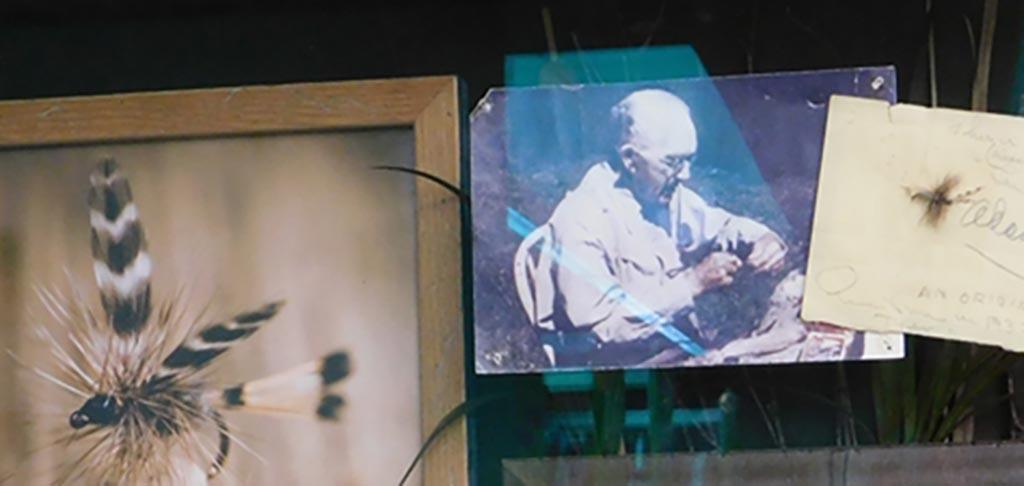
The Adams Fly was first conceived in Mayfield, Michigan, by expert tyer Leonard Halladay in 1922. At the urging of his friend Charles F. Adams, an Ohio attorney, the two contrived to imitate the mayflies that inhabit Michigan’s cold, clear streams; an insect that also serves as one of the most delectable items on any trout’s menu.
Since it’s well-known that most fishing lures have been designed to catch more fishermen than fish, imitating one of North America’s roughly 630 mayfly species doesn’t seem all that significant. What’s important is to realize what’s important to the fish — color, size, lifecycle stage of the bug and presentation of the fly to the fish.
Halladay and Adams were on the quest for a general imitation that was flexible enough to be tied in an assortment of sizes and could assimilate the identity of a variety of mayfly species. Halladay presented Mr. Adams with a supply of the new, unnamed impostors, and he headed for his favorite trout stream — the Boardman River near Kingsley.
The rest is history. When Adams returned to report his experiences, he expounded upon his success and said that it out-fished other flies he’d come to rely upon. Due to that testimonial, Halladay decided to name the fly after his friend, and the Adams fly — considered one of the most popular, versatile, effective and bestselling dry flies since its creation — was born.
That indispensable Adams can be found in every fly fisher’s collection in the country, encouraging Kingsley to use that notoriety to highlight this spring festival. The event had live music, custom fly-fishing crafts, fly tying, casting demonstrations and clinics, the always-popular beer tent and an original Halladay-tied Adams fly on prominent exhibit in the library.
Legends abound
One guy was stuck in a corner of the displays and was peddling raffle tickets. I really wasn’t sure what those tickets were for, but it was for a good cause, so why not? He mentioned his name was Bob and, as we talked, I realized he wasn’t any old Bob — this was Bob Summers, not that I think the name should ring a bell for most folks.
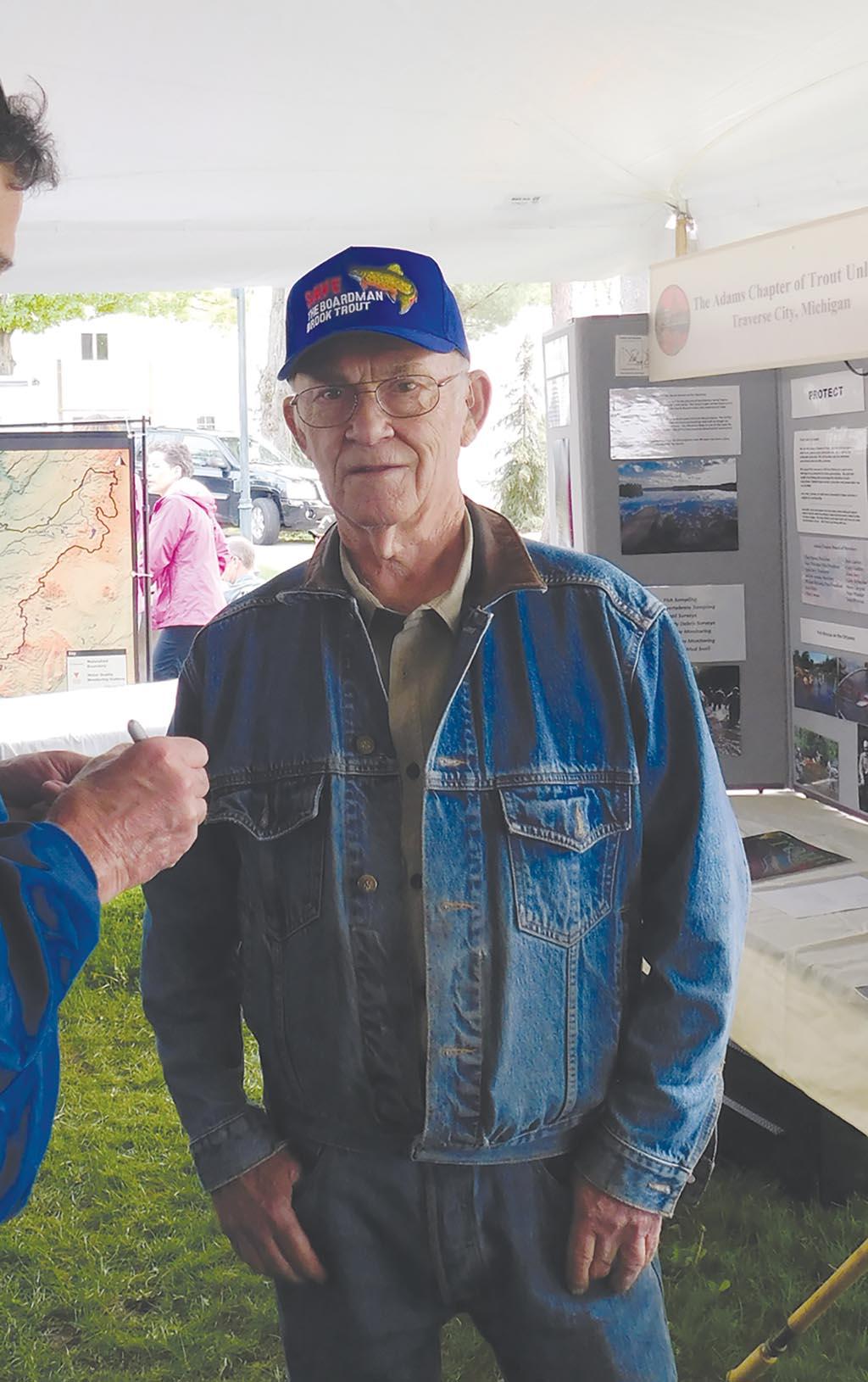
Bob didn’t play for a Michigan football team, didn’t pitch for the Tigers and never wanted to be a presidential candidate — a real oddity these days. But Robert W. Summers is as much a legend to fly fishing as the Adams fly.
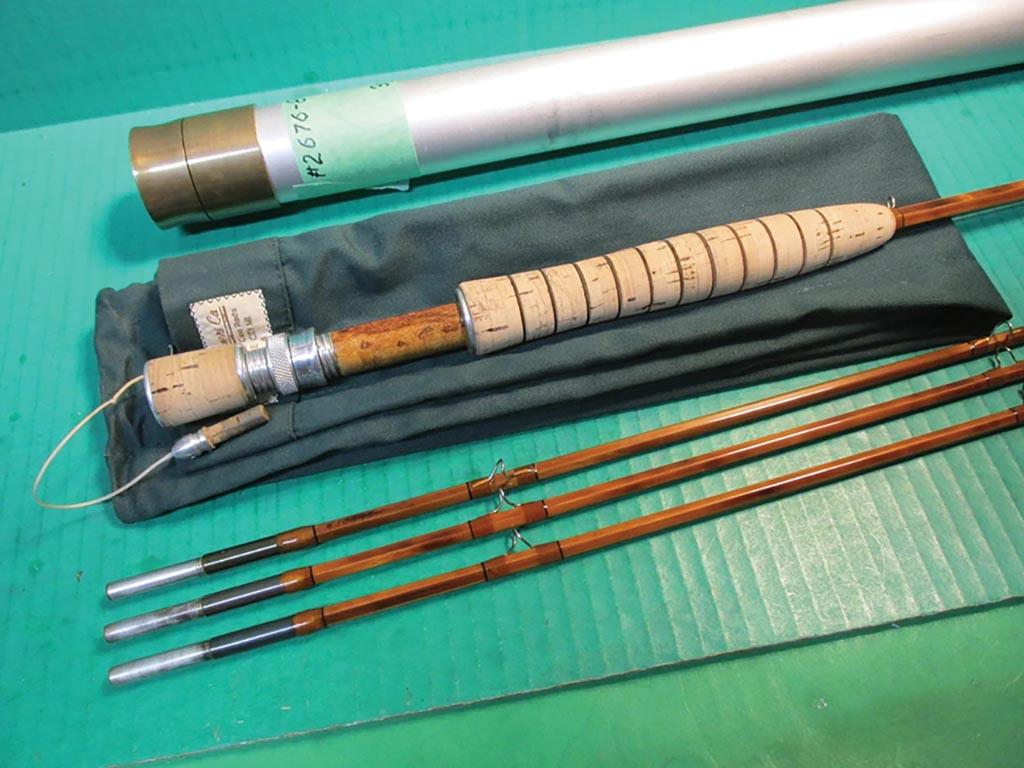
Summers has been building bamboo fly rods on a full-time scale since 1956, having worked with prominent custom builder Paul H. Young for 18 years. He continues building bamboo rods today in his shop near Traverse City. Bob also specializes in repairing and restoring the classic rods of Young and the renowned Lyle Dickerson, both of whom he knew well.
Bob has become a legend for those seeking the very best of bamboo fly rods. Ordering a rod built on one of his tried patterns can have you waiting nearly five years, and the cost of getting it in your hands will set you back more than $3,000. Late Young fly rods, which were likely built by Bob, have been sold for as much as $7,000, and many used Summers’ rods sell for more than a new one because folks just don’t want to wait.
While I couldn’t quite bring a Summers fly rod home with me, at least I got to stand where fly fishing history was made and shake the hand of the man who has had such an impact on classic American fly fishing. I expect to become a regular at this annual event. The 2026 Adams Fly Festival is scheduled for June 6, from noon to 5 p.m. If you happen to be traveling near Traverse City during that time, it might be a fun stop! Learn more about Bob Summers and his rods at www.rwsummers.com.
The rest of the story
When Tamara (Wyckoff) Luchini heard I was writing about the Adams Fly Festival, she offered to review it. Proving that it’s indeed a small world, she explained that she was the great-granddaughter of Len Halladay, the famous fly’s originator.
Her father, Ken Wyckoff, was the oldest surviving grandson of Halladay. Tamara remembers sitting beside Halladay’s desk and watching him create many of the beautiful patterns used to lure trout to the net, undoubtedly seeing him tie the Adams. Tamara gave me the history behind the history.
“When Dad read your article…he commented that it ‘wasn’t quite right.’ As Dad remembers Grandpa Len telling the story of creating the Adams fly, Len had already been making and testing that particular fly for some time before Judge Charles Adams asked Len for a bait to use for trout on the Boardman River. Grandpa gave Adams his fairly new, unnamed fly to try.”
“Judge Adams had such success that he came back and asked to purchase a dozen of them to take home to Ohio. Grandpa Len gave his friend the flies and, when asked what the name was, said, ‘Well, let’s call it the Adams fly,’” Tamara explained as she unfolded the years.
As often happens with discoveries and inventions, after the fly gained its quickly mounting popularity, a young man stepped forward to claim that he was the originator. This didn’t sit well with the Halladay clan. Luckily, it didn’t turn into anything like the Hatfields’ and McCoys’ feud.
Ken Wyckoff laughingly remembered his aunt saying, “That boy only went fishing … because his mother insisted, and that boy was much more interested in my sister than he ever was in the fish!” As a high schooler, I remember fishing a particular pond for similar reasons … huh …
While the Adams’ inception is celebrated in Kingsley, Michigan, the nearby community of Mayfield was where Len Halladay lived when it was created, so the real gold is buried in Mayfield’s history.
Legacy
While a few might be miffed that the fly’s heritage was somewhat co-opted, it’s certainly true that it was first fished around the Boardman’s bends near both Michigan towns.
Even though the location of the festival may not exactly portray the Adams’ Mayfield roots, the Halladay clan is quite content with the increased publicity for Grandpa Len’s work. Tamara adds that she believed that Len Halladay’s fly-tying desk now resides in a museum in Traverse City.
The Kingsley Adams Fly Festival has also gotten the nod from 93-year-old Edna Sargeant, one of the original “founding families” of Mayfield. Edna remains friends with the Halladay and Wyckoff families and doubles as the historian of the communities. I’ll even bet she remembers who that boy was who was chasing the Halladay girl.
Tamara and her father Ken have both passed since I began writing this column. Fortunately, you can watch “Grandpa’s Story, The Adams Fly”, the story of Len Halladay, narrated by his grandson John Falk, on YouTube at www.youtube.com/watch?v=HNIinE5J9QY.
Learn how the son of a Civil War veteran took feathers, fur and wire and transformed those disparate items and himself into historical icons of the sporting world.
“Tell me a fact, and I’ll learn. Tell me a truth, and I’ll believe. But tell me a story, and it will live in my heart forever.”
— Ed Sabol