





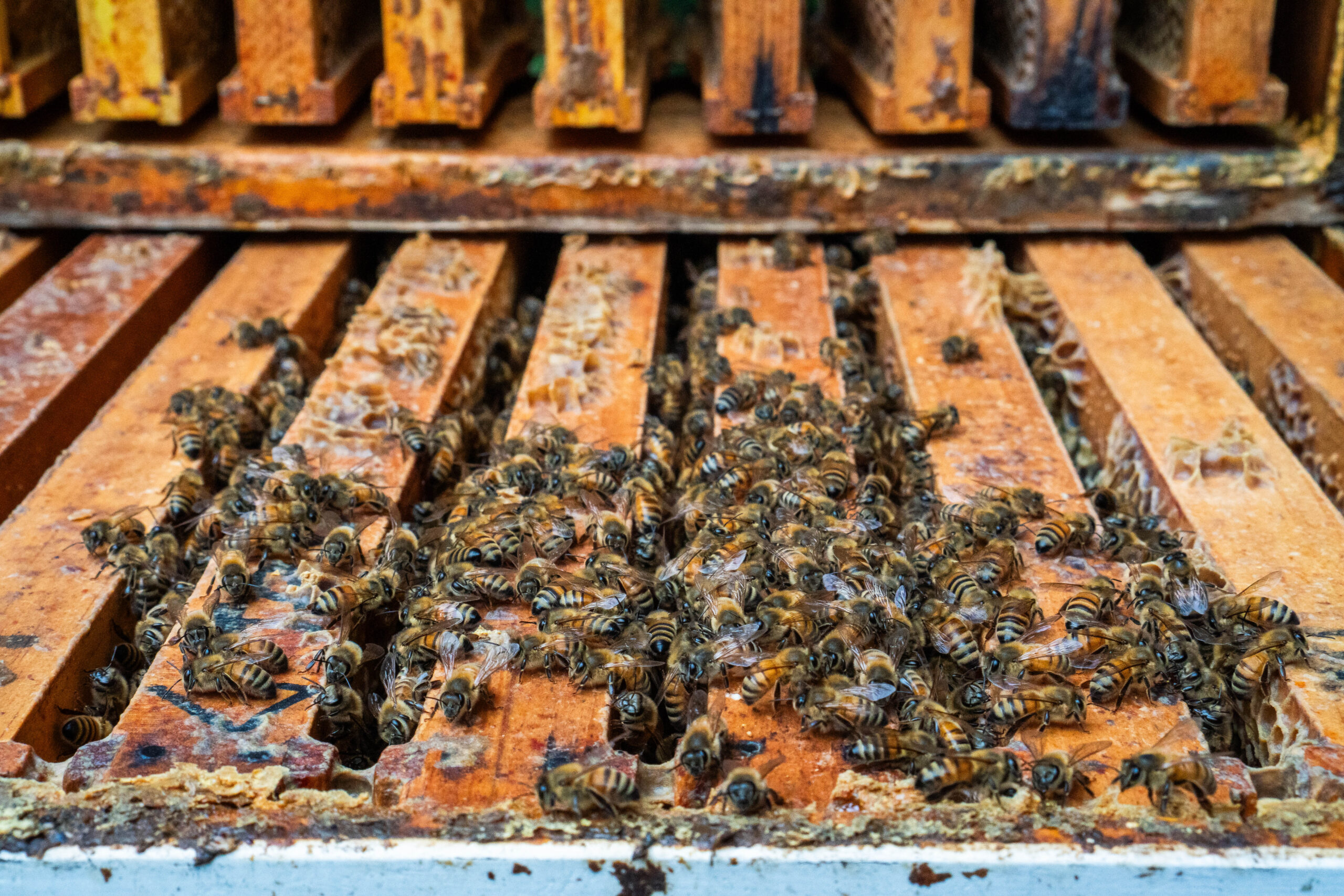
Researchers at an Ohio university are trying to find a way to better combat a parasite threatening the state’s fruit and vegetable fields. Central State University in Wilberforce is looking for ways to kill the Varroa destructor, a mite that destroys honey bee colonies, without harming the bees.
While the parasite was first discovered in the United States nearly four decades ago, it grows more fearsome with each passing year as it adapts to Ohio’s climate and adjusts to the techniques beekeepers use to kill it.
Know thy enemy
The mites are found virtually anywhere that honeybees live, researchers say. The parasites burrow into the hexagonal cells that make up honeybee colonies.
“They’re small, about the size of a pinhead,” said Reed Johnson, a professor of entomology at Ohio State University who studies honeybees. “But relative to the size of a honey bee, it’s a huge parasite. It’s like us having a parasitic squirrel.”
A family of mites feeds on developing bees, Johnson said.
“That really threatens their lifespan,” he said.
The mites can also carry deadly viruses, Johnson added.
Honey bees are essential to agriculture. The black and yellow insects pollinate roughly a third of the nation’s crops and are crucial for the flowers that grow fruits such as strawberries.
Bees carry pollen from flower to flower, facilitating the mating process for plants that grow fruits such as strawberries, said Hongmei Li-Byarlay, a professor of entomology at Central State University and an expert in honey bees.
“That enables the flower to be fertilized and produce fruits and seeds,” she said. “In one of my talks, I have a slide to show people a nice breakfast with fruits, eggs and milk.”
The professor goes on to explain that everything in the picture is brought to you in part by honey bees.
Oranges, for example, are pollinated by honey bees, as is the alfalfa that sustains dairy cows, she said.
New help needed
The mite is native to Asia but was first spotted stateside in the 1980s. Farmers have traditionally used miticides to kill it, which is already an imperfect solution.
“It can have negative effects on the queen and on the development of the larvae,” Johnson said of miticides. “But in almost any case the disease is worse than the cure. These mites will kill colonies.”
The mite has evolved over time to make it more likely to survive, leading to what Johnson called a “pesticide treadmill.”
“We need to find new miticides or new approaches to control the Varroa mite,” Johnson said. “The ones that worked really well have been used up and the mites are resistant.”
The parasites have also adapted to the United States’ climate, Li-Byarlay said.
“We used to see a lot of winter losses,” she said. “Now we’re seeing even more summer losses due to the mite resistance.”
About the research
That’s why researchers at Central State University are looking for better ways to fight the venerable menace.
Some honey bee colonies have resisted mite infestations, and Li-Byarlay is trying to figure out why.
“We’ve collected mites dropped from [honey bee] colonies and examined each mite under a microscope to see when there is a high percentage of these mites that are chewed off or bitten by the worker bees,” she said.
L-Byarlay said she has a database and is developing genetic stocks of honey bees and selecting the colonies with the highest percentage of mites that are chewed off or bitten by the worker bees in order to replicate the traits that make those colonies resistant to the mites.
Her work became even more crucial after the USDA announced earlier this year that it would shutter a Maryland honeybee lab that studied mites.
In the meantime, Li-Byarlay recommends that beekeepers diversify their mite treatments.
“If you only use one miticide year by year, that accelerates the development of miticide resistance,” she said.





Chilling: “Her work became even more crucial after the USDA announced earlier this year that it would shutter a Maryland honeybee lab that studied mites.”
WHAT? We have billions/trillions to blow up people and countries, yet we close vital research facilities looking into why our food supply may be decimated?
Paraphrasing Bill Shakespeare: “Something is rotten in the state of D.C.”