




It has long been said that bread is the staff of life. And perhaps nowhere was that more true than on the frontier of the Ohio Country, where it was often the only food standing between the settlers and starvation.
The pioneers enjoyed bread — especially toasted bread — every bit as much as people do today. Unlike today, however, when we have modern electric toasters at our immediate disposal, the early methods of toasting bread were a bit more challenging since the process occurred in the cooking fireplace in front of the fire.
Before I delve into that actual process, however, let me say a little about bread in pioneer times. Back then loaves of bread were formed by hand into mounded circular loaves. Unlike today’s commercially produced elongated loaves, the bread of yesteryear was also considerably denser and more heavily textured than most of today’s breads.
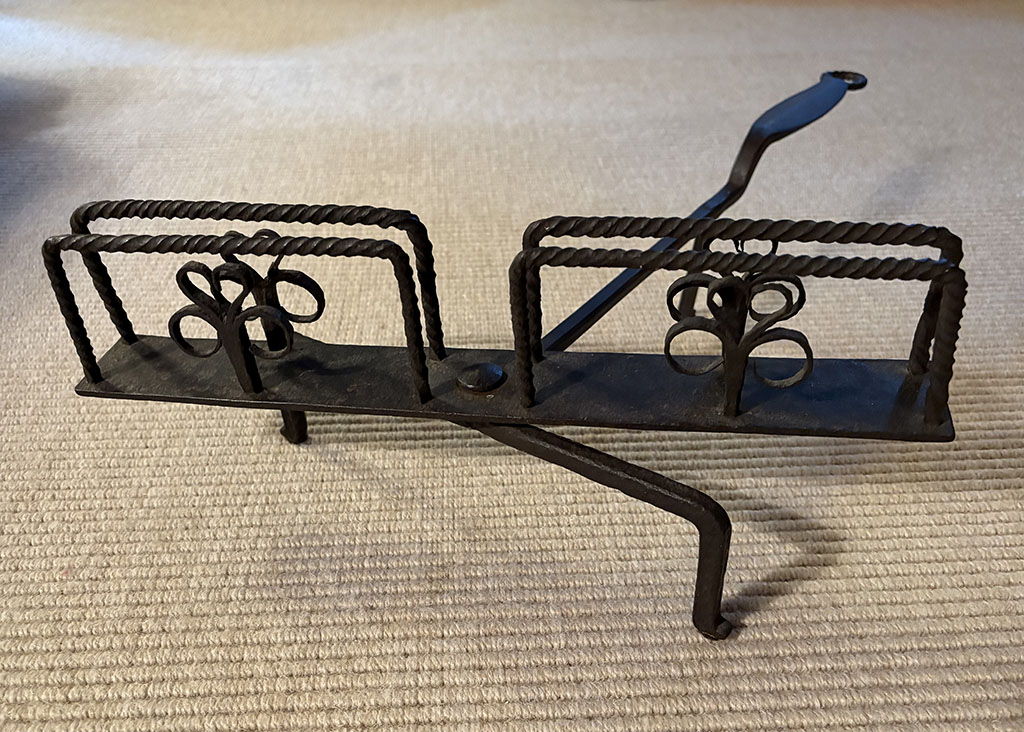
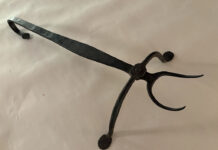
Two distinct styles of bread toasters were used in the fireplace setting. The first was the “kick toaster,” a wrought-iron basket for the bread slices which revolved on a base with three or four legs.
To toast bread, the slices (much thicker than we typically slice bread today) were stood on end in the basket and the toaster was pushed toward the fire by use of a long, attached handle. When the slices were toasted on one side, the basket was revolved — often by kicking it with the foot or using a poker — to expose the other side of the slice to the flames.
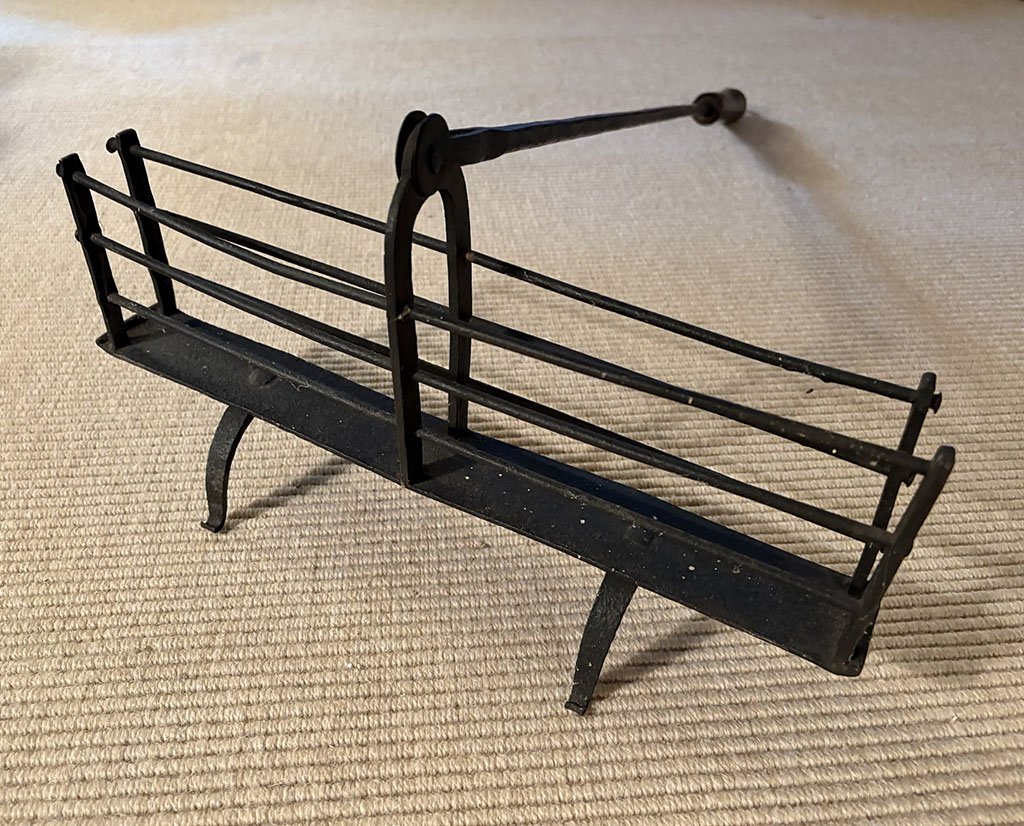
In a second type of early wrought-iron toaster, a footed basket was suspended at the end of a three-foot iron rod in such a manner that after the bread was toasted on one side, the basket could be swiveled to allow the other side of the bread slice to be exposed to the heat.
The baskets of both these forms offered perfect opportunities for the blacksmiths to express their artistic skills. As a result, such toasters are often decorated with motifs that ranged from hearts, stylized trees and human figures to fleur-de-lis and arches exhibiting all manner of decorative twists and curls.
Bread that is manufactured today cannot be toasted the way it was in pioneer times (I’ve tried it and know whereof I speak). Because slices are comparatively thin, and it lacks the body and texture of its pioneer counterpart, it is quickly dried out by the flames and becomes as hard as melba toast and an immediate threat to one’s dental work.
Roasting beans
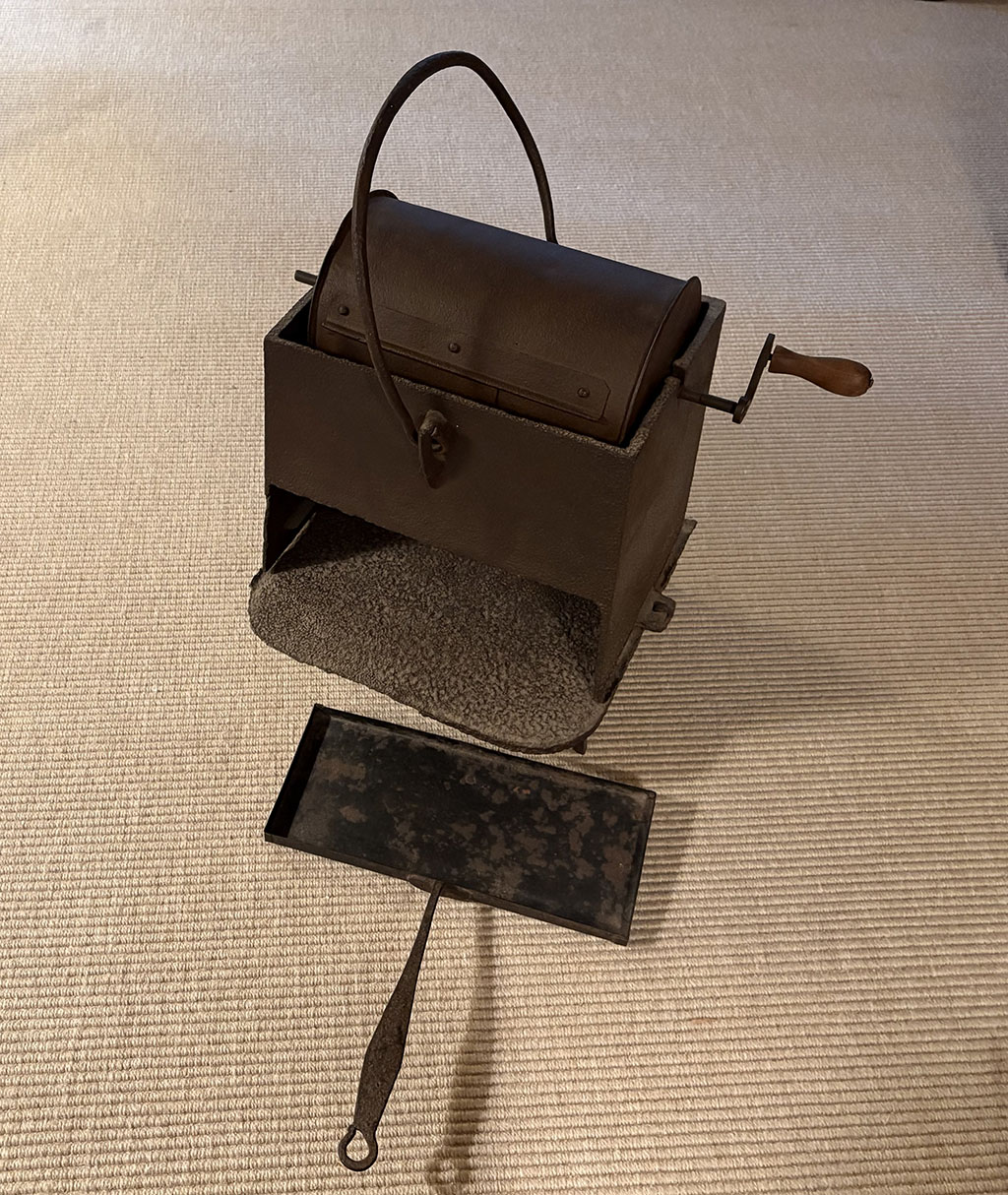
Another early blacksmith-made device used in front of the fire was the coffee roaster. This typically consisted of two pieces, the first of which was a sheet iron cylinder having a long arm with a crank at one end. The cylinder had a sliding door that allowed the green coffee beans to be poured in and removed after roasting. The roasting cylinder sat atop an iron base piece that held hot coals from the fireplace, which heated the cylinder. The base might have had either an interior gridiron for holding the coals or a flat pan onto which the coals could be placed before being inserted into the base.
Coffee roasting actually began in the 15th century in Africa and the Middle East. In the 17th century, the first metal cylindrical roasters appeared in North Africa, and were quickly adopted in America. As coffee consumption increased, people started to roast their own beans at home. Drum-type roasters were used throughout the 1800s.
Coffee arrived in America in the early 1600s, brought by Dutch, French and English traders. Tea was the dominant drink in the developing country until the 1773 Boston Tea Party, which caused the consumption of it to be regarded is unpatriotic.
In the Civil War, coffee was a staple for soldiers needing energy, and by the 20th century, it became a national obsession, moving from a kitchen necessity to a lifestyle statement and cultural status symbol.
Unlike many pioneer cooking implements, coffee roasters seldom incorporated any significant decoration or embellishment by the blacksmith, except perhaps for a curl in the handle of a coal pan or a curl on the handle of the sliding lid of the roasting cylinder.
Early coffee roasters seldom turn up in today’s antiques market. The roasting cylinders, fragile from many heatings and coolings, often became broken, badly dented or simply rusted away. In addition, the base pieces often go unrecognized as to their original use and are subsequently discarded.





Thanks, Paul! Great story. It’s truly hard to believe exactly how difficult it was for early Ohio settlers. Especially now in the Winter season–many inches of snow on the ground and sub-freezing temperatures.
Simple pleasures like bread toast were highlighted in many Charles Dicken’s novels–especially in David Copperfield. In Chapter 3 (“I Have a Change”), young David visits the Peggotty family in Yarmouth, where the ever‑cheerful Mr. Peggotty delights in toasting bread over the fire and sharing the simple pleasure with his guests.
By the way, famous English author, Charles Dickens toured Ohio by stagecoach in 1842. He wrote:
“A great portion of the way was over what is called a corduroy road, which is made by throwing trunks of trees into a marsh, and leaving them to settle there. The very slightest of the jolts with which the ponderous carriage fell from log to log, was enough, it seemed, to have dislocated all the bones in the human body …”