






NEW PHILADELPHIA, Ohio — Four different experts agreed that Ruth Miller was suffering from a complex and severe mental illness that was improperly treated and had been escalating for years when a series of confounding events were carried out in public view at the busy Atwood Lake Park and campground late last summer, resulting in two deaths.
By the time Miller was pulled from the shallow water alongside her oldest children — asking strangers to pray when they offered help and telling rangers she had “given” her youngest son to the Lord — the story of what had happened to the Amish family from Millersburg already defied easy explanation. Through the night and into the morning of Aug. 23 last summer, investigators say, Ruth and her husband, Marcus J. Miller, 45, had been carrying out a series of faith‑driven “tasks” in the water they believed God had commanded. By dawn, Marcus had drowned, his body found not far from the end of the dock where Ruth would soon throw their young son into the lake as an offering to the voice in her head, followed by their older children. She then corralled the surviving family members onto a golf cart and drove it erratically through the park until it plunged off an embankment and into shallow water near a restaurant in the busy campground, where authorities finally found them.
The court’s question on March 13 was no longer whether Miller was legally sane. Judge Michael Ernest had already found her not guilty by reason of insanity on March 3. Instead, the court wanted to know where she should go if not prison, how she should be treated and what it would take to keep both her and the public safe.
Setbacks and misfortune
Over nearly two hours of testimony, a procession of psychiatrists and psychologists described a woman whose sanity had been fraying for years.
In the spring of 2025, Miller visited her family doctor, describing how sadness and exhaustion were taking a toll on her life. She left with a prescription for Zoloft, a common antidepressant. But pharmacologist Daniel Buffington, a Tampa-based clinician hired by the defense, told Judge Ernest it was the wrong medicine for the wrong diagnosis, a treatment Miller began and quit in a matter of months that potentially precipitated her descent into psychosis that would crescendo in startling fashion at Atwood Lake.
Buffington testified that those medication decisions “set up the conditions for something like this,” worsening an already deteriorating mental state as Miller’s insomnia, racing thoughts and religious fixations intensified without the long-term, specialized psychiatric care experts say she needed all along. The timing of Miller’s later break at the lake, he said, was “almost textbook” for the kind of destabilization that can follow discontinuation of such a medication. By the time authorities say she threw her 4-year-old son, Vincen, into Atwood Lake, Buffington believed she had become increasingly detached from reality.
Asked by defense attorney Ian Friedman whether a different, more appropriate regimen might have prevented the tragedy altogether, Buffington answered that yes, in his view, they likely would not be in court.
As Christopher Marett, a forensic psychiatrist at the University of Cincinnati, testified, Miller’s condition was marked by grandiose religious delusions, believing, for example, that she could walk on water. He also noted that several of her relatives have been diagnosed with a rare inherited brain disorder called MAST syndrome — also known as autosomal recessive spastic paraplegia 21 — which can cause both neurological and psychiatric problems.
Without proper genetic testing, Marett said, doctors cannot rule out whether the same condition is contributing to Miller’s mental illness.
Daniel Hrinko, a forensic psychologist with Ohio’s District 9 Forensic Diagnostic Center, testified that her insight into her condition and medications is “very limited.” Miller can say she has a mental illness and take medication, he said, but struggles to explain what the drugs are for, what her symptoms are or what might happen if she stopped taking them.
Defense expert Susan Hatters‑Friedman, a Case Western Reserve University forensic psychiatrist who specializes in cases where parents kill their children, said Miller’s psychotic disorder left her “out of touch with reality,” hearing special messages from God and convinced she had to perform acts to prove her devotion, including keeping her foot on the golf cart’s accelerator as it went into the water. Hatters‑Friedman also described how Miller repeatedly sought but did not receive effective help, turning to a chiropractor and “holistic” treatments for supposed toxins and infections, scheduling a private brain scan for the month after the incident and seeking therapy. But during her first counseling session, after the therapist revealed they knew her father, Miller said she felt too uncomfortable to return, so she never did. Meanwhile, Miller faced other serious medical issues and the hazards of a mold‑infested home that ultimately had to be torn down, leaving her family of six in temporary housing and under strain.
Taken together, the experts said, her history and ongoing lack of understanding of her illness leaves the county jail unequipped to provide the intensive, evidence‑based care she needs. They urged that she be sent instead to Heartland Behavioral Healthcare, a secure state psychiatric hospital they described as the appropriate “least restrictive” setting that will see to the round-the-clock monitoring she needs while still protecting the community.
By the end of the hearing, both prosecution and defense were in rare agreement. Tuscarawas County Assistant Prosecutor Fred Scott and Friedman urged Ernest to follow the experts’ unanimous recommendation and send Miller to Heartland. Scott told the court that from 2022 through 2025, Miller’s improperly treated mental illness had been steadily worsening, exacerbated by the numerous setbacks cited by the experts.
“There’s much work to be done,” he said, and Heartland is where it should happen.
Friedman framed the tragedy as the predictable end of a long, failed search for care.
“We wouldn’t be here but for the mental illness that Ruth struggled with and that Ruth tried her best to get help with,” he said, echoing Buffington’s testimony that a better treatment regimen might have prevented the Atwood Lake disaster entirely.
In a brief ruling from the bench, Ernest agreed.
Citing “clear and convincing evidence” that Miller is a person with a mental illness, he ordered her committed to the custody of the Ohio Department of Mental Health and Addiction Services, with placement at Heartland Behavioral Healthcare. Heartland, he said, is a locked facility where patients cannot simply come and go from; Miller will remain in the Tuscarawas County Jail until a bed opens. State law requires a review of her status in about six months, and then every two years after that, though her lawyers can ask for additional hearings if her condition changes.
“Madness, not badness”
The outcome has stirred debate among people following the case, some of whom see the insanity verdict as Miller “getting away with it.” Douglas Berman, a criminal law professor at The Ohio State University who has studied the insanity defense for decades, told Farm and Dairy that the same reaction surfaces in almost every high‑profile insanity case, especially when a child has been killed.
“We actually legitimate the rest of our justice system if we’re prepared to say there’s a small class of folks who aren’t going to be subject to it because of this mental illness… Because we recognize this mental disease, it actually makes it more legitimate that we’re punishing everybody else,” Berman said. Sending Miller to a locked psychiatric hospital under mandatory treatment and repeated court review, he suggested, is a different form of accountability, not an absence of it.
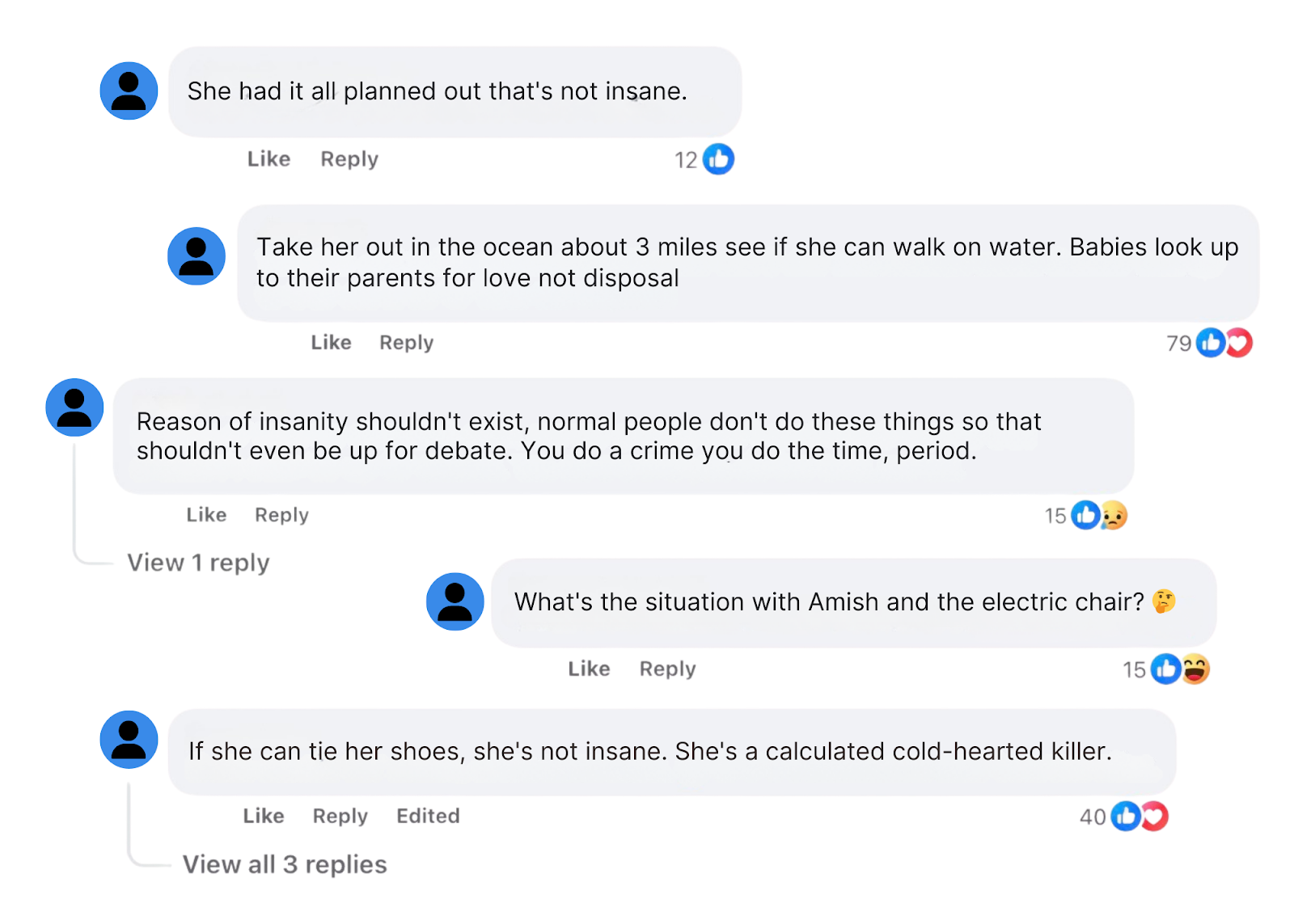
“We really only want, and to some extent, only need, the most extreme kind of cases to be in the category of, ‘okay, we get it. This is about madness, not about badness,’” Berman said. When a severe mental disease leaves someone unable to grasp the wrongfulness of their actions or untethers them from reality altogether, the law has long treated them as a different kind of offender — not excusing the harm, but questioning whether traditional criminal punishment is the right tool to address it. In Ohio, defendants must now show they suffered from a severe mental disease or defect that left them unable to understand the wrongfulness of their acts, a deliberately narrow doorway that only a small number of defendants ever possess the credentials to pass through.
Jim Cates, a board-certified clinical psychologist who has spent decades working with Amish communities, said serious mental illnesses such as bipolar disorder can gradually intensify religious thinking before crossing into psychosis. At first, he said, families may interpret the change as a deepening faith.
“But then as time goes by, it’s more than just revved up. It becomes more, ‘I’m talking to God. God is talking to me. I’m having these visions where Jesus is speaking to me. I am an agent of God, and I have special powers or special things that I’m supposed to do,’” he said. “And that usually steps outside of most people’s faith or spiritual practices, and at that point, families become alarmed.”
But whether Amish or not, concern isn’t always met with action.
“Denial is one of the first responses a lot of times. People just do not want to deal with the fact that they have a seriously mentally ill family member. So the first response is, it’s not happening.”
Leaders of the Old Order Amish church and members of the extended Miller family echoed the distinction between faith and illness in a joint statement released after the tragedy, expressing grief over the deaths and emphasizing that the couple’s actions were not reflective of Amish beliefs or teachings. Instead, it said, the delusions that led to the events at Atwood Lake were the result of severe mental illness. The family and church leaders also said relatives and church members had been trying to help the couple through ongoing struggles in the months leading up to the incident.
Amish communities, like any community, try to guide members who seem to be drifting away from shared beliefs, Cates said. Church leaders will usually step in and try to draw someone back, reminding them of the values of humility and the teachings of the church.
But when someone is experiencing psychosis, he said, those efforts may not work.
“They believe what they’re saying. They believe that this is reality. We’re very fortunate that most of the time, these psychotic delusional beliefs don’t involve situations where someone is hurt or someone wants to hurt someone, but it’s every bit as much reality to them as what reality is to us right now,” he said.
For Scott, the prosecutor, that gap also shapes how the wider public sees cases like Miller’s.
“You have to dive into the details of the case,” he told Farm and Dairy. “I think there’s a misperception of the public regarding mental illness, and perhaps that may lead to how people feel. But I think as they see how it plays out, and the heavy lifting she’s going to have to do — the fact that she’s in a locked-down mental health treatment facility — perhaps will go a long way to helping people understand mental illness and the role the criminal justice system plays in (addressing) it.”




