




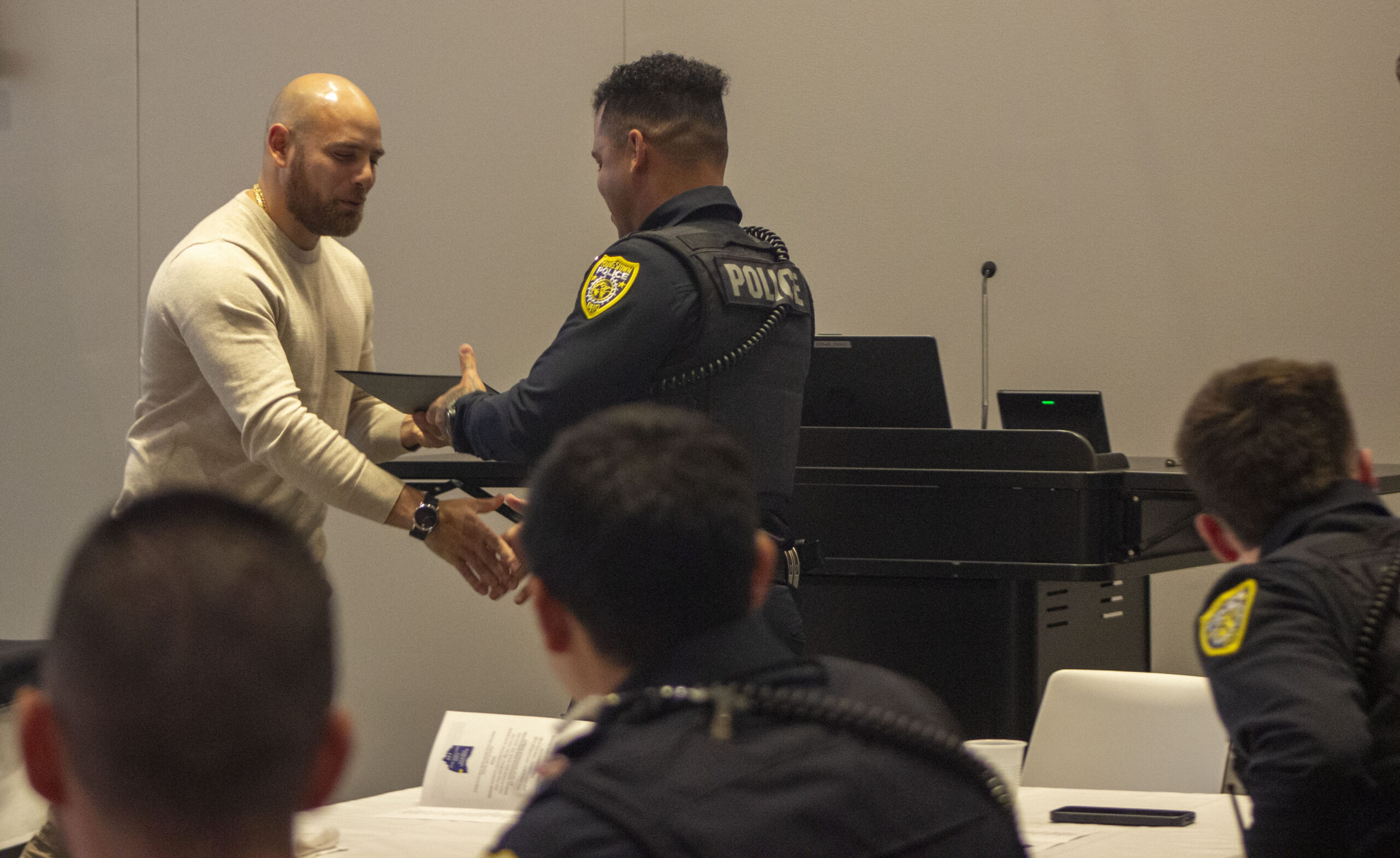
YOUNGSTOWN — Ryan Zagotti, a police officer with the Milton Township Police Department, said the training he received through Mahoning County’s Crisis Intervention Training program has changed the way he approaches calls involving people in distress.
“I deal with it a lot at work,” Zagotti said. “The training definitely helped on how to not only identify (a crisis) but kind of how to even build rapport with them, just making them feel better in any way I can help.”
Zagotti was among a group of local officers recognized at a graduation ceremony and luncheon on Oct. 24 at the Public Library of Youngstown for completing the Mahoning County Mental Health and Recovery Board’s Crisis Intervention Training, or CIT.
The 40-hour program, held in partnership with NAMI Mahoning Valley, aims to strengthen connections between law enforcement, mental health providers and individuals experiencing mental illness or crisis.
For Zagotti, the lessons from the program went beyond professional skills.
“It definitely helped me in a personal way,” he said. “I was already kind of empathetic with people, so it helped me kind of just further that and just understand what they’re going through is not what I’m going through and vice versa.”
But the training, Zagotti said, helped him see himself differently, too. He noted that one of the most valuable things he learned was how to better process trauma experienced on the job.
“Anything that we might carry with us over time,” he said.
Now, he said, he recognizes the importance of not leaving his feelings bottled up.
“It’s OK to talk with people. And I do that all the time.”
The program, now in its 25th year in Ohio, has ensured that every law enforcement department in Mahoning County has at least one officer trained in crisis intervention. This year marks the second group of officers to graduate in 2025.
Standard practice.
For those overseeing the program, that milestone represents years of steady growth and collaboration.
Detective Sgt. Jerry Fulmer, who works as the law enforcement coordinator for the program, said that what began as a small, specialized initiative has now become standard practice across many departments.
“It’s evolved in the sense that before, it was a small percentage of officers that would get this training with the goal being 25% of all officers in the department,” Fulmer said. “It’s more to the point where this training is considered so good, it’s now being taught, to a degree, in the police academies, and departments are trying to get to 100% participation.”
Michelle Werth, who serves as the clinical director at the recovery board and as a CIT coordinator and instructor, said that interest in the training has even expanded beyond traditional law enforcement.
“Now dispatch is asking for CIT training for their departments,” she said. “Sometimes fire has even asked us to come out and do a bridge program.”
Mahoning County now offers two CIT classes a year, each training about 40 officers.
“And that’s growth in itself as well. And we always have a wait list,” Werth said.
Fulmer agreed. “In fact, we’ve increased from once a year to twice a year because of the demand for this type of training,” he said.
Both coordinators said the program’s success comes down to collaboration and the shared understanding it creates.
“I believe that the collaboration becomes really important,” Fulmer said. “Because as law enforcement officers, we know what the mental health corps can do, and then mental health can now see how law enforcement can handle things. And instead of both working independently, we’re now on the same page.”
As for how they measure success, Fulmer said that feedback from the field is positive: Thanks to the training, calls are handled better by officers and families are being connected to treatment and services they might not have known about before.
Werth said she’s proud of how far the local program has come and the strong support it continues to receive.
“I’m just proud to be on the team,” she said. “We do good work. And in the community, I think there’s a strong commitment to make sure that this program continues.”
Positive outcomes.
Duane Piccirilli, executive director of the recovery board, said that at its heart, the program is about building understanding and cooperation.
“The whole goal is not to try to make (police) social workers,” he said, “but to try and make them understand that people react differently to situations, and to keep them safe and to keep them out of harm’s way.”
Numerous situations police encounter, he said, such as instances of domestic violence, can pose serious danger to both those involved and responding officers. Piccirilli said there’s a will on the part of those working in mental health to ensure police have every tool they’d ever need in such a scenario to help bring the temperature down.
“It’s just not easy being a police officer,” he said. “Mental health wants to partner with them.”
The 40-hour training combines classroom lessons with hands-on exercises and site visits. Officers tour a crisis stabilization unit, the county jail, juvenile justice facilities, group homes and the Rescue Mission. They also practice de-escalation techniques through role playing with the county’s crisis response team and learn to recognize conditions like Alzheimer’s and dementia.
“There’s also a technique they use where they put on headphones and hear voices,” Piccirilli said. “So it’s like seeing what it’s like for someone with schizophrenia, hearing voices in their head when they’re communicating with them, what they’re hearing.”
Beyond safety, Piccirilli said the program has led to more positive outcomes both for individuals in crisis and their families.
“We see more positive outcomes getting people to the hospital,” he said. “Also helping the families, better communication with the families.”
He credited local police departments for making the training possible despite staffing challenges.
“We’re especially pleased that the different townships and police departments give us their officers for a week, because I know they’re short-staffed,” Piccirilli said. “To take an officer off the beat for a whole week and put them in our class and go through training, it’s a strain on them because they’ve got to replace those officers with other officers … but we’re happy that the police departments see the importance of this.”