




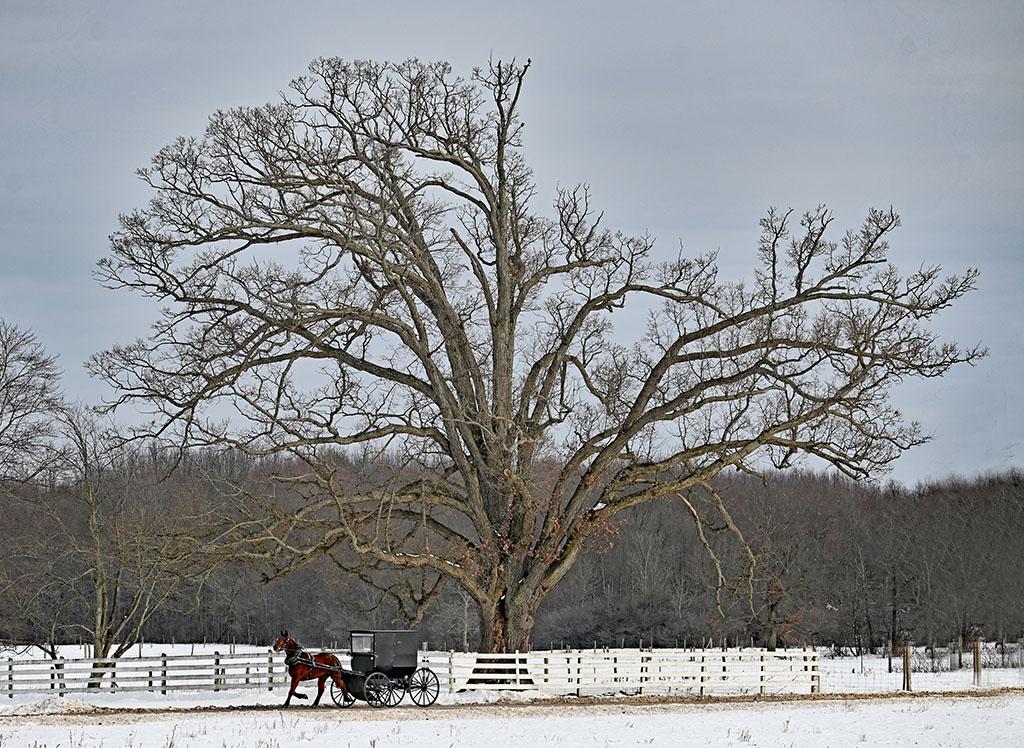
Strolling through the woods, you suddenly come upon a behemoth tree that stands out from all the rest. This spectacular specimen has huge, spreading branches which originate from low on the trunk, reaching outward in all directions. Its bark is wrinkled and cavities of all sizes can be seen. Its trunk is so thick that when you lean in to hug it, you realize that it would take at least several people to encompass its girth. Because it is surrounded by much younger trees, none of which are even close to matching its size and age, you wonder how this particular individual came to manifest itself in such a situation. Congratulations, you have just discovered a “wolf tree.”
During the early 19th century, European settlers began to arrive in North America. In an effort to clear the land for agricultural purposes and to obtain lumber for building, entire forests were felled, especially in the northeast. In fact, up to 80% of the land was cleared for tillage, pastures, orchards and development.
Occasionally, a tree was spared, left in place to mark a boundary between properties or to provide shade for livestock during the heat of the day. Oftentimes, the species chosen to remain was one that produced some sort of mast crop, which would provide free meals for their animals in the form of nuts or seeds.
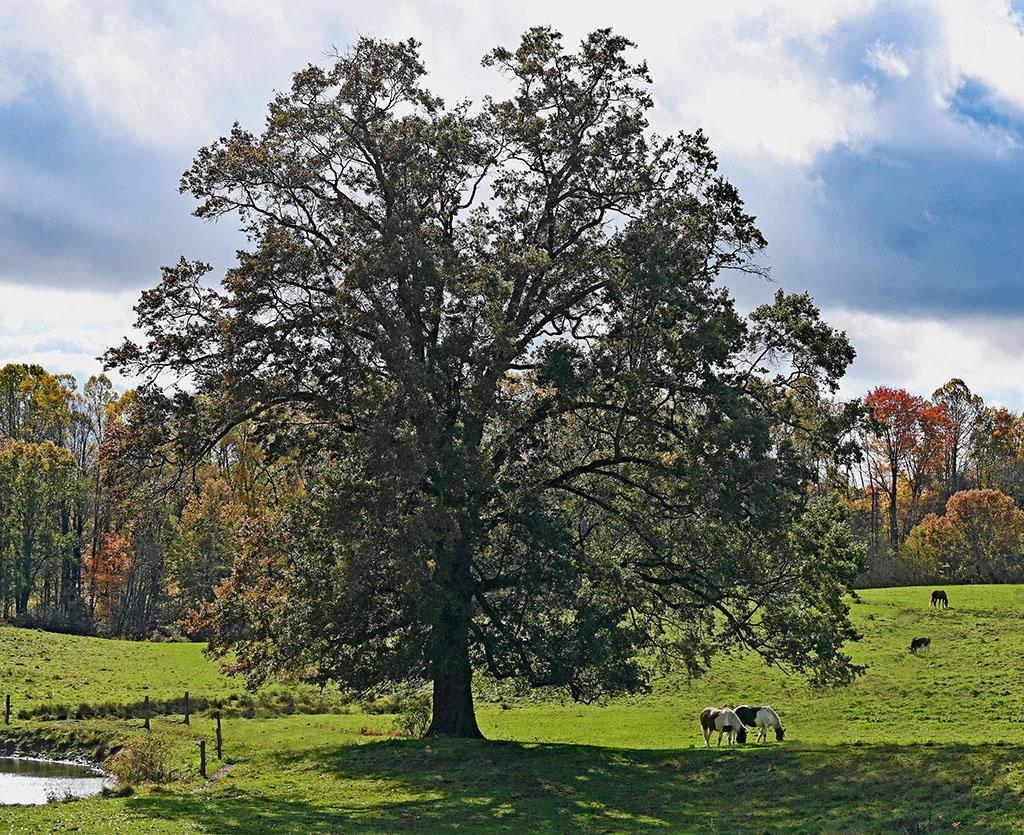
These hand-picked trees stood alone upon the landscape. No longer competing with other flora for light or water, the individuals flourished. Surrounded by sunlight, the low-lying branches of the trees had room to stretch outward, rather than upward, maximizing photosynthesis and displaying huge canopies. Such trees grew well past maturity. As imposing loners, the analogy was drawn between them and the occasional lone wolves seen or referenced, and they began to be referred to as “wolf trees.” These isolated trees were fine examples of individuals allowed to prosper in an open-grown environment, displaying the unique shape and growth patterns characteristic of their species.
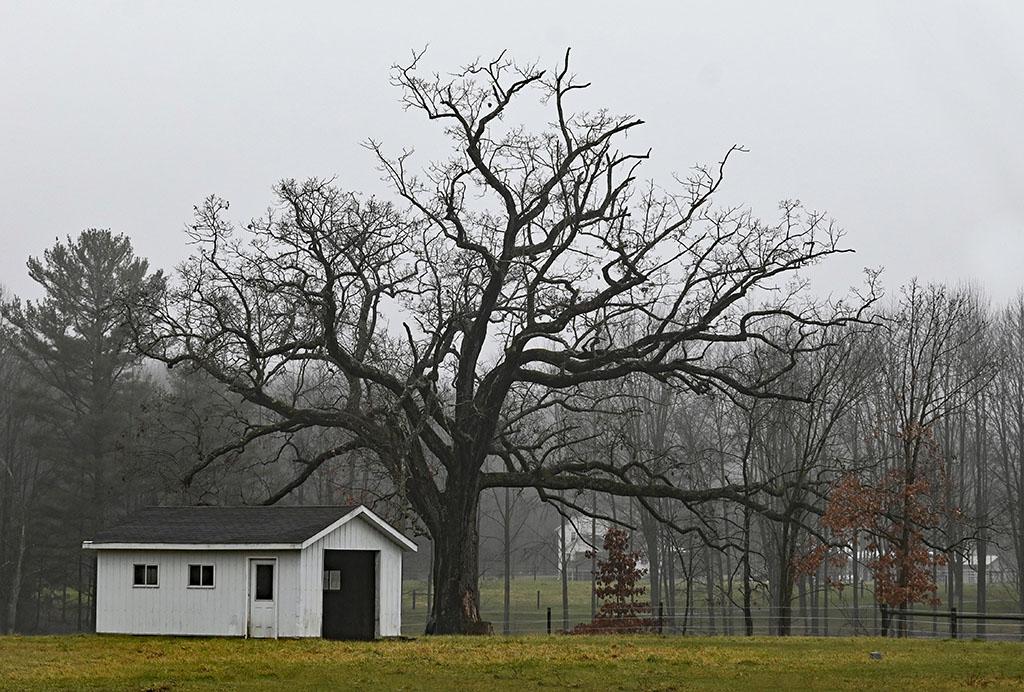
During the second half of the 19th century, interests began to change and many farms were abandoned. Pastures and fields began to regrow. Younger trees began to fill in around the wolf trees, growing straight and tall as they competed for light and surpassing them in height. Now, encircled and shaded by the new, younger forest, the giant trees, some nearly 200 years old, began their decline.
During their peak, wolf trees not only provided shade for the farmers’ livestock, but they were also home to many forms of wildlife. The copious, verdant leaves provided food for many insects, especially caterpillars. These, in turn, were eaten by songbirds, who relied upon the larvae to rear their nestlings. The spreading branches provided structure for many nests, not only for the smaller birds but for larger birds of prey that required strong branches to hold their aeries. Nuts and seeds produced by the trees provided a smorgasbord for many rodents such as squirrels and mice, as well as deer, wild turkey and many other species of wildlife.
Today, as wolf trees continue their decline, they have become more alive in death than they were in life. The rough peeling bark and numerous cavities provide shelter and a home for hundreds of species. Rodents such as flying squirrels, as well as bats and many species of birds such as owls, woodpeckers and bluebirds take advantage of nest holes. Insects bore into the rotting wood. Many forms of fungi begin to break down the tree and return it to the soil. Broken branches on the ground beneath provide shelter for a host of invertebrates, worms, snakes, salamanders and many other reptiles and amphibians. Such a tree can be likened to an apartment building, with a plethora of tenants living on every floor. While the majority of these trees lack commercial value, their ecological significance and importance to wildlife is overwhelming.
Discovering a wolf tree gives one cause to ponder. It is living proof of the property’s past agricultural use — a testament to the open land on which it was allowed to prosper. Each wolf tree represents a piece of history, a symbol of days gone by. Take a minute or two to contemplate the life of these giant trees, many of which still stoically stand in the open like an archive, offering insight into the history of the land upon which they thrive.





A few years ago , I attended a Geauga walkers outing and we hike on property belonging to an order of Nuns in Northern Geauga County, we came along an oak tree, the oldest and largest one I have ever seen. It took 5 of
the walker to measure the size of the trunk with out stretch arms . I hope it is still alive.
Thank you, Tami! So very true.
These “Wolf Trees” are national treasures.
We had a walnut tree near our barn, adjacent to Mohican-Memorial State Park–it was gigantic! We had to keep an eye on all our livestock not nibbling the leaves or walnuts–but NEVER thought about timbering it or harming it in any way. We’d always get the knock on the front door: “Hi, I’m from the XYZ Hardwood Co. and can offer you XXX dollars for that walnut tree there…”
no, No, NOPE! was our constant answer.