

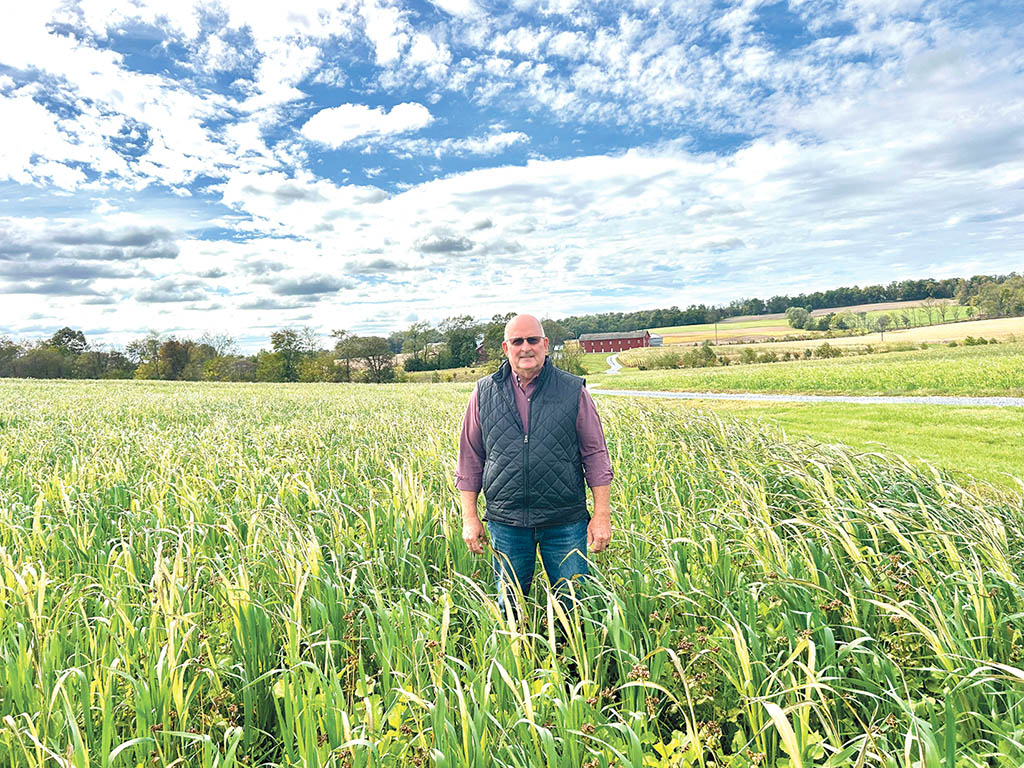
HARRISBURG, Pa. —Jim Hershey, of Elizabethtown, Pennsylvania, was named the Pennsylvania Leopold Conservation Award recipient.
The $10,000 award honors farmers and forestland owners who go above and beyond in their management of soil health, water quality and wildlife habitat on working land.
Hershey, a farmer from Lancaster County and the co-founder of the Pennsylvania No-Till Alliance, was revealed as the award recipient at the Pennsylvania Farm Show in Harrisburg on Jan. 12.
Given in honor of renowned conservationist Aldo Leopold, the award recognizes landowners who inspire others to consider conservation opportunities on their land. In his influential 1949 book, A Sand County Almanac, Leopold advocated for “a land ethic,” an ethical relationship between people and the land they own and manage.
Pennsylvania landowners were encouraged to apply, or be nominated, for the award. Applications were reviewed by an independent panel of agricultural and conservation leaders from Pennsylvania.
Sand County Foundation and national sponsor American Farmland Trust present the Leopold Conservation Awards to private landowners in 28 states. In Pennsylvania, the award is presented with The Heinz Endowments, Horizon Farm Credit and Pennsylvania Farm Bureau.
About Hershey
The farm crisis of the 1980s led to something positive for Jim and Shirl Hershey.
After purchasing her parents’ dairy farm in the late 1970s, they soon faced high debt and soaring interest rates. Unable to afford hired help, they tried to do it all. Something had to give.
That’s when their conservation journey began. Jim Hershey tried no-till farming practices to reduce fuel costs and time spent plowing, without giving much thought to the potential environmental benefits. He jokes that farmers didn’t widely discuss soil biology back then.
A decade later, when he began growing rye as a cover crop, he noticed that water no longer pooled in his fields. The combination of no-till with a cover crop was improving the soil’s ability to infiltrate moisture.
With a roller crimper mounted to his planter, he became an early adopter of planting corn and soybeans into fields of living cover crops. This practice is better known today as “planting green.” He also noticed that any soil compaction issues were alleviated and soil structure improved. Leaving crop residue on his fields has increased organic material and biodiversity in the soil while reducing erosion and weeds.
With each growing season, Hershey adopted more conservation practices to increase productivity and profitability while preventing soil erosion and water runoff and reducing the need to apply costly nutrients and herbicides.
Jim and Shirl farm with their son Marc and daughter-in-law, Crystal, who have operated an event venue, Harvest View Barn, since 2014. Together, they grow 500 acres of corn, soybeans, wheat and barley, and raise about 6,000 pigs and 1.7 million chickens annually. The manure is incorporated into soil to maximize the efficiency of the nutrients, control odor and prevent runoff.
Penn State University researchers have long had an open door to the Hershey farm to conduct research trials on the impact of planting green and cover crops on nitrogen efficiency, weed control, and soil temperature. Hershey has also partnered with 4R Alliance and Pasa Sustainable Agriculture to analyze soil health and water infiltration.
To share his experience with other farmers, Hershey co-founded the Pennsylvania No-Till Alliance in 2005. He has served as president of the farmer-led organization that promotes no-till practices for 15 years. He also leads the Pennsylvania Regenerative Ag Research Foundation and serves on the State Conservation Commission Board.
In 2019, Jim and Shirl traveled to Zambia to establish an agriculture sustainability program for farmers who grow maize and other vegetable crops. They continue to mentor a farm family they met there.
On their own farm, the Hersheys established 13-acres of buffer strip along a stream with 3,200 trees. An NRCS Forestry Management Plan on another 27 forested acres controls invasive species.
Hershey’s drive to keep his farm’s landscape green through as many days of the year as he can has led him to innovate. He designed and built a cover crop interseeder that has been sold to other farmers.
His expanded cover crop production now includes crimson clover, tillage radish, Hairy vetch, and winter peas. The multi-species mix is attracting more butterflies and bees to his farm, which serves as inspiration for a conservation leader who is still excited to learn.
Other Leopold Conservation Award finalists include Burk-Lea Farms of Chambersburg in Franklin County; Maple Valley Cattle Company of Meyersdale in Somerset County; and McElhaney Family Farm of Hookstown in Beaver County. The 2024 Pennsylvania Leopold Conservation Award was presented to forester Troy Firth of Spartansburg.
For more information, visit leopoldconservationaward.org.