KIDRON, Ohio — A family dairy that has spent years pushing its crops farther and harder is now looking for something else to carry them forward: endurance.
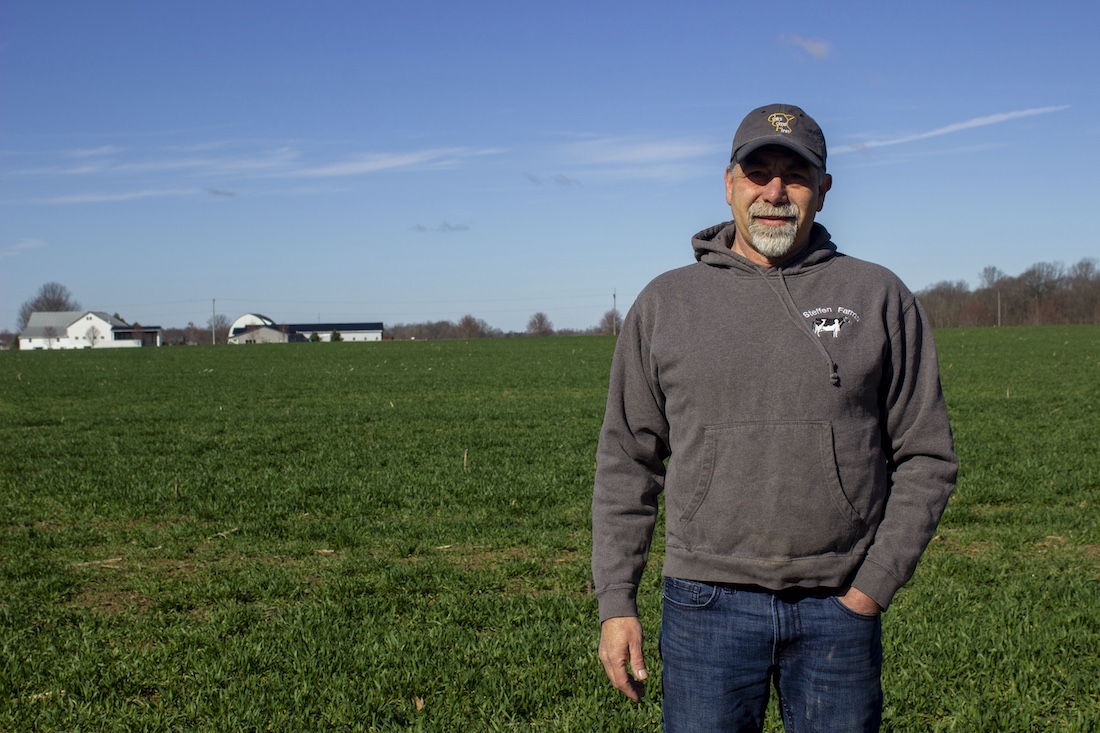
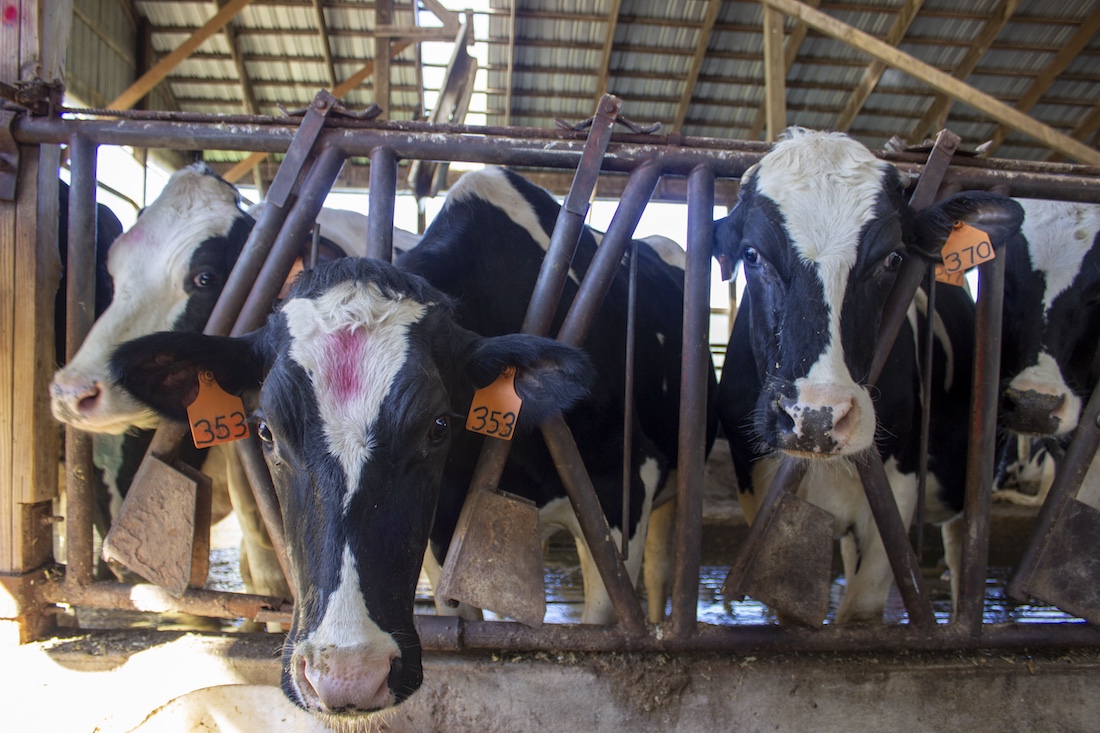
Greg Steffen and his family farm corn, soybeans, triticale and rye. On just under 100 acres around their historic home — his children are the sixth generation to grow up under that roof — he milks about 130 cows, nearly four times the herd his parents tended when he was a child.
Now he’s trying to answer a question that could shape the future of his dairy: How long can he push his land while keeping his soil healthy for the long haul?
After years of tinkering with forages and cover crops on his own, he joined a new, farmer-led research effort called From the Ground Up. Funded by a $10 million U.S. Department of Agriculture grant, the five-year project works with a network of farmer groups in Ohio and Missouri and a team of university researchers led by Ohio State University. Together, they’re looking for ways to reduce greenhouse gas emissions, enhance carbon storage, improve resilience to climate change and ensure the long-term viability of farms.
Bucking the convention of university scientists designing trials and asking farmers to host them, the project starts with farmer questions and builds the science around them.
“The point of this is to develop information that is actionable and trustworthy for the whole farming community,” said Douglas Jackson‑Smith, project director and a sociologist and economist at Ohio State University.
Together, those involved in From the Ground Up represent a cross‑section of agriculture, from large‑scale grain operations pushing the envelope on cover crops, to small urban vegetable farms, to conventional dairies like Steffen’s. The project lets farmers themselves define the conservation questions that matter most on their operations and tests how practices like cover crops and reduced tillage perform under real-world farm conditions — agronomically, economically and over time.
“Outcomes farmers value.”
That kind of ground‑truthing is exactly what From the Ground Up was built to do, according to Jackson‑Smith.
“The essence of the project is to try to really invest heavily in farmer-led research and innovation in the conservation space,” he said.
Jackson‑Smith has spent decades studying the adoption of climate-smart agricultural practices on farms that protect soil, water and other natural resources. Too often, he said, practices that look promising in small plots or tightly controlled experiments don’t translate cleanly to busy, complex operations. He pointed to a strong body of research showing that approaches such as cover crops, reduced tillage and diversified rotations are effective and widely endorsed. But one successful research trial does not a working farm make.
“The outcome of the project isn’t basic research. It’s not that we’re going to discover if cover crops can do X, Y and Z, for example,” Jackson‑Smith said. “This is about how you can make it work under realistic, working farm conditions, and can we focus in on those outcomes farmers value most?”
To see which approaches might have potential in the fields, Jackson-Smith and his team knew they needed a broad swath of farmers willing to experiment.
“We tried to find farmers who are not just the well-known innovators at the cutting edge,” Jackson‑Smith said, “but also to try to reach that middle ground, where farmers are curious and interested but not yet convinced or have frustrations.”
Alex Jefferies, the project manager, said the farmer-first model embraces the variability scientists often try to control for, like uneven soils and differing farm sizes, as an inherent part of conducting research on working farms. For her, success will ultimately be measured not in journal articles but in what sticks on the ground.
“We want these practices to be something at the end of the project that they would continue with if they’re working on their farm,” she said. “The farmers have to be just as invested or more invested in the project outcomes than we are.”
Should that happen, “if people pick up and adopt these practices through our project, that would be a really big measure of success, I think,” she said.
Better than before.
Steffen isn’t alone in asking questions about how to improve his farm. Just down the road, another farmer is grappling with the same tension between production today and the health of the ground underfoot.
Scott Stoller milks about 400 cows and raises crops, including corn and soybeans, along with mixed forages. Lately, he’s wrestling with a question that looks deceptively simple on paper. When he grows a lush stand of cover crops such as clover or peas, should he plow it down to feed the soil, or harvest it to feed the cows and return those nutrients later as manure? Does it make a difference? And if it does, what kind of difference?
“We cannot rob the soil; that’s where it all starts. But I don’t sell organic matter, either. We sell milk. So, how do we get the milk without depleting the soil? We want to leave it better than when we came. But how do you do that?” Stoller said.
Since the late 1990s, when he began transitioning the farm to organic, Stoller has been driven by a desire to answer fundamental questions about what his practices were really doing to the soil, the crops and the cows, and whether he could truly succeed by utilizing natural processes instead of depleting them. His search for answers led him to the farmer-driven project at From the Ground Up so he could learn what it takes to keep his soil healthy. With support from the project’s research team, Stoller has helped recruit other farmers and co‑design on‑farm trials that compare different ways of managing cover crops and rotations under actual field conditions. On most participating farms, the research plays out at field or split‑field scales and is replicated across rotations, with farmers and scientists tracking not only crop yield and forage tonnage, but also changes in soil health and the economics of each choice.
Stoller believes their organic practices have improved the farm’s soils, but he’s not satisfied with gut feelings alone.
“Compared to the neighbors, I’m not a bit embarrassed. We’re not depleting our soil, but is it as good as it was 200 years ago?” he wondered.
Stoller has already seen one clear result above ground: corn yields dropped where he mowed his cover crop. That hints that leaving more biomass to feed the soil might pay back in grain, but it still doesn’t answer the deeper question of what’s happening to the soil, or how the lost yield compares to the value of the extra forage.
For now, Stoller must wait for patience to bear fruit. As part of the project, baseline soils were taken last year, but follow-up tests in years three and five will show whether the soil is actually better off.
His place has changed a lot over the years. The 1840s-era barn where his great-grandparents once milked cows twice a day has given way to a modern parlor built in 2014. But the old barn still stands, today playing host to community sings and graduation parties while kids disappear into its hay maze, feeling their way through tunnels before they finally spill back out into the light.
In some ways, that journey mirrors the one the farm has taken. But one thing hasn’t changed: Stoller’s insistence on questioning everything, especially what it really takes to keep both the soil and the business that depends on it alive and healthy.
He said the vision he’s committed to is about more than his own fields.
“The organic system was built on, ‘everybody along the way has to win.’ And it’s even right down to the truck driver, to the grocery store; everybody has to win, including the farmer and the consumer,” he says. “The goal is for everybody to win along the way — no losers.”
Cows
“Farmers always have questions.”
Before he joined the research project, Steffen’s growing herd pushed him to rethink his forages and look more seriously at winter annuals. After years of struggling with inconsistent alfalfa, he turned to triticale, a cool‑season wheat‑and‑rye hybrid winter annual. Because triticale can be harvested early enough to fit into a rotation with short‑season corn, the shift quickly paid off. The crop not only proved more reliable, but it also allowed him to expand into soybeans. With triticale covering his haylage needs over winter and freeing up ground in his rotation, Steffen was able to plant 52 acres of soybeans last year.
Triticale has also delivered the consistency he was looking for: where alfalfa can thin out in wet spots and leave patches of uneven feed, triticale tends to perform more uniformly from field to field. Early soil tests on his longest‑running triticale cornfield have come back encouraging, and he’s seen less erosion since moving to heavier cover and strip‑till, with live roots in the ground for most of the year.
Those are positive signs, but for Steffen, they’re evidence in progress, not final answers. Even as the data improves, he’s uneasy about what long, continuous rotations of corn and triticale on the same ground might mean for his soil over time.
“I don’t want to get 10 years down the road and find out I depleted my soil, and now I’m in big trouble,” he said.
That question of what intensive production means for soil over the long haul is what ultimately led him to work with researchers in the first place. Today, Steffen is leading a From the Ground Up project that tests how two different approaches — terminating traditional cover crops or harvesting annual winter forage before planting corn — affect both soil and corn yield. For him, partnering with the university is a way to turn field observations into evidence other farmers can put to use.
“Farmers always have questions on, can we do this better, or can we be more profitable? We all have those questions. And so how do we find out the answers?” he said. “I think it is so helpful to be able to partner with [the university] and do the project together. It’s research that us farmers wanted to figure out the answer for.”