





Before the years of television’s multiverse and time-wasting computer games, kids were pretty good at entertaining themselves. Summertime was the best. Friends were gathering for pick-up basketball and baseball games, jumping into ponds and community pools, fishing for sunfish, catching crayfish and salamanders and riding woodland trails on big-tired bikes before there was such a sport. There were scrapes and bruises, and a few unlucky ones got a new cast for us all to sign, but even that became a legendary memory that few would trade.
Evening adventures. When night enveloped the countryside, you might think that those kids’ options became limited — and that may be true by today’s standards. A mere generation or two ago, a hot summer night was just another chapter in the day’s adventure.
Of course, there was a difference between kids growing up around big-city brick and concrete compared to those who had trees and fields for neighbors. Parents of the former worried a lot more, and I suppose that they were right to do so.
Most of us rural-raised and small-town kids were given a little more rope as long as we kept everyone informed of our general whereabouts. Without cell phones, that meant that it was our responsibility to use a telephone at a friend’s house or carry enough change for the pay phone at the gas station. Failure to follow that simple rule caused that rope to be shortened considerably.
Fireflies, backyard tents and wiener roasts were weekly. A campfire often brought nearby neighbors over with their lawn chairs. I didn’t know adults could talk and laugh that much. Somehow, the fire’s warmth seemed to melt their years away and their stories would always begin with “Do you remember?” and “I remember.”
When only embers were left glowing, the impromptu partiers would say their goodnights. As they walked away, sometimes holding hands, they looked happily reflective, and if you watched carefully, you could see those lost years slowly return to their step. It was magical.
Catfishing
Probably one of the best invites my brother and I could get on those summer nights was from Dad: “You want to go catfishing?” That meant Orange Crush, bologna sandwiches and chips all co-mingled with a carton of nightcrawlers in a red and white Coleman Cooler. Sometimes Dad would toss in some slimy-looking chicken livers, doughball or cheap shrimp.
It required packing two rods for each of us, a tacklebox, a lantern and sometimes a minnow bucket and minnow trap. Finally, a blanket and mosquito repellent were packed along with binoculars for looking into the night sky. By this time, the dog had usually hopped in, refusing to miss the adventure. That required finding the leash.
Night fishing also involved a destination. All this preparation wasn’t just to go down to the local pond; we were headed to a real hotspot. For us, two favorites were Guilford Lake State Park and Berlin Lake Wildlife Area. For you, it could be any one of hundreds of places around the state. Our primary quarry was channel catfish, although Berlin yielded the occasional walleye. The doughball sometimes tempted a carp, and those finned muscle machines were just pure fun to catch.
Channel cat
Channels were our favorites of the catfish and, besides bullheads, were the only ones we ever caught, although Ohio now has blue and flathead catfish available. Channels occur naturally in most of Ohio, including Lake Erie and Sandusky Bay. Averaging 15 to 25 inches and weighing as much as 10 pounds, bigger brutes can be found in larger reservoirs and rivers, some reaching the 26-inches required for a Fish Ohio Award.
Ohio’s record was caught in 1992 by Gus Gronowski, of Parma, from LaDue Reservoir in Geauga County. It weighed 37.65 pounds and was 41.5 inches long, but everyone knows a new record has to be swimming around somewhere. The Division of Wildlife regularly stocks more than 300,000 channel catfish in more than 100 different reservoirs every year … it’s just got to be out there waiting!
Blue cat
If you hope to catch a real whiskered monster, then consider visiting the Ohio River, Clendening Lake (Harrison County), Seneca Lake (Noble County), Caesar Creek (Warren and Clinton counties) or Hoover Reservoir (Delaware and Franklin counties). This is where you’ll find Ohio’s largest catfish: the blue. Regularly reaching 30 to 40 inches, the state record was caught in 2009 out of the Ohio River by Chris Rolph (Williamsburg), tipping the scale at 96 pounds and measuring 54.5 inches. Blues must be 35 inches for a Fish Ohio Award. More than 150,000 were stocked in 2021.
Flathead
The flathead catfish offers a real tug-of-war, too. Weighing up to 80 pounds, most will be between 5 and 40 pounds and up to 50 inches long. They’re found in larger rivers and reservoirs, with the Muskingum watershed being very popular. Both the blue and the flathead will require heavy equipment and that you be on your “A-Game.”
Flatheads need to be 35 inches for Fish Ohio. A 76.5-pound, 58.62-inch Clendening bruiser caught in 1979 holds the state’s rod and reel record. Dale Yoho, of St. Clairsville, landed that one.
The kittens of the bunch are the smaller bullheads: the black, brown and yellow. They’re found statewide and in a variety of waterways. Averaging 10 to 12 inches, they’re the little guys, but they’re aggressive and a lot of fun to catch. They need to be 14 inches long for Fish Ohio and their collective state record is a 4.25-pound, 18.5-inch fish taken from a farm pond in 1986 by Hugh Lawrence Jr. from Keene.
Different technique
While I’ve been referring to rod and reel fishing, cats are also susceptible to trotlines, banklines and float-lines. That’s a whole different technique, and their entry into the record books is separated from those caught on a rod.
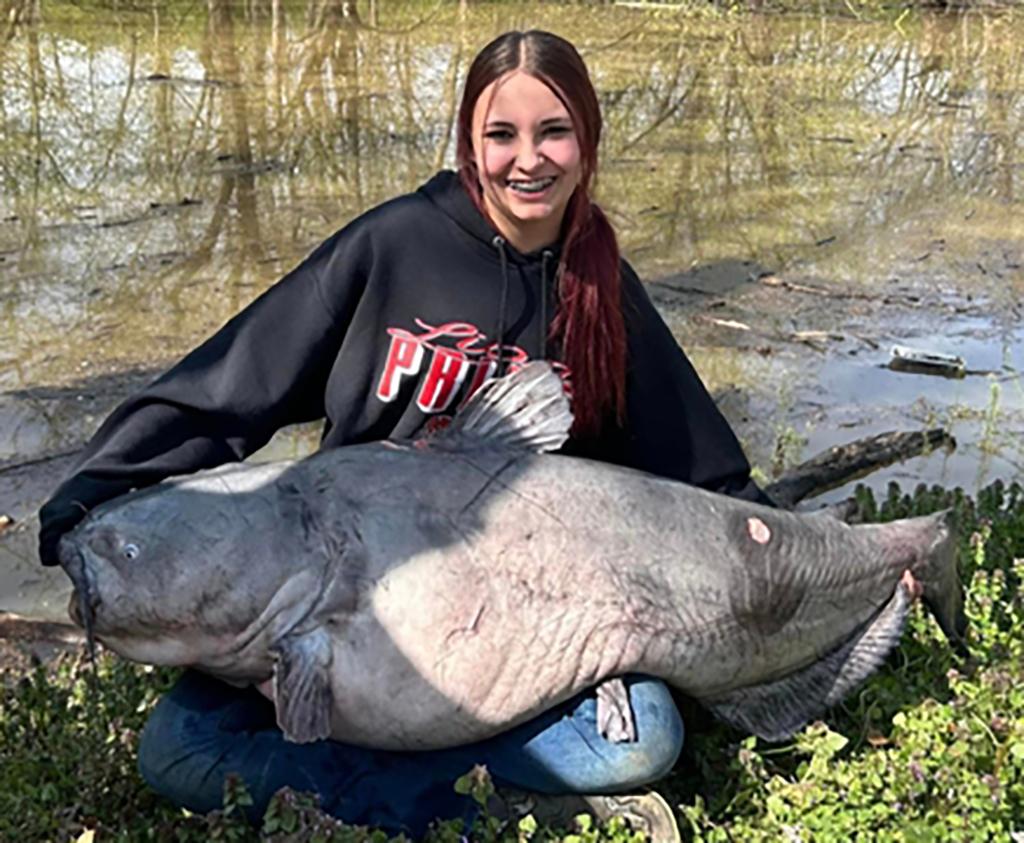
One of those cats, which was returned to the water after weighing and a photo session, might serve as a heads-up to those targeting blues with lighter tackle. In April 2024, Jaylynn Parker, of New Richmond, caught one giant blue catfish. Fishing Twelve Mile Creek, a tributary of the Ohio River, she landed the 101.11-pound, 56-1/2-inch behemoth using a float-line (sometimes called a jugline).
Catfish spend most of the day in deeper water and tend to be bait-shy, but summertime night fishing finds them vulnerable. The fish will become more active after sundown, moving into shallower water.
Try shallow flats next to deep holes, along beaches and near submerged structure. All are omnivorous with blues and flatheads feeding on smaller fish, so baits like gizzard shad, suckers or chubs work well. For channels and bullheads, try shrimp, chicken livers and nightcrawlers. All catfish have a strong sense of smell and are susceptible to scented baits — and some really stinky recipes can be found online.
If you enjoy rivers over lakes, these offer some of the best opportunities: Maumee, Huron, Auglaize, Muskingum, Great Miami and the Ohio Rivers and the tailwaters of Clendening, Tappan and Atwood Lakes. Regardless of which catfish you’re after, the hotspot you’ve chosen, or if you’re taking a load of kids, going with friends or angling alone, one sure catch will be the memories. I know — I have a stinger full.
“Three-fourths of the Earth’s surface is water, and one-fourth is land. It is quite clear that the good Lord intended us to spend triple the amount of time fishing as taking care of the lawn.”
— Chuck Clark




