

I just returned from a fishing trip on Michigan’s fabled Au Sable River (also spelled AuSable), and I’m already thinking about another visit. Known for its lore and incredible trout fishery, it winds 138 miles through the state’s Lower Peninsula while draining over 1,900 acres in the process. It meanders through the towns of Grayling and Mio, finally emptying into Lake Huron at Oscoda.
The river is designated a Blue Ribbon trout stream by Michigan’s Department of Natural Resources, is registered as a National Wild and Scenic River and has gained the deserved notoriety of being one of the finest brown trout fisheries east of the Rocky Mountains. Anglers can wade much of its accessible length, and outfitters offer guided float and fishing trips that are well worth the learning experience.
While browsing around a local fly-fishing shop, I ran across several books by well-known fly-angling author John Gierach. Known for his knowledge, insights and tongue-in-cheek approach to the subject, I often enjoy reading about his experiences.
Of the Gierach books I noticed, there was one I’d not seen before: “Good Flies.” While flipping through it, I wasn’t surprised to see some familiar feathered and fur-dressed hooks. I must have been nodding like I agreed with what I was reading when the proprietor walked over.
“I think anyone can learn a lot from that one,” he said in the hopes of hooking another customer.
I glanced over and gave another of my best knowing nods. I couldn’t help but wonder if he said it in recognition of my learned approach, my gray hair or to give me some glimpse of hope. “How long were you out fishing?” he asked.
Since I’d just walked in and wasn’t wearing any telltale gear, my look must have appeared a little questioning.
“Uh…your dry pants and wet shirt. I call it the Au Sable handstand,” he explained. Yep, just as I suspected; he was offering that glimpse of hope.
As most sporting shop owners tend to be, he was quite helpful. He offered advice on everything from leaders and tippets to the best wading areas. I bought a few flies that had been doing well — at least according to him — plus a different book from the shelf. We shook hands and I left, promising to stop back on my next trip.
Left behind
The reason I didn’t buy that “Best Flies” book wasn’t because I didn’t think I could use some pointers; I just found it to be a bit too much of a reminder of how my day had progressed. Just that morning, I’d left a “best” Prince nymph stuck on a submerged log. I hated losing it because I had no spares. I attempted to retrieve the fly, which resulted in the mentioned Au Sable handstand. Note to self: Where there’s a submerged log, there are also submerged branches.
I also left a “best” elk wing caddis wrapped neatly out of reach in an aspen, a “best” Adams across the river in some low, over-hanging brush and a “best” bead-head March brown nymph swimming away as a brown trout’s lip jewelry.
I think every fly fisher —actually, every angler — has left more than a few “best” lures behind. This really isn’t a failure since it’s the result of searching for fish in areas where they’re most likely lurking. How many times have I chosen to break off a favorite fly rather than disturb a potentially productive pool or hide? The number would probably restock Cabela’s. Then again, sometimes a small loss results in great gains; if not in fish, in fishing knowledge.
On a mission
Eventually, I’ll pick up that “Best Flies” book – just not that day. There was another reason I’d driven to the Au Sable River, and was visiting the famous “Old AuSable Fly Shop.” I had a friend who loved the neighboring upper reaches of the Manistee River. I’ve never fished that upstream portion of the stream, and my trip was to learn more about it.
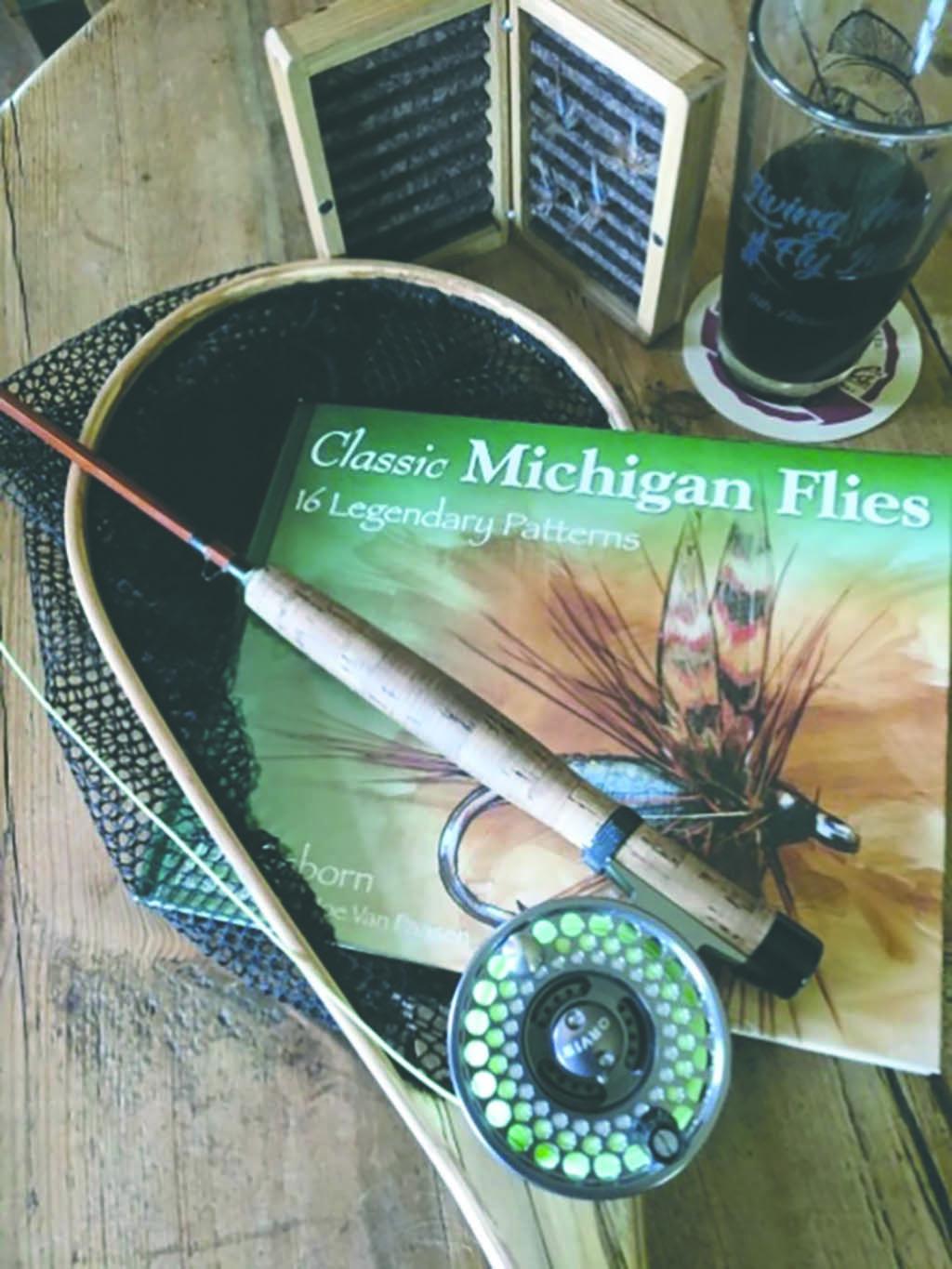
The book I’d bought was “Classic Trout Water of the Manistee River,” put together by the Challenge Chapter of Trout Unlimited. It offers a fisherman’s guide to the area and plenty of detailed maps. Not being quite as trendy as the historic stretch known as the Holy Waters of the Au Sable, some anglers believe the Manistee can offer a comparatively, but more solitary, opportunity.
My friend often asked me to fish with him on the Manistee, to spend some time learning what he had been experiencing for many years — maybe to understand why he loved that river. He passed suddenly, leaving that possibility permanently behind us. Why hadn’t we cast those waters together? Those reasons that once seemed important now ring hollow.
The shop owner had marked a particular area in which I was interested — the area my friend enjoyed fly fishing and where his family had quietly released his ashes to drift among the riffles, dancing mayflies and trout. I didn’t visit the site that day, but I will. When I do, I’ll be carrying a classic bamboo rod — his favorite tool — and some of my best flies; ready to fish water more holy than anything the Au Sable can offer me.
As I finally take the time to wade that stream, there’s little doubt that my backcast will end up leaving one of my best Adams wrapped high in an aspen, a submerged log will capture another best nymph or a brown or a rainbow will break a weakened knot and swim off with my best caddis – and when those things inevitably happen, I know I’ll be leaving them in the best of company.
“If you wait, all that happens is that you get older.”
— Mario Andretti