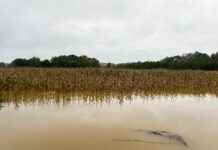


Exceptionally wet weather throughout Ohio over the last few weeks has made it hard to store forages. Very few folks in my area got silage corn off before this most recent round of rain, and I expect that upcoming harvests will likely take place on wetter-than-optimal soils. This article covers considerations for fall field operations, focusing on establishing small-grain forage.
Fields that had muddy silage harvest this year may have visible ruts on the soil surface. While the continuous rain has been frustrating, the upside on some of my research fields is that ruts that would normally crust over and cause longer-term issues have leveled out more than I expected. I generally don’t worry too much about seed spacing as long as ruts are shallower than 2 inches when I go to plant next, but older drills are more sensitive to ruts deeper than 1 inch at the time of planting. Depth of ruts, weather between harvest and planting, and equipment sensitivity all play a role in determining whether you’ll need to do repair work before planting small grains this fall.
Generally, we recommend waiting until the upper 2-4 inches of the soil is dry enough to work before repairing ruts. If the ground is too wet for a closing wheel to effectively close a seed furrow, it’s too wet for tillage. Multiple shallow passes are better for rut repairs than a single deeper tillage pass or a full turning of soil, since a few shallow passes can better move material laterally along the soil surface to become more level. Also, deeper passes risk incorporating moist soil from lower layers of the soil profile into the worked soil, and pockets of moisture on the soil surface can increase compaction risk during a subsequent pass.
Rutting is the more visible issue in wet years, but deeper compaction is a perennial challenge for forage producers. Field entrances and paths of travel usually have the worst compaction, especially in a silage corn-small grain baleage rotation. Sometimes it’s easier to spot compaction before silage corn harvest wraps up by looking for shorter plants, horizontal root development, and harder soils. Inserting a survey flag into the soil can help identify areas with increased resistance, which may benefit from some deeper tillage to address compaction. Generally, aim to till at least one inch deeper than the compacted layers, focusing on areas with frequent machinery traffic.
Avoiding deep tillage across the whole field can help save time during a hectic season and reduce how much diesel is needed. If you have drier weather this fall, deeper tillage before small grain planting can help you save time in the spring. But if your soils don’t dry enough for deep tillage this fall, I wouldn’t worry about reduced yields too much — most years, deeper compaction has less of an effect on winter crops than summer crops, especially if you plant a lodging-resistant variety this fall.
The biggest concern I hear from folks who don’t typically till before establishing small grains is whether the improved seedbed after tillage overcomes the downsides of planting a bit later. This doesn’t have a super clear-cut answer, especially when the time between rainfall events is short. But the optimal planting window for small grain forages is really just getting started for the year in Ohio, and earlier planting for winter annuals does not necessarily correspond to higher yields as it does for spring-planted crops.
Avoid planting before the Hessian Fly Free date for your area, which is usually sometime in the last week of September for northern Ohio and up to Oct. 5 for southern Ohio. Planting in the first two weeks after that date is ideal for more sensitive small grains like wheat and barley, and you can continue to plant triticale for an additional two weeks after that. I like to see rye in by Nov. 1 for central Ohio, but planting a bit before that is helpful in years when snow comes early or fields further north. Consider boosting the seeding rate by 15-20% for your later-planted small grains.
We really do still have time to get things planted this year, and many areas of Ohio and the surrounding areas will still have time to address some of the soil management concerns from this year’s rain, too.