




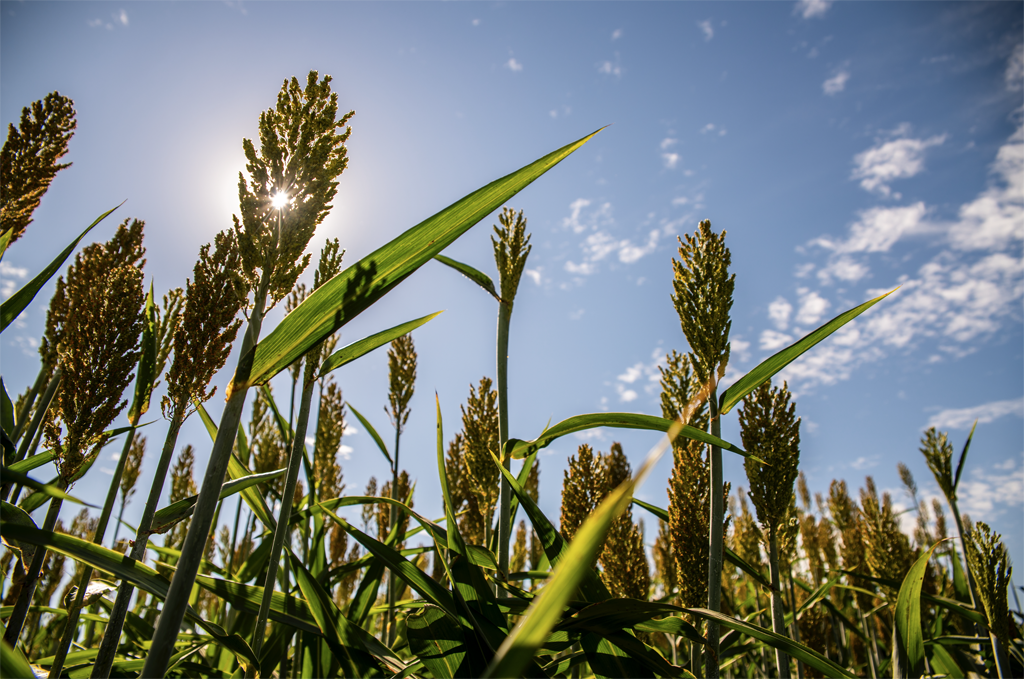
First cutting of hay is wrapping up, and we’re still months away from silage corn harvest. Are you looking for a forage that might be ready to feed before then, or that has a lower per-acre production cost with delayed planting? There are many other warm-season annual grasses, besides corn, that grow well in our area and can quickly produce lots of forage biomass.
Warm-season annual grasses can be planted as soon as the soil temperature is above 60-65 degrees Fahrenheit, and plantings can continue well into July. Warm-season annual grasses are very water-efficient and can continue growing in much droughtier conditions than cool-season grasses, but they do require sufficient soil moisture to emerge. Once we approach August and the soil really starts to dry out, new seedings of warm-season annuals tend to be patchy and thin.
There are many species of warm-season annual grasses. Sorghum-sudangrass is probably the most popular of the bunch, and I personally was impressed with it last year. Our June planting in South Charleston, Ohio, had good soil moisture and warm weather, so all varieties we tested were out of the ground in less than two days. Later planting dates were a bit drier, so emergence took longer, but all combinations of varieties and planting dates were ready for their first cut in 30-45 days.
Just like the name sounds, sorghum-sudangrass is a hybrid between sorghum and sudangrass. Sorghum is a great option for silage, and it excels in dry weather, but, be careful to choose a variety that has an appropriate season length for your location. Sudangrass is much smaller than sorghum and its stems are a bit thinner than those of sorghum-sudangrass, which makes it more suitable for drying down for hay if desired.
There are many other options for warm-season annual grasses, too. Teff is probably the one I get the most questions about from farmers, and I’ve gotten a couple of calls about millet as a dual-purpose grain and forage crop, too. Neither is as high in biomass as sorghum-sudangrass, but their thinner stems are palatable, and their shorter stature can be helpful for dry hay production. Browntop millet is also less sensitive to low pH than some other forage options.
When purchasing seed for warm-season annual grasses, be sure to understand whether the variety you’ve selected will have good regrowth for a second or third cutting. Most sorghum-sudangrasses have good regrowth, and some we tested last year actually performed better during the second cutting. But, only some varieties of millet will do well in a multi-cut system; pearl millets usually have better regrowth than foxtail millets. Talk to your trusted seed vendor and use results from variety trials, such as those run by Penn State’s forage agronomy extension team or your local extension program, to get a sense of which varieties might work well for you.
Another benefit of checking out local variety trials is seeing what nitrogen rate they’re using for trial management.
Optimal nitrogen rates vary based on expected biomass, so the right rate for a lower-biomass millet is probably 20-50% lower than you’d use for sorghum-sudangrass. If you overshoot the ideal nitrogen rate and growing conditions are good, you probably just spent a bit more money than you needed to. The real risk is when you over-apply nitrogen and then the weather turns dry, since that combination can increase the risk of nitrate accumulation in the forage.
Splitting your nitrogen across 2+ applications is a great option, since smaller applications allow you to adjust rates based on mid-season weather conditions. Plus, the second application helps a lot with regrowth in a multi-cut system.
Warm-season annual grasses are known for their water efficiency, heat tolerance, fast growth, and a wide planting window. Each species is a little bit unique, and many can be a great fit for summers in our area.