
H.W. “Chip” Gross began his professional career as an Ohio Wildlife Officer, but his skills as a writer, photographer and communicator could not be ignored, and the Division of Wildlife quickly capitalized on those skills.
I’d gotten to know Chip early in my career, and to say I had respect for his abilities would be a terrible understatement. I envied his ability to put together a good story.
While I was chronicling the history of the division, I asked if I could include a story of his choosing. Without hesitation, he sent me the following account. It concerns an undercover wildlife agent and the work he did to try to nab a few of Ohio’s most serious violators. This is that story.
Undercover agent. “You ain’t no damn game warden, are ya?” the poacher snarled.
I looked him straight in the eye and lied. “Game warden…? I ain’t no game warden!”
The poacher paused, mulling over my answer and added quietly, “Then why you askin’ so many questions?”
Thus begins the true story of R.T. Stewart’s career as an undercover wildlife law enforcement officer with the Ohio Department of Natural Resources Division of Wildlife. For nearly two decades — late in the 20th century and early in the 21st — Stewart used his specialized skills to infiltrate poaching rings throughout Ohio, the Midwest and beyond.
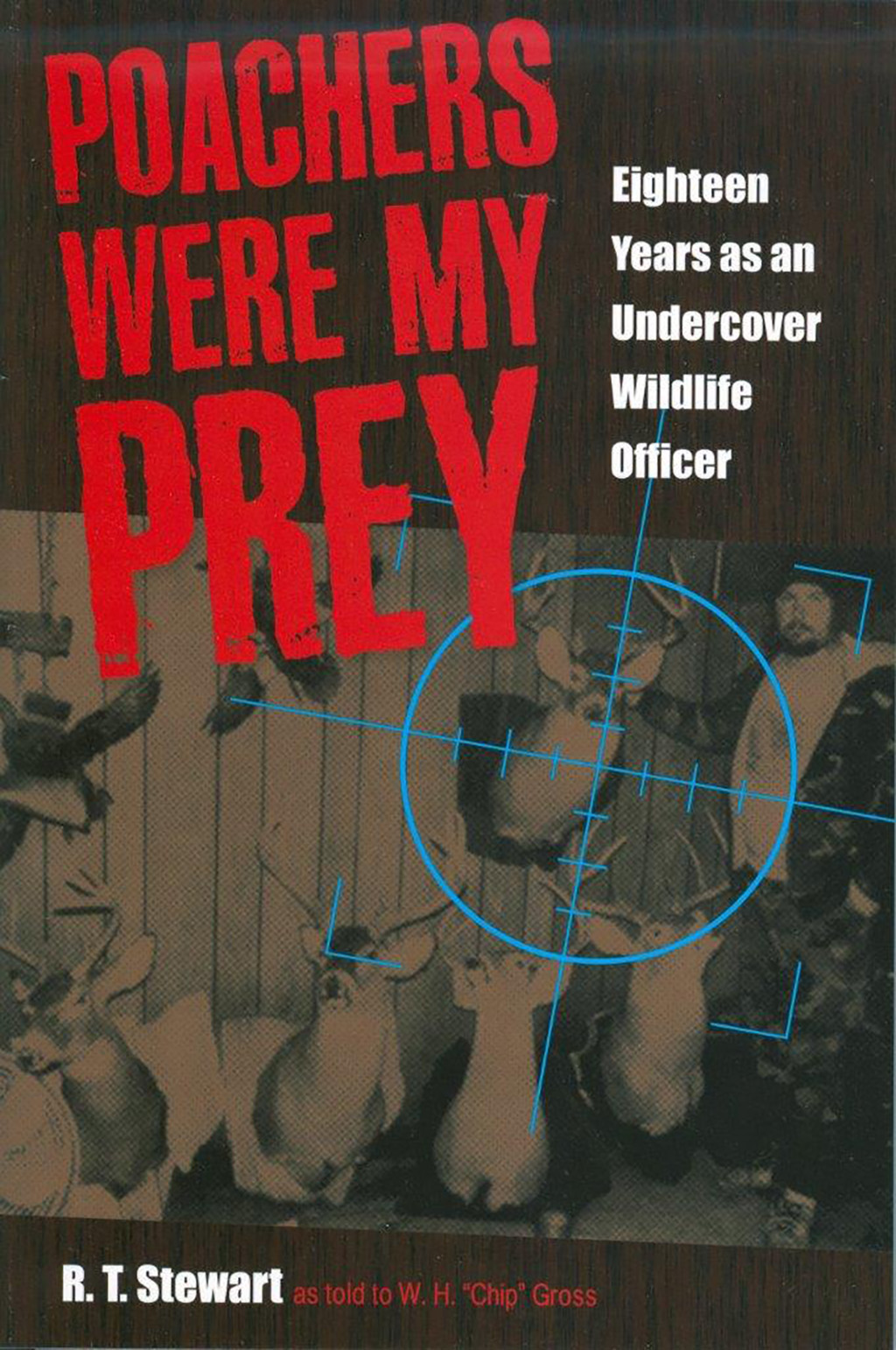
In his book, “Poachers Were My Prey: Eighteen Years as an Undercover Wildlife Officer,” Stewart chronicles his many exciting undercover adventures, detailing the techniques he used in putting poachers behind bars. It also reveals the secrets employed by undercover wildlife officers in catching the bad guys.
Poaching, the illegal taking of wildlife, goes on every day across the United States and other countries throughout the world. Multi-millions of dollars change hands annually from the illegal sale or trade of antlers, hides, horns, meat, feathers, fur, teeth, claws, gall bladders and other wild animal parts. As a result, wildlife populations suffer — including some endangered and threatened species — and legitimate, law-abiding sport hunters get a black eye.
R.T. Stewart dedicated his professional career to stopping such slaughter, actually living with poachers for months or even years on end.
“In essence, being an undercover officer involves living a lie,” said Stewart. “You’re always pretending to be someone you’re not.”
Undercover law enforcement work is dangerous and, as a result, extremely stressful. In addition, there are also psychological dangers. Stewart recalls during one particular case, nearly getting too far “under” and coming close to forgetting his real identity. Many undercover officers have crossed the line and become the very person they initially swore to stop.
In Stewart’s book, you get an up-close and personal chance to look over his shoulder as he deals with the many temptations offered an undercover officer — money, sex, drugs, etc. — yet gets the job done and brings the poachers to justice.
Humorous sides. But “Poachers Were My Prey” is not all seriousness; it also has its lighter moments. In his open, honest, straight-from-the-shoulder storytelling style, Stewart recounts some of the more humorous sides of undercover wildlife law enforcement work. Such as the time, early in his career, when he was so nervous around a group of poachers that he inadvertently put a lit cigar in his mouth backwards, burning his lip.
The first time R.T. Stewart thought he was going to be shot and killed by poachers occurred during his very first undercover operation. He was staying with a group of poachers in a sleazy motel in southern Ohio when the incident happened.
“Driving into the motel parking lot, I pulled up and parked in front of the door to the poachers’ room,” Stewart remembers. “I had one of the poachers with me — we were sitting in my truck eating sandwiches and talking — when I saw the door to the poachers’ room slowly begin to swing open. I continued watching the door and all of a sudden, I saw the muzzle of a 12-gauge shotgun pointed directly at me, not 20 feet away!
“The first thought racing through my mind was that the bad guys had set me up and were going to kill me. I dropped the sandwich I was eating into my lap and started to reach for the handgun concealed under my coat. About that time, however, the guy pointing the shotgun at me broke up laughing — it had all been a joke!
“It may have been a joke to the poachers, but it scared the hell out of me. I jumped out of the truck and started cussing the poachers, who were all laughing their heads off. I tried to hide my real feelings by acting tough, but in reality, I was just glad to be alive.”
Operation Clanbake. One of R.T. Stewart’s most lengthy and complex undercover investigations involving white-tailed deer was known as Operation Clanbake, so named because one of the two groups of poachers targeted in the case called themselves “The Clan.”
It began in the spring of 1992 and involved the illegal killing of hundreds of whitetails in southeast Ohio, as well as the illegal snagging and sale of walleyes from the Maumee River, a major Lake Erie tributary.
Over a period of several months, Stewart slowly infiltrated the two groups of poachers and eventually introduced the leaders of each group to one another.
“The two poachers took such a liking to one another during that very first meeting that we all went out after dark that night and shot three deer together illegally,” said Stewart. “We drove the rural roads shining the woods and fields with a flashlight, then shot the deer in the head or neck from the vehicle with a .22 magnum caliber rifle, equipped with a telescopic sight.
“Something that really bothered me during that very first night of poaching with those guys was that all three of the deer we killed were does carrying unborn twin fawns. White-tailed deer in good habitat normally give birth to twins each spring, sometimes even triplets or quadruplets. It bothered me to know that not only the deer we’d killed were females, but that they had unborn young in their wombs.”
Stewart continued, “These poachers, it seemed, simply didn’t care. To them, each deer was just another slab of meat with a dollar sign on its head. That was my first up-close encounter with men who appeared to have no conscience about killing wildlife illegally. It shocked me, and I vowed to myself that I would do whatever it took to eventually see these guys behind bars.”
One of those first three deer did not die immediately when shot, so one of the poachers jumped out of the truck and beat it in the head with a tire iron to kill it. “I could hear the doe bawling in the road ditch as he continued beating her until dead,” said Stewart, “it sickened me. That’s when I first realized that these guys were hardcore poachers, and I wanted to see them arrested and go to jail in the worst way. And I was willing to place my life on the line to make it happen.”
Many months later, following many such poaching incidents, teams of uniformed Ohio Division of Wildlife officers were assigned, assembled and briefed. The takedown in the case happened the next morning at dawn, Feb. 10, 1993. All the suspects were arrested simultaneously without incident and transported to either Chillicothe or Gallipolis, Ohio, for incarceration.
Clan members and others, a total of 20 people, were charged with 256 wildlife law violations. Found guilty, they were assessed fines in excess of $24,000, ordered to pay restitution to the state of Ohio for the loss of wild animals in excess of $14,000, and received revocation of hunting privileges in Ohio for a combined total of 88 years.
In addition, the Clan forfeited one vehicle and four guns to the state, were sentenced to 86 days in jail (with 30 years’ probation), and were ordered to do community service work involving 19 different programs.
“I will never forget the emotions I experienced that night,” said Stewart. “When I finally got home and realized that everything was over, that Operation Clanbake was completed and a success, I cried like a baby. No doubt that emotional letdown was a relief from the mental stress I had been under for nearly a year and a half.”
Truth be told, R.T. Stewart is not the author of his own book. R.T. and Chip had an agreement for years that when his undercover wildlife law enforcement career was finally over, Chip would write his story. Both thank Kent State University Press and their editors for publishing “Poachers Were My Prey” in 2012.
The book is available in print or audio from Amazon.com. Other books written by Chip include: “Pro Tactics Steelhead and Salmon;” “Young Beginners Guide to Shooting and Archery;” “Trolling Big-Water Walleyes;” “Ohio Wildlife Viewing Guide;” “Home, at last, is the Hunter” and “How to Become a Freelance Outdoor and Nature Writer.”
Learn more about Chip Gross and his writing at www.chipgross.com.
“And if you ever consider stepping across the line when it comes to wildlife laws,” concludes Stewart, “just remember, we’re out there. Catch ya later…”
“There’s a simple way to solve the crime problem, obey the law; punish those who do not.”
— Anonymous