





Be careful when choosing your friends! I have found that the most interesting friends can liven up your life with unique experiences. One such friend did just that! Linda Gilbert started working as a naturalist at Geauga Park District 15 years after I did. The close association of our jobs made us realize that we had much in common, especially our like-minded mode of thinking, and we became fast friends. Linda and I always leaned toward the more scientific aspects of the job and completed many successful research projects together.
So, I suppose I shouldn’t have been surprised when one day she came to me to say that she had to attend an out-of-town conference for a few days, and would I be able to take care of her “pets” while she was gone?
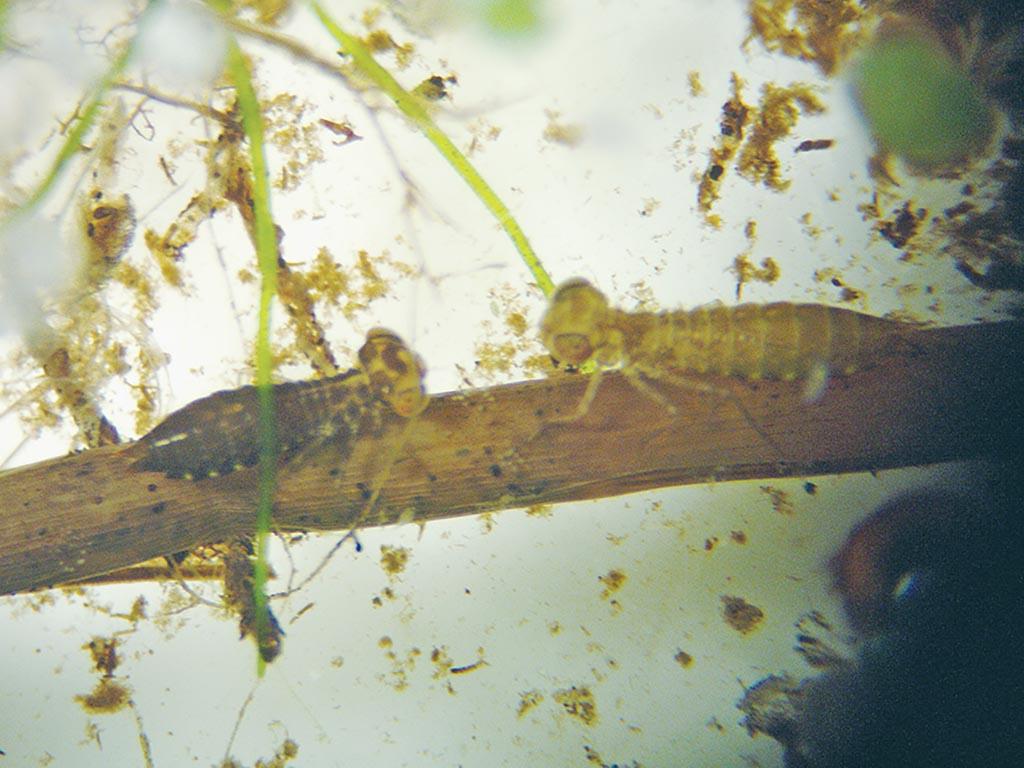
Those pets were two teeny, tiny dragonfly nymphs about 3 mm in length, which were residing in a small aquarium on her desk, completely decked out to mimic a pond habitat. You see, Linda is a dragonfly expert. She has an uncanny ability not only to identify nearly every dragonfly she spots on the wing, but she can also nearly always identify them during their aquatic nymph stage as well.
It should be no surprise that she is also a co-author of Dragonflies and Damselflies of Northeast Ohio. This field guide, which was funded and published by the Cleveland Museum of Natural History, is chock full of interesting information and can be relied upon efficiently to help identify any dragonfly you may come upon within the designated range.
Personal bug zapper
It is nearly impossible to visit any lake, pond, marsh, bog, swamp, stream or other habitat with water during the warmer months and not see dragonflies darting around. Like miniature helicopters, they zoom about, making agile turns, flying forward and backward, up and down or hovering in one spot. These aerial stunts enable the dragonfly to catch their prey on the wing, namely any small insect that may be sharing their space. One of their favorite food items is mosquitoes, giving them the name “mosquito hawk.”
If you spend time near a pond, fishing or just relaxing nearby, soon you will notice dragonflies hunting those irritable insects that have begun to gather around you…your own personal bug zappers! Look closely and you can often see a tiny insect clasped in the dragonfly’s jaws as it munches on the wing. It is no surprise that they rank among the fastest insects on earth, having been known to reach speeds of up to 35 mph. A glance through the field guide will reveal names reflecting their athletic abilities, such as dashers, skimmers, pondhawks, meadowhawks, cruisers, gliders and more.
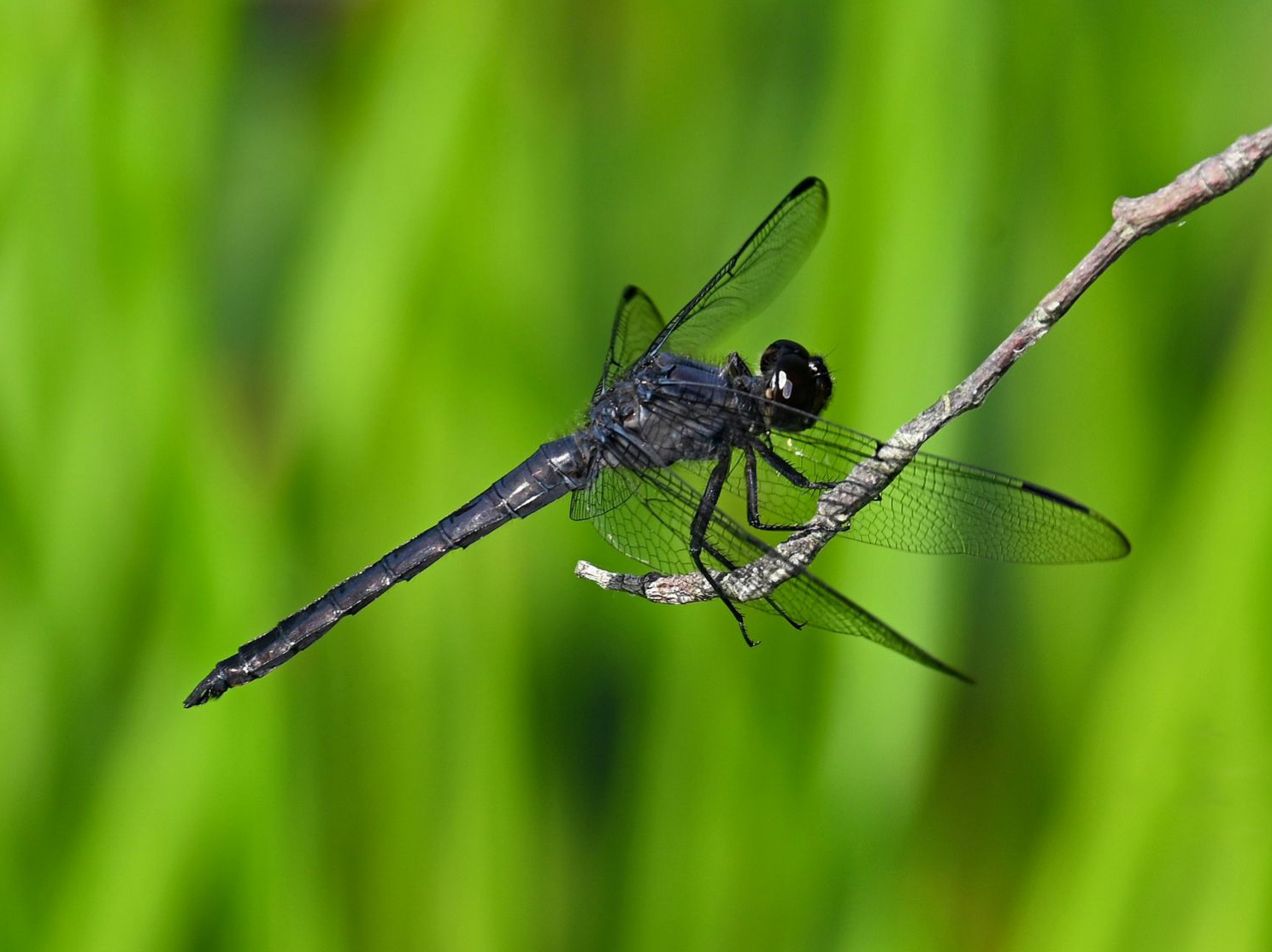
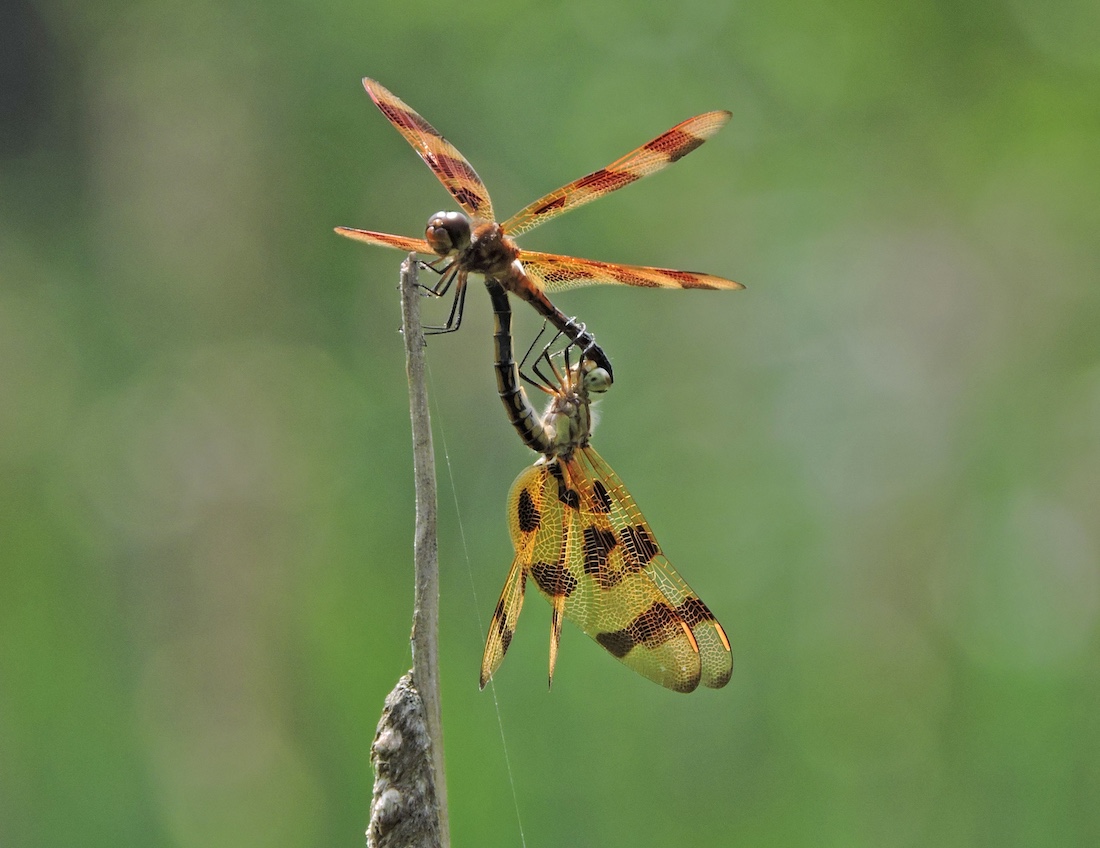
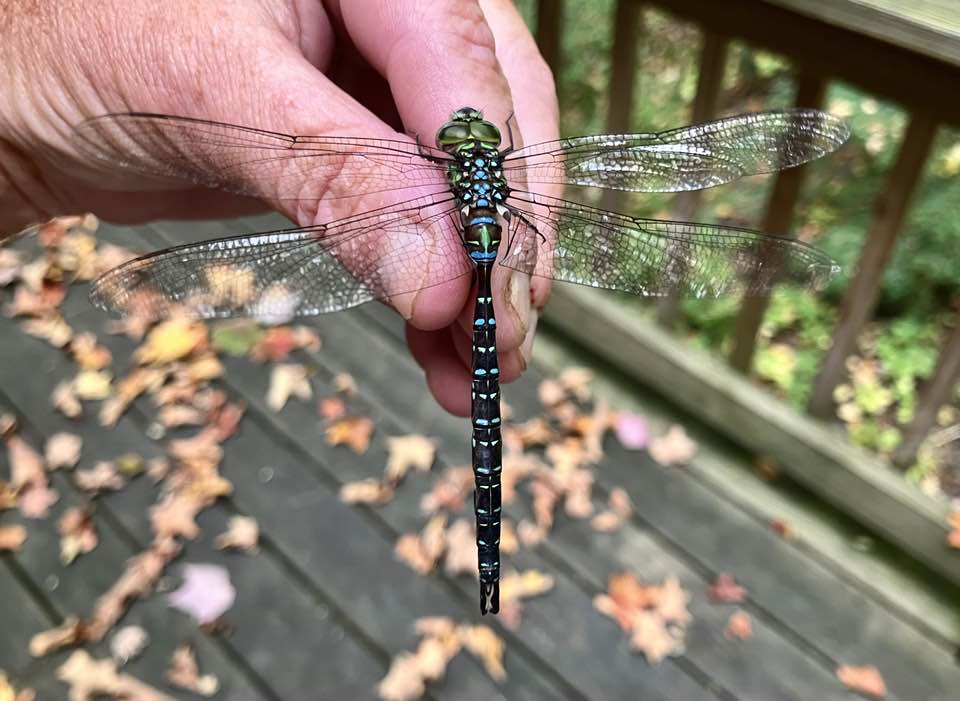
Dragonflies belong to the order Odonata. Often referred to as odonates, they also share this title with their “cousins,” the damselflies. Adult dragonflies are recognized by their four transparent wings held flat out, horizontal to their bodies. These two sets of membranous wings, some sporting various colors or patterns, are transparent and delicately laced with venation. The wings are attached to the thorax of their hefty bodies, and a long abdomen trails behind. Huge compound eyes, comprising most of their head, give them nearly 360-degree vision.
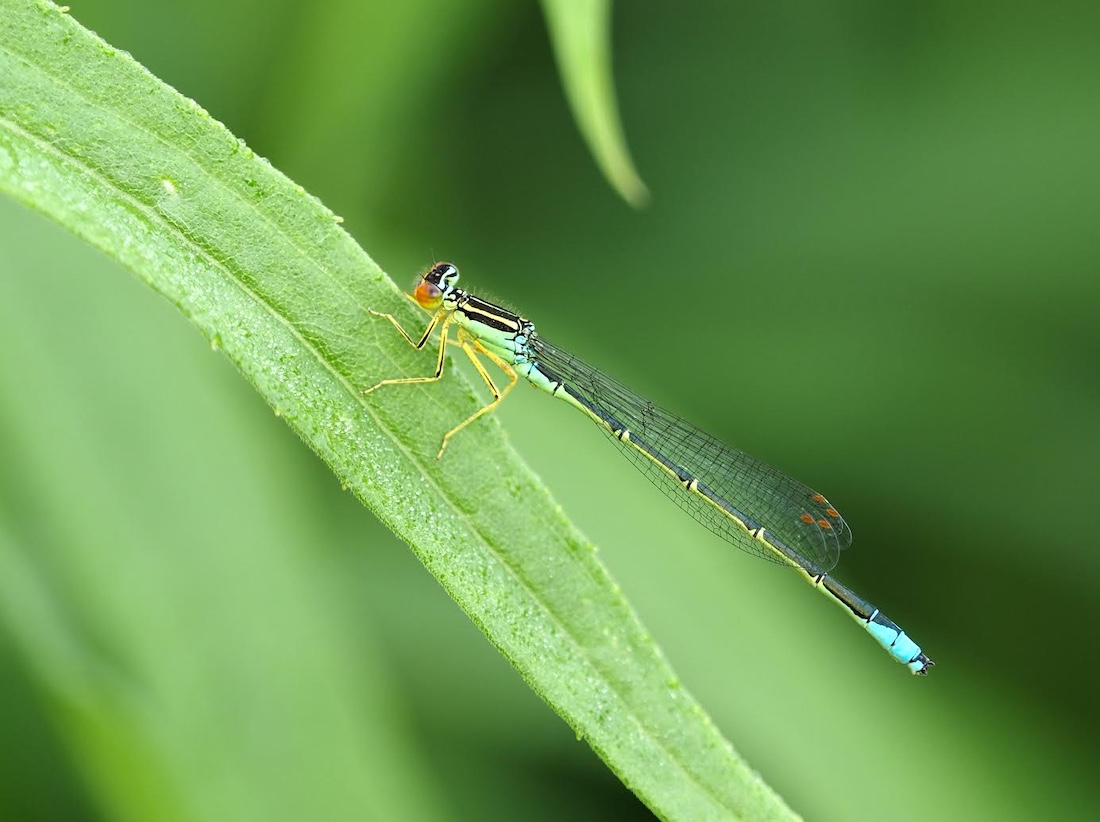
In comparison, damselflies are smaller and daintier, with wings held in a closed position above their bodies, although their life cycle is similar.
Water lovers
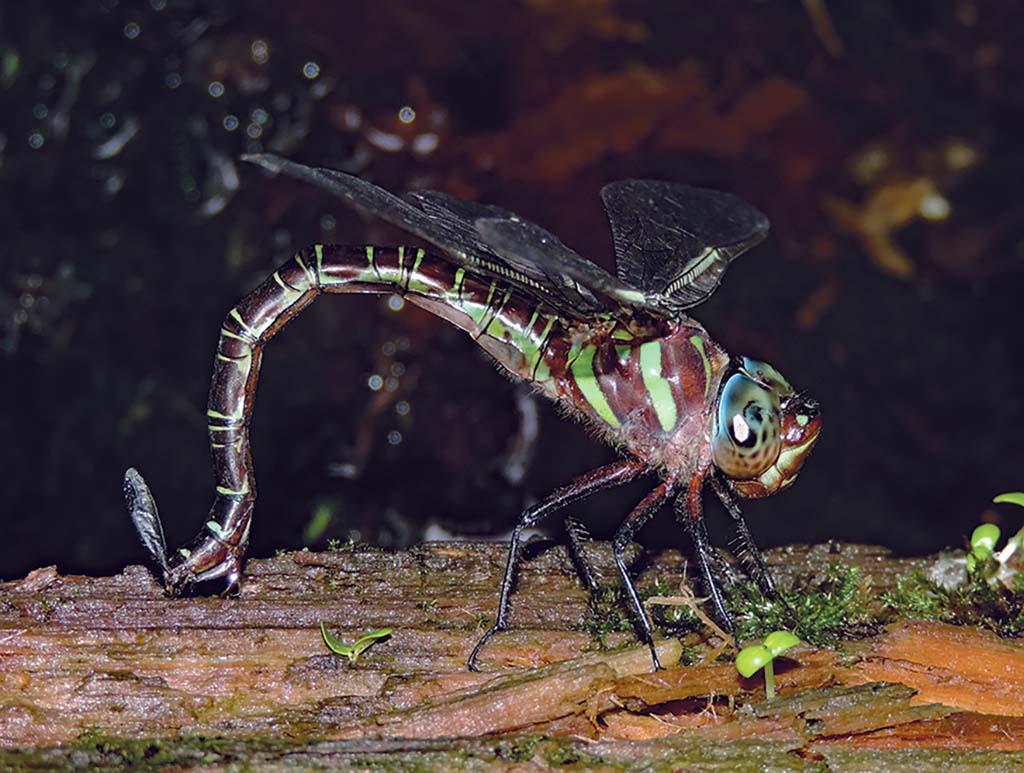
All dragonflies spend the first part of their life as aquatic nymphs, the main reason for their association with water. After mating, usually on the wing, females can be observed depositing their eggs. Some can be seen dipping the tips of their abdomens into the water multiple times in the same spot; others sit on rotten logs, placing their eggs inside the spongy wood; still others drill into the stems of emergent vegetation. When the eggs hatch, the tiny offspring, known as nymphs, enter their aquatic habitat.
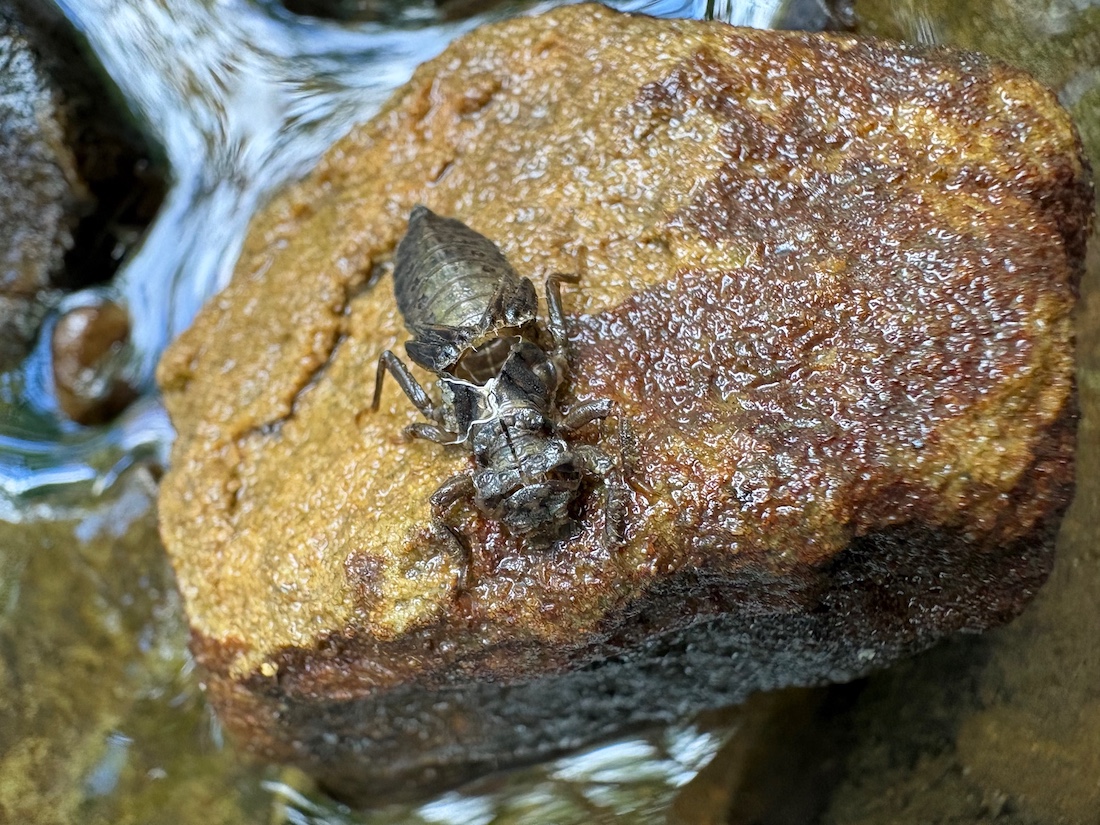
Nymphs bear little to no resemblance to their adult stage, but that is not to say that they are any less unique. Lacking wings for movement, the nymphs rely on jet propulsion to get around, sucking water in through the tip of their abdomens and shooting it back out with enough force to propel themselves forward great distances. Even in this immature stage, they feed voraciously on other insects and pond denizens. Like something out of a horror movie, the nymph’s lower jaw, tucked neatly beneath its head, slowly lowers and shoots out with lightning speed, nabbing its prey between powerful pinchers.
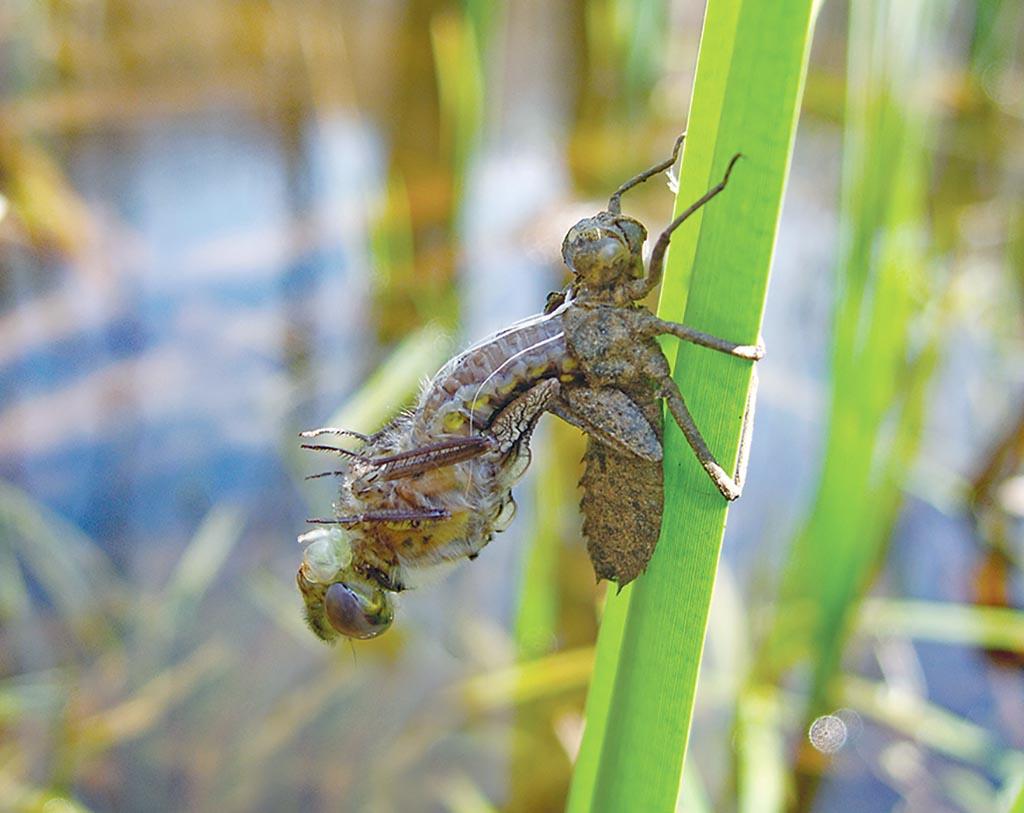
As they grow, so do their appetites and their ability to consume larger prey, such as tadpoles and tiny fish fry. They shed their skin multiple times as they increase in size, a process they may complete over 15 times. Finally, after months or even years beneath the surface, the dragonfly nymph crawls from the water, anchoring itself to a sturdy stick or stem. Slowly, its skin splits and out it crawls, leaving a dry exoskeleton behind. Slowly, like a butterfly, its wings expand and eventually dry. Hours later, it takes to the air.
Dragonflies are a riot to observe. Pick a spot by the water’s edge, have a seat and watch the show. Often, a dragonfly will have a favorite perch that it returns to over and over again, offering the opportunity for a good photograph.
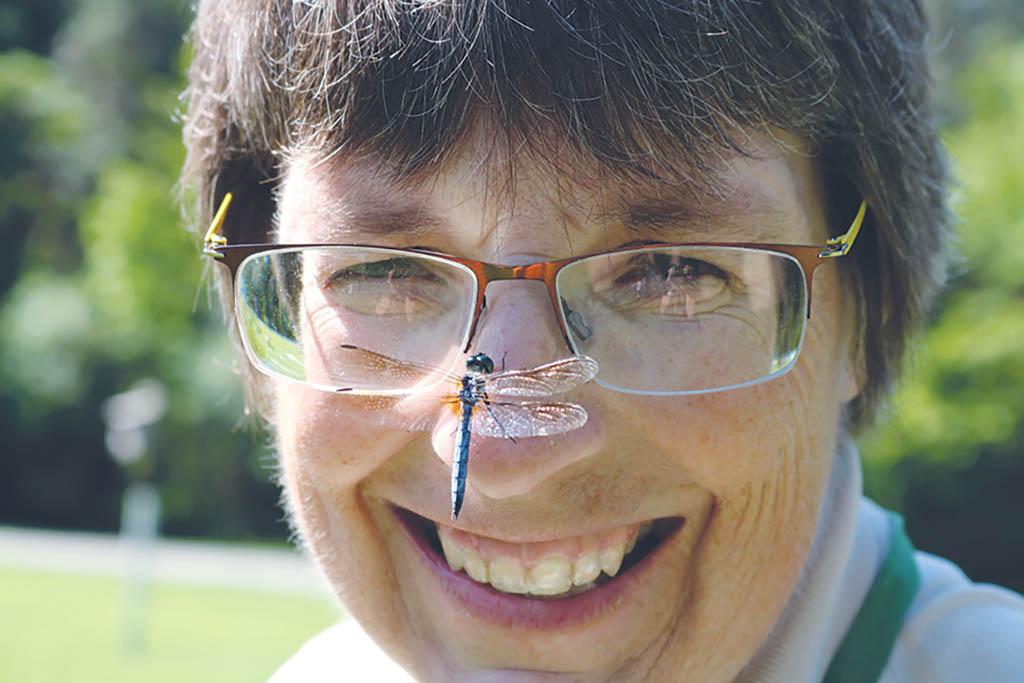
Despite their intimidating name, dragonflies are harmless. They do not bite or sting, although if captured, they may harmlessly attempt to chew on a finger if offered. A few species are migratory and can be observed in impressive swarms during late summer; radar has picked up throngs of them flying south across Lake Erie!
Bug babysitter
You can imagine how nervous I was to assume babysitting duty for Linda’s nymphs. Her story about this experiment began while she was walking through a wetland and noticed scarring on the stems of some reeds. Cutting one of the stems open, her suspicion that they contained dragonfly eggs was confirmed. Not knowing which species the eggs belonged to, she took one of the stems home with her, in the hope that the eggs would hatch and she could rear the resulting nymphs to adulthood.
Taking over care duty for a few days was nerve-wracking. Feeding such tiny, new larvae required only an eyedropper or two of pond water each day containing tiny microorganisms, small crustaceans and aquatic worm species chopped into minuscule pieces. I called and texted Linda several times each day to confirm that I was doing things correctly. Needless to say, I had never been happier to see her return from a trip. I am also happy to report that nearly one year later, her large, healthy nymphs finally emerged from the water and revealed themselves as black-tipped darners. This whole experience was so amazing that there is an entire chapter written about it in the field guide.
I must admit, I’m no dragonfly aficionado. In fact, I am weak on my identification of them. No doubt this is the result of having a friend who is an expert. When I find or photograph a dragonfly, I don’t even consult my field guide. I just text the expert and have an answer within seconds. As I said, it certainly pays off to have unique friends!








Thanks, Tami for this great story.
Yep–the dragonflies are amazing critters. They’re at our pond bright and early “cleaning up” pesky bugs and when we mow our fields–they are 5 feet ahead of the tractor’s hood–spying to the sides seeing what’s ‘kicked up’ for them to gobble up!
Also a huge fan of dragonflies. So thanks for this interesting article. And yes they are excellent at mosquito control, we have a pond and we thought they would be a problem.
Great article! I notice Slaty Skimmer (Libellula incesta) does not have a specimen for Richland County, either in the Ohio Division of Wildlife field guide “Dragonflies and Damselflies of Ohio” by Dave McShaffrey and Bob Glotzhober, nor are there any records in iNaturalist.
But there are numerous Slaty Skimmers on the wing here at Gorman Nature Center, Mansfield, Richland County. I have photos.