


2025 Pennsylvania farm fatality report draws attention to agricultural hazards
By Alexandra McLaughlin
Penn State Ag Sciences News
UNIVERSITY PARK, Pa. — In 2025, 19 people died of injuries suffered in farm-related incidents in Pennsylvania, according to researchers in Penn State’s College of Agricultural Sciences.
The Penn State Agricultural Safety and Health Program, housed in the Department of Agricultural and Biological Engineering and affiliated with Penn State Extension, releases the “Pennsylvania Farm Fatal Injury Summary” each year. Researchers and extension educators use these data to identify hazards in agricultural production and guide the development of training and resources. The full report can be found here: extension.psu.edu/2025-pennsylvania-farm-fatal-injury-summary.
The 19 farm-related deaths recorded last year represent the same number of known fatalities as in 2024.
Experts noted that agricultural fatalities can vary widely from year to year, and reported fatalities likely capture only a portion of the problem. It is possible that not all the agricultural-related fatalities were identified. Experts also emphasized that nonfatal injuries are even more difficult to track, even if these injuries can significantly impact the victim and their loved ones.
The victims
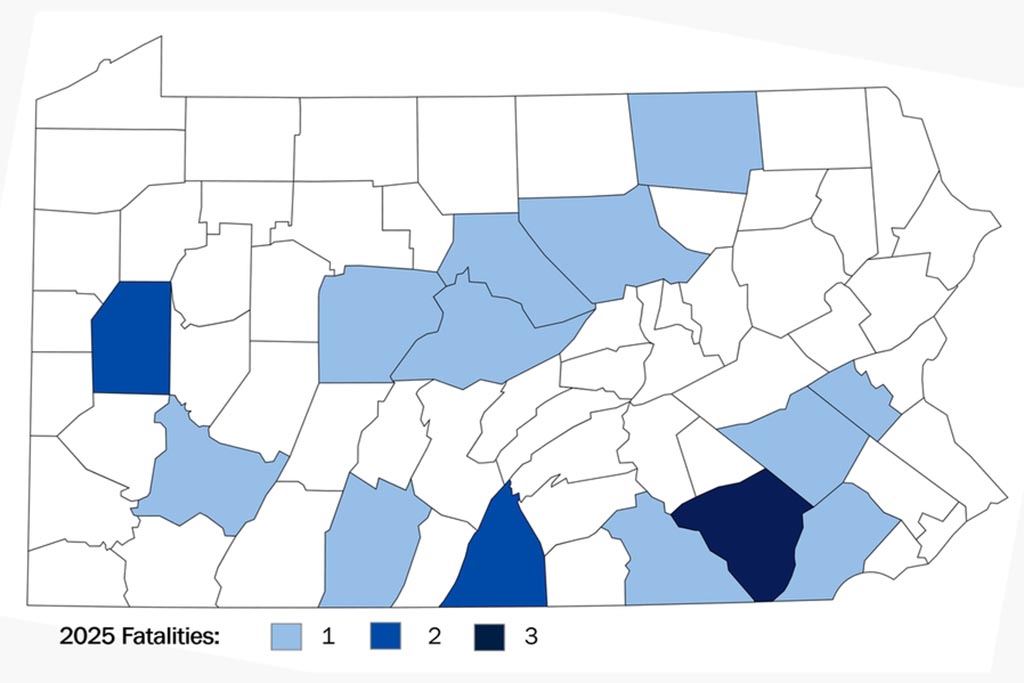
The victims in 2025 were from 14 counties across the state. Three counties reported more than one death: Lancaster, Butler and Franklin.
In line with previous years and national data, more than 80% of the victims were male. An estimated 31% of victims were from the Anabaptist community.
Over a third of the victims were between the ages of 45 and 64, while over a quarter were 65 and older.
“Notably, the distribution differed from prior years, with a higher proportion of fatalities among middle-aged individuals and lower rates among the youngest children,” said Florence Becot, Nationwide Insurance Early Career Professor, who leads agricultural safety and health programs at Penn State.
In 2025, 79% of the victims were actively working at the time of injury, and all but one regularly worked on the farm.

Vehicles
Off-road and industrial vehicles continue to be the leading source of fatalities in Pennsylvania, as almost half of the fatalities involved this type of equipment. These incidents included tractor rollovers, other tractor incidents, skid steer rollovers, being struck by skid steers or forklifts, and an all-terrain vehicle crash. Tractor overturn fatalities most often happen when tractors do not have a rollover protection structure, or ROPS.
The next most frequent types of events were due to compression or contact with equipment, objects or buildings.
Over one third of the fatalities occurred this way, including being struck, crushed or trapped by a piece of machinery, silo collapse, and tree/limb falls.
Three fatalities were due to a horse kick, silo gas and a roadway collision with a tractor.
“While we do our best to identify all fatalities, we recognize that some fatalities may be missing,” Becot said. “This is particularly the case as newspapers, which have been a primary source of information, have decreased in number in rural areas.”
If individuals know of any fatality that might not be listed, or want to confirm that one is, they can reach out to the lead author of this report, Becot, at florence.becot@psu.edu or 814-865-1783. This happened recently when Becot received an email about a fatality that was not included and she updated the report as a result of that email.
Farm safety walkthrough
The Penn State Agricultural Safety and Health program was established in 1976 to support the health, safety and well-being of agricultural communities through research, extension and teaching.
The team regularly collaborates with a range of organizations to deliver presentations and training. They also offer individualized farm safety assistance by phone, email or in-person; safe equipment and machinery operation training for youth through the National Safe Tractor and Machinery Operation Program; and training for first responders and farm workers looking to build safety and preparedness for farm emergencies.
Starting this year, the team is offering a new program: a farm safety walkthrough. This is an individualized program that includes a farm visit to help farmers identify hazards on their operation and develop mitigation strategies to support safer working conditions for everyone on the farm. This program is offered strictly for educational purposes and is not regulatory or enforcement-based. This program is offered to farmers in Pennsylvania at no cost. Those interested can contact Justin Darlington, education program specialist in agricultural safety and health, at jjd6342@psu.edu or 814-863-0234.