

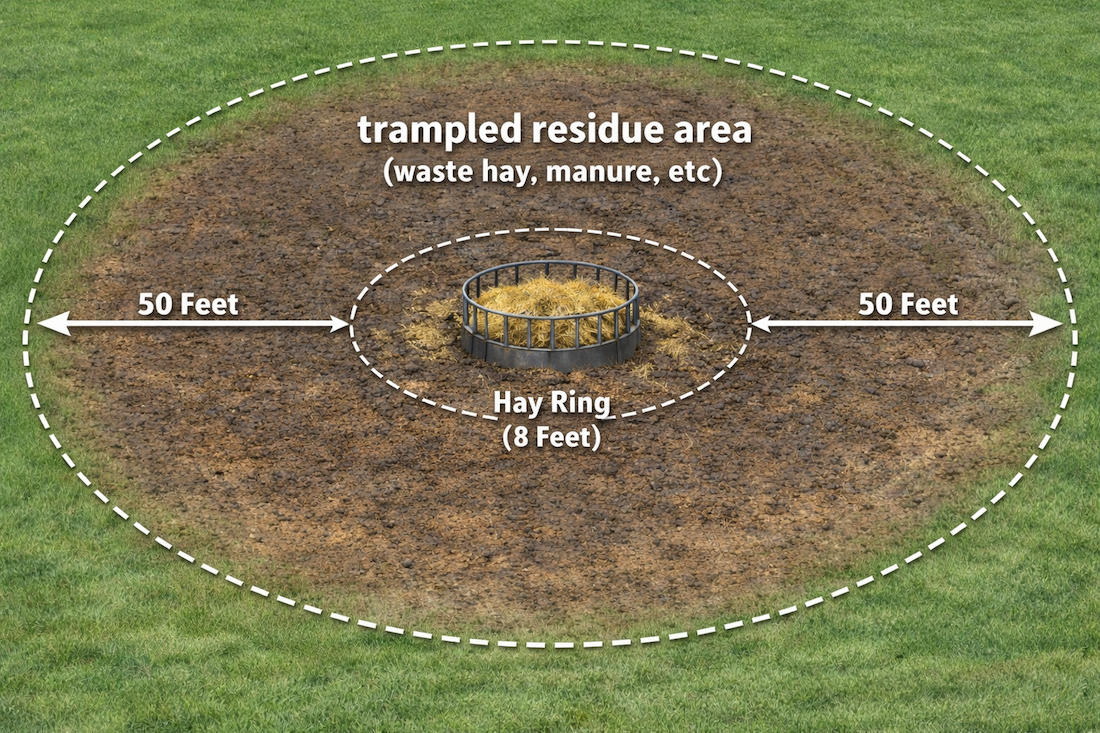
Let’s do some mud math. Your typical 8-foot hay ring covers 50 square feet of ground. Adding in the space where the cows are standing to eat expands this to 452 square feet. The residue area of manure and waste hay around the feeder can etend to 50 feet beyond the edge of the bale ring.
Research from Kansas State University (“Managing Stable Fly at Pasture Feeding Sites”) estimates that a single bale can result in damaging up to 2,800 square feet of pasture area.
During a 150-day hay feeding season, feeding just one bale a day and moving the location of the hay ring each time can result in up to 9.6 acres of your winter-feeding area being damaged from the residual hay and livestock cattle traffic.
I know everyone has a different strategy for feeding hay. The quality of the hay you are feeding and how that hay is fed can dramatically affect how much damage your feeding area has sustained. The scattered piles of leftover hay and the damaged ground around those piles from the cows, typically leave our feeding areas a mess. The piles of residual hay are a prime breeding area for flies later in the year.
The same KSU publication indicates that the waste area from one bale can lead to the production of 1 million stable flies. Deep piles of residual hay can take years to break down in our climate and prevent grass re-establishment. The bare, damaged soils allow weeds to quickly establish, which out-compete our desired forages and reduce overall pasture quality.
Regardless of what you have planned for that field next, you need to either remove the residual hay and smooth out the surrounding soil, or if the cows did a good job of cleaning up the hay for you, you may only need to focus on smoothing things out.
Large piles can be removed with a loader bucket, and the material can be composted and later land-applied. If there is less residual hay, you can use a pasture drag to smooth out the damaged areas. The drag will also aid in spreading out the manure that the cows left behind to provide needed fertility to undamaged portions of the pasture.
Once you have corrected the bale sites, you may need to consider reseeding the bare spots to the forage of your choice.
It is highly recommended that you pull a soil sample from these locations to have a soil test performed. The excessive urine and manure deposited in these areas can lower soil pH and you may need to lime the area in order to help the new seeding get off to a good start. Again, the extent of the damage will dictate whether you need to consider complete pasture renovation or spot seeding.
If you decide that a complete renovation is in order, you have the option of planting the area to a spring/summer annual small grain crop such as oats, or a member of the millet or sorghum families. This crop can be grazed or harvested for hay, and then a new perennial pasture grass can be planted in the late summer or fall.
A well-managed winter-feeding area can benefit low-fertility pastures. Feeding quality hay, with high digestibility, encourages your livestock to consume more of the forage provided. Limiting the amount of hay provided at a time to a single day’s feeding and implementing bale grazing or unrolling bales can also improve hay utilization. This allows for a more uniform distribution of urine and manure.
If the hay is a little more mature and weed-free, seeds from the hay can reseed thin areas. At the end of the day, how you manage your winter feeding areas during and after the hay feeding season will decide how quickly the area returns to a productive forage stand.