




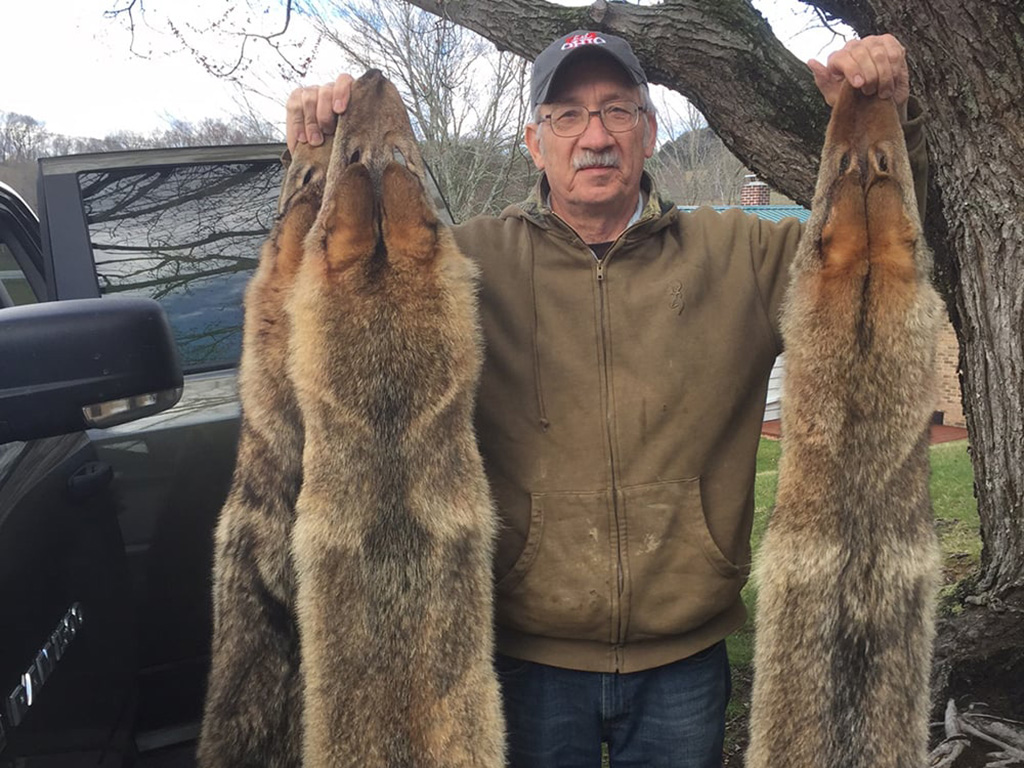
Wildlife bounties are government payments for proof that a particular critter has been killed. The conversation comes up when people become frustrated at the apparent lack of game animals.
Bounty systems have been around since men discovered that predators were hurting their chance of harvesting animals to put food on their table, or when livestock or crops were threatened.
History
When Ohio was being settled, few laws protected wildlife from the landowners’ wrath. By 1803, the last of Ohio’s American bison was killed near the present site of Vesuvius Furnace in Lawrence County. Deer were shot whenever convenient, and bears, mountain lions, and wolves were killed on sight. Even the common gray squirrel caused concern.
Squirrels were found to be so destructive that legislation was once passed requiring taxpayers to kill gray squirrels and turn their scalps into the county clerk. In a 1948 research paper by Charles Dumbach of Ohio State University’s Department of Zoology and Entomology, it was noted that squirrel scalps were required to be submitted by each taxpayer and should be “no less than 10 nor more than 100.”
Athens County once offered a bounty on wolves and mountain lions and would pay $4 (nearly $110 in 2025 currency) for each dead animal verified by authorities. By 1818, the county suspended bounty payments because the animals had become nearly non-existent.
The Great Hinckley Hunt of 1818 in Medina County was meant to rid the area of any creature that might threaten farm or friend. The area had a huge and unbroken forest of big trees, which was believed to be a haven for wolves, bears and smaller animals. Landowners, who had cleared and farmed the ground around the woods, claimed that their produce was often raided and that entire flocks of sheep were being decimated in a single night.
A plan was made for a “war of extermination” upon wolves and bears. At dawn on Dec. 24, the forest was surrounded by approximately 600 men. At day’s end, the tally included 17 wolves, 21 bears and 300 deer. Uncounted animals included turkeys and additional deer that were carried home by participants, as well as innumerable foxes and raccoons.
Changing landscape
While it’s accurate to say that large predators were more quickly extirpated due to bounties, that would have eventually occurred without cash incentives. These species were not going to do well in Ohio’s changing landscape. Logging, land clearing, mining, degradation of streams, improving farming technologies and a steadily growing population and industrial complex made the land and people less hospitable for these larger carnivores.
In the span of a few generations, those abrupt changes of habitat and unchecked harvest took a heavy toll on most of Ohio’s native wildlife. Since that last bison was killed, mountain lions, beaver, elk, gray wolves, black bears and bobcats were all considered extirpated from Ohio by 1850.
Driven hunts and targeting “problem“ species still existed. In Ohio, during the 1920s and ‘30s, bounties on certain wildlife species — usually fox and avian predators — were considered a solution to help burgeoning pheasant populations thrive.
Even Aldo Leopold, the father of modern wildlife management, was a bounty advocate and was paid to kill wolves himself. As he continued studying wildlife and its impact on the ecosystem, he found that he’d been wrong.
“I thought that because fewer wolves meant more deer, that no wolves would mean hunters’ paradise,” Leopold said in his book, “A Sand County Almanac” (1949). He witnessed that once the wolves were gone, the deer ultimately suffered as populations became so far out of balance with the countryside’s carrying capacity that the deer numbers declined. So much damage had been done by the overpopulated herd that deer numbers remained depressed for decades due to the long-lasting destruction caused by over-browsing. Leopold’s careful studies of natural predation led to a reversal of his previous opinions.
Pheasants
Let’s get back to Ohio’s pheasant population and the idea of bounties on predators. With today’s low wild pheasant numbers and the drastically declining grouse population, why not reinstitute bounties on certain animals to relieve pressure on the remaining birds?
It’s important to understand the predator-prey dynamics prior to making a possibly over-reaching and expensive decision. During the heydays of Ohio’s pheasants, roughly 1930 to 1955, farms were smaller, some partially abandoned due to economics; equipment was less efficient and more labor intensive, and there was more livestock, lots of pastures and hay fields (preferred nesting habitat) and fencerows (travel lanes and winter cover). Additionally, drainage of odd areas was less intense, allowing more fallow and unused ground. These circumstances created a boon for upland cover and were perfect for a booming pheasant population.
At the same time, grouse were recovering in areas where mining land was being reclaimed — thanks to the CCC (Civilian Conservation Corps) — or reforested naturally, while decades-old logging areas sprouted vast stands of young and mid-growth trees, all of which were perfect habitat for grouse to bounce back from losses felt earlier in the century. Circumstances of the times allowed pheasant and grouse to flourish.
To understand predation, we need to understand predators. Whether coyote, fox or hawk (or Bengal tiger), they are opportunist. They don’t wake up in the morning and decide “today feels like a pheasant day.” They hunt for the easiest meal, which provides the least physical exertion and amount of risk.
If one prey species is more abundant than another, that’s what is most likely to be targeted. Predator numbers tend to be higher in good habitat, a reflection of the amount of food they can find.
In 1972, the Migratory Bird Treaty Act protected all raptor species — a law that followed in line with the Bald Eagle Protection Act of 1940. This stopped bounties on raptors and soon, most states, including Ohio, terminated bounty programs on all species.
I was once at a public meeting when one very irritated man began arguing (yelling) for a new fox bounty to protect pheasants. The district manager, an “old school” warden, held his hand up for silence. “So, the fox ate all the pheasants. Are you still seeing any pheasants?”
“I only got one all season, and it was the only bird we jumped,” came the reply.
“Do you see any fox?”
“All the time,” the man said.
“Then I guess all those poor son-of-guns (not exactly what he said) are starving now,” the old warden answered.
In his own way, that warden was pointing out that fox had never relied exclusively on pheasants as their primary food, but were most likely chowing down on meadow vole meals — a common rodent found all over farm fields and one that fox see as a juicy, fuzzy sausages.
When pheasant populations were high, the birds simply became Brer Fox’s bonus meal. The man was lost to the irony that the only pheasant he saw all season was killed by another predator — the two-legged kind.
Though bounties are now a rarity in the U.S., a few persist. Utah pays hunters up to $50 per coyote to help protect mule deer. During 2018, $500,000 was paid for more than 11,000 coyotes, but fraud-plagued payouts with coyote scalps being brought in from other states. Since its inception, the program has not given wildlife managers any measurable results, since coyote populations can be both nomadic and their numbers uncertain. Biologists believe that habitat loss, particularly on winter range, is the most serious threat to mule deer and are investing heavily in establishing better habitat. South Carolina, Texas and Virginia offer coyote harvest incentives, and there are some duck-producing states experimenting with furbearer removal inducements due to decreased trapping pressure.
Nebraska, which once championed coyote bounties, has suspended them.
“It was apparent the bounty system was having no real effect on coyote and fox numbers, so the program was discontinued,” said furbearer biologist Stephanie Tucker during an interview with the Bismarck Tribune. “In Nebraska, coyote numbers continued to rise although a bounty system had been in place for 68 years.”
Not worth it
What do I think? Bounties tend to be a reflection of looking for a simple solution to complex problems. While predation occurs, it tends to be the result of too little habitat or an abundance of good habitat. Both should be expected. In one, wildlife has few places to hide and predators are forced into hunting those areas to find food — something that’s also easier for the layman to spot. On the “good habitat” side, animals tend to flourish, making them more available to predation.
While it may have its role in some isolated instances, a broad bounty program tends to lead to ethics being stretched and to fraud. It seems better to rely on adjusting seasons and spending that money on wildlife and their habitat needs. Loss of habitat takes a far larger toll than predation ever could accomplish. In any natural ecosystem, predation will happen and should be expected.
Most wildlife professionals believe that bounties are no longer valuable for fish and game management, acknowledging that those antiquated practices are simply not worth the cost. I agree.
“Like the resource it seeks to protect, wildlife conservation must be dynamic, changing as conditions change, seeking always to become more effective.”
— Rachel Carson