

My local weather forecasters had been warning me for three weeks that bad weather was headed our way. But, ever hopeful, I thought that just maybe we would dodge their predictions.
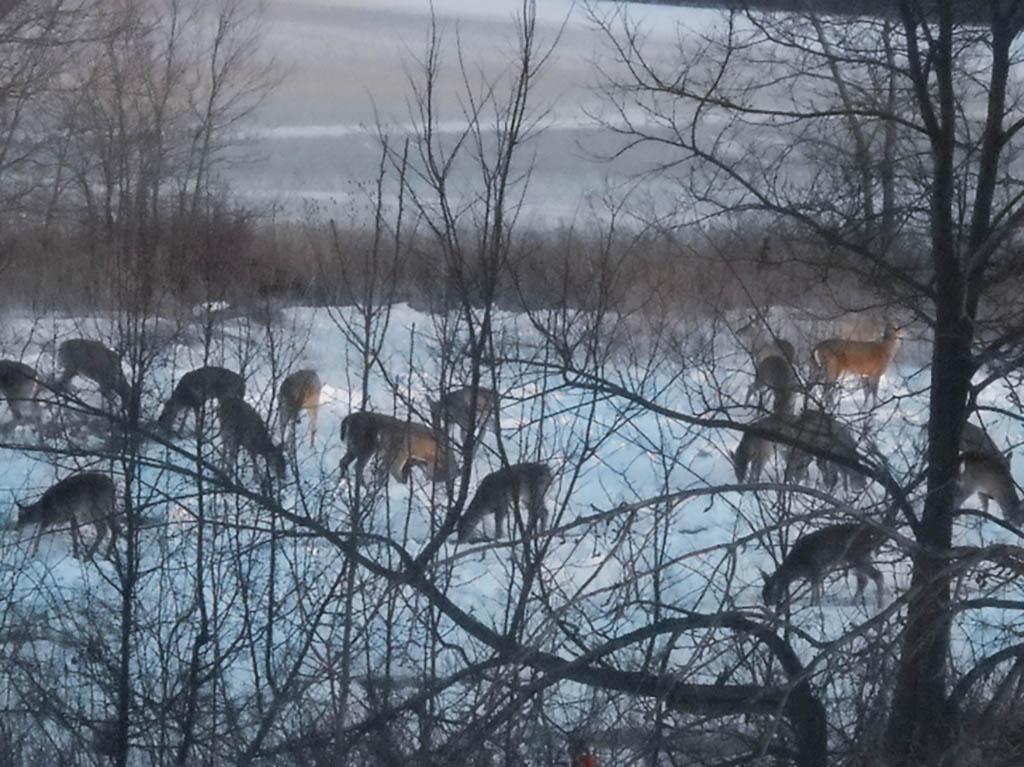
These meteorological experts were the whitetail deer that inhabit the woods and fields around my home. They’ve been spending a lot of time foraging for food in harvested corn fields and my clover food plot. Last week, that feeding frenzy intensified and what were just a few animals has grown to dozens.
Then it hit: cold, Arctic cold — the kind of cold that gives you a chill just reading the forecast. Car batteries fail, prayer is required to start diesel engines, electric meters are spinning wildly and lawyers have to keep their hands in their own pockets.
We use our collective common sense, huddling at home and doing our best to wait it out. We limit our exposure to those frigid temperatures and safeguard pets and livestock while double-checking our water pipes. Thankfully, these northern blasts are relatively short-lived in our region. But what happens to wildlife during these uncommonly frigid spells?
Animals, such as the deer in my backyard, instinctively seek out high-energy foods, limit their movements to conserve body heat and will spend their time loafing in sheltered areas that are protected from the wind.
Migratory birds hopscotch their way farther south as weather worsens. Those who have taken-up winter residency are equipped for cold spells. They’re mobile food-finders and have a circulatory system that helps keep them warm. Their feathers are excellent insulators; they’re literally carrying a down jacket with them.
The snow acts as an insulation for the voles and mice that inhabit our landscape. They scurry through tunnels that they excavate from warm den to food sources, invisible to lurking predators.
Reptiles and amphibians burrow into mud, dens, leaf litter or other protective cover and entered into states of hibernation or “torpor,” a slowing of the metabolism and circulatory system to survive cold weather.
What might be hurt? A deep-penetrating ground freeze will often reduce the summer’s mosquito population. While I don’t relish a negative 10 on the thermometer, I also don’t care for swatting summer’s swarms of mosquitoes. Score one for the cold.
Heavy snow cover is a greater threat than the cold temperatures alone, especially if that snow has been covered by a layer of ice. This can hinder mobility and makes finding grazing patches a difficult venture for deer and turkeys. A blizzard’s high winds and blowing snow will take its toll on birds with its hypothermic effects and all animals will struggle to find their next meal. Fortunately, we’ve thus far been spared those conditions.
Mother Nature teased us with a few warm days, but they were short lived. The fabled Punxsutawney Phil warned us on Feb. 2 that six more weeks of winter was headed our way. He must know what a practical joker Ma Nature can be.
Let me offer you some hope for milder weather. While working with the Division of Wildlife, we always tried to schedule officers for peak times of sportsmen’s activity. One of those annual occurrences is the spring walleye run in the Maumee and Sandusky Rivers. History has taught us that we can expect walleye to begin filtering into those rivers during about the third week in March.
I’ve also been hearing cardinals and robins testing their spring songs and several redwing blackbirds have announced their gradual return along various wetlands. It won’t be long until the first gobbler booms from the backwoods and the dainty little woodcock arrive to perform their evening aerial ballets. Be patient, spring is coming.
“Everybody talks about the weather, but nobody does anything about it.”
—Mark Twain
Along the way
I’ve gotten emails and calls concerning dead Canada geese along some waterways where the big birds have been congregating. I had a suspicion of what the likely culprit was, but called the Division of Wildlife District 2 (Findlay, Ohio) manager to see what the experts would say. Prior to his current position, Bob Ford had served as the District 2 wildlife management supervisor, so I knew that if anyone would have the answer, he’d be the one. I was right.
Bob told me that the division had sent out several of the dead birds for testing and they came back positive for HPAI. Highly Pathogenic Avian Influenza, commonly known as bird flu, is a viral disease affecting poultry and can cause severe illness and death. The H5N1 strain of HPAI is present in wild birds worldwide and is causing outbreaks in U.S. The disease has also been in the news due to its impact on domestic poultry.
The U.S. Geological Survey is collaborating with agricultural and wildlife management partners to address the threat of highly-pathogenic avian influenza to wildlife, domestic poultry and livestock. Partners include federal U.S. Fish and Wildlife Service and U.S. Department of Agriculture and non-federal agencies as well as state government, private organizations and academic institutions.
In a recent report, the Eastern Ecological Science Center for USGS reports: “Although low pathogenic avian influenza viruses regularly occur in wild waterfowl and gulls, there has historically been limited evidence of avian influenza infection or virus antibodies reported from other waterbird species. Following the incursion of clade 2.3.4.4b Gs/GD highly pathogenic H5N1 into North America in 2021, increased mortality of wild birds has been reported, including from species not previously known to be affected by avian influenza virus.”
“Of the 508 wild bird species recognized as impacted by highly pathogenic H5Nx viruses by Food and Agriculture Organization of the United Nations, 281 have been added since 2021. Within North America, organizations tasked with wildlife disease surveillance, including USGS and collaborators, have observed unprecedented disease impacts across waterbird species, particularly colonial nesting waterbirds. Scavenging and raptor species have also been affected by the latest avian influenza outbreak, including newly affected species like the federally endangered California Condor (Gymnogyps californianus).”
While domestic fowl such as chickens, turkeys and ducks are the most common agricultural victims, other captive birds are also at risk.
As for affected wild birds, their species outnumber their domestic cousins. I found it interesting to review those that have been hit by the virus. While the list include nearly the complete range of waterfowl, other species include gulls, terns, bobwhite quail, ruffed grouse, sage grouse, California quail, mourning doves, common pigeon, wild turkey, ringneck pheasant, sandpipers, plovers, American kestrel, golden and bald eagles, many species of both hawks and owls, vultures, California condors, blackbirds, robins, bluejays, goldfinch, crows, sparrow species and many more. The complete list can be found at www.fao.org.
You can learn more about the virus’s impact on wildlife by visiting the USGS at www.usgs.gov.