



Readers of this column have heard me say many times that the early settlers of the Ohio Country never threw anything away, but instead reused and recycled virtually everything. When one doesn’t really have anything, one makes the most of what they do have.
This philosophy even extended to the pits of peaches.
No … really; they actually saved peach pits. And why would they do such a thing? Well, to carve, of course. On long, cold winter nights when they had had it up to here with carving butter prints, they reached for a peach pit on which to bestow their sense of artistry.
Easy to carve. And why carve peach pits? Well, believe it or not, at one time in the 19th century, peach pit carving was a thing. Unlike regular wood, peach pits do not have a grain and so lend themselves to easy carving with no more than a jackknife. Peach pits must be cleaned and dried, but age does not affect their suitability for carving. And with a modicum of imagination, they could be transformed into of all sorts of wonderful shapes.
Some pioneers carved peach pits into letters of the alphabet or into numerals as teaching tools for their children. Others carved them into all sorts of imaginative whimsies for family members or romantic partners. With the addition of a simple piece of string, these could become jewelry worn around the neck.
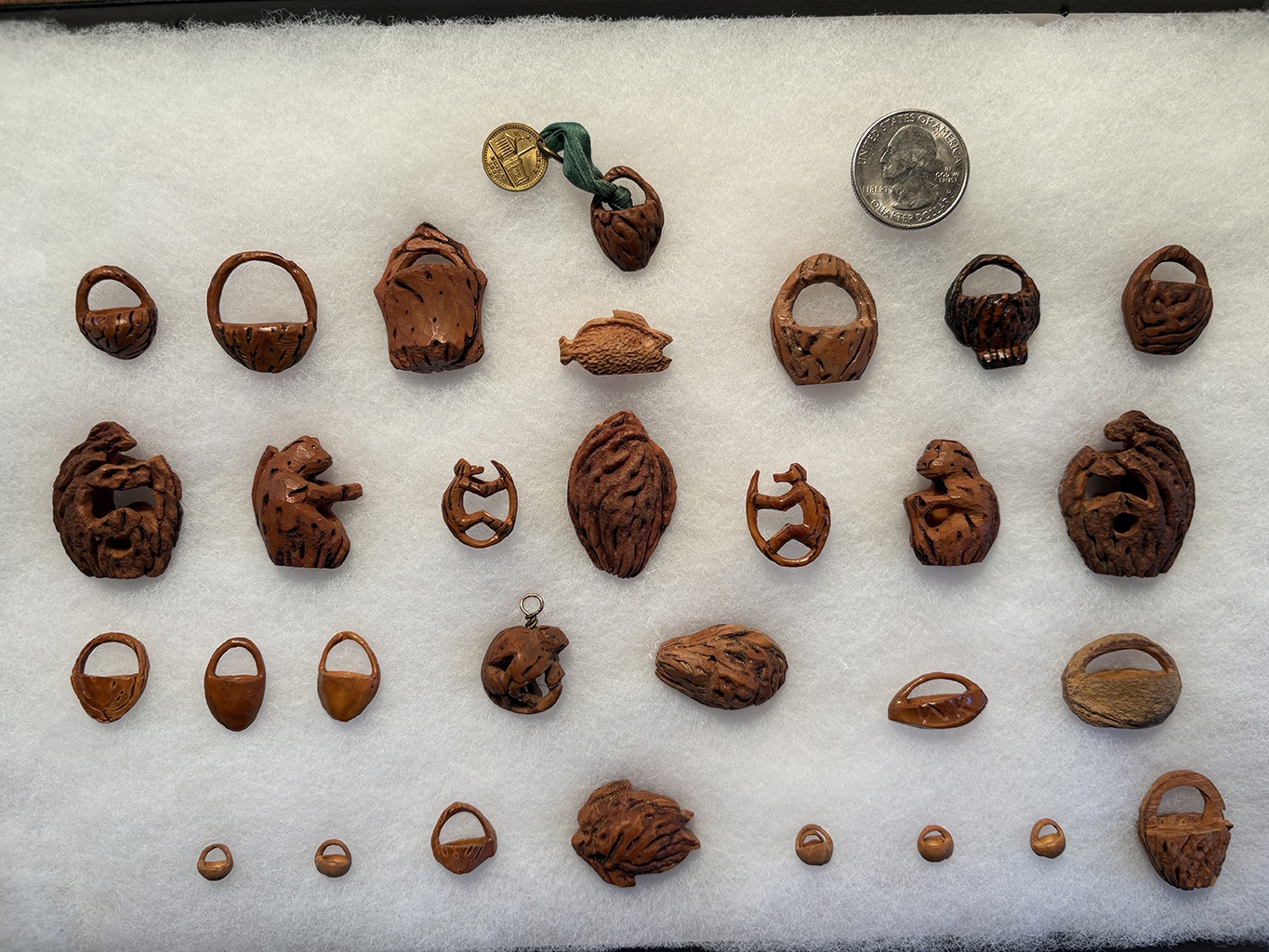
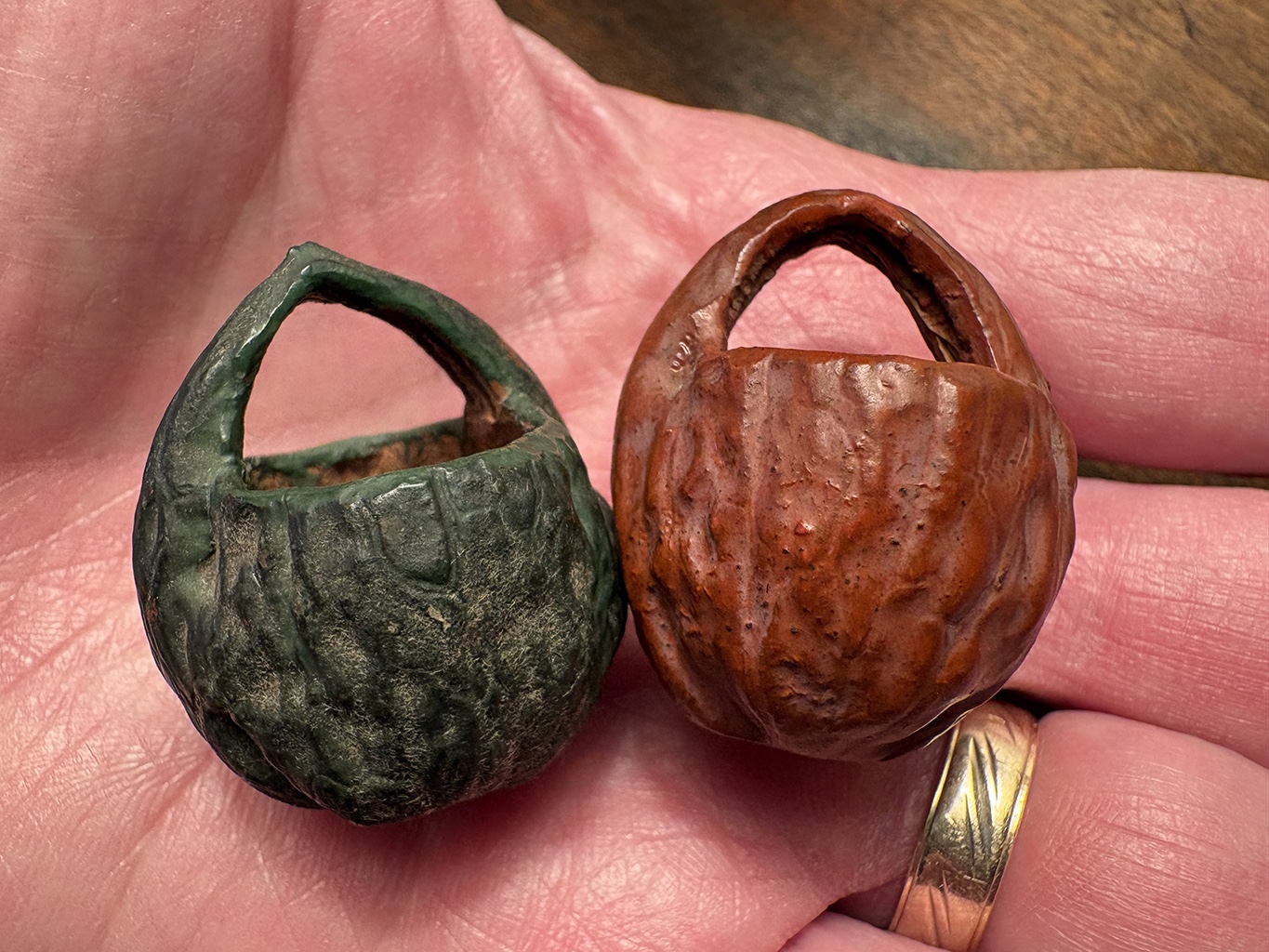
Among the more common forms of peach pit carvings were handled baskets of varying shapes and sizes, squirrels, monkeys, fish, filigree and much more. Sometimes these were varnished or given a linseed oil finish, while other times they were ornamented with paint or various decorative materials.
As time went by, settlers began informally competing with one another to see who could come up with the most interesting or most detailed designs. Eventually, as county fairs became established, some featured competitive categories for peach pit carving and awarded ribbons or medallions for the best workmanship.
Origins. So where did peach pit carving start? Actually, it came from China, where the peach tree is believed to have originated. As a folk art, it started in the Song dynasty (960-1279), and became the rage during both the Ming (1368-1644) and Quing (1644-1911) dynasties.
The Chinese carved peach pits into tiny, intricate and symbolic figures such as Buddah, animals, figures of the Zodiac, flowers and boats. They used such carvings as jewelry, talismans, symbols of longevity, fertility and ways to repel evil spirits.
Excellence in carving
As with every art form, some people in early America excelled at peach pit carving, and even carried it to the extreme. Perhaps the best known of these was Professor Albert William Gimbi, who became known nationally as the Pennsylvania Peach Pit Carver. Gimbi, who was born in 1857 in McAdoo, Pa., where he worked as a barber, became enthralled with peach pit carving early in his life.
Over the years, Gimbi created thousands of peach pit carvings which he framed in large shadowboxes. In the late 1800s, Gimbi took to traveling around the country holding exhibitions of his peach pit art and the special tools he created to carve them. His displays always attracted large crowds and spurred enthusiasm for the craft.
Frames of Gimbi’s work include such figures as seashells, insignias, emblems, paint brushes, shoes, sewing tools, books, baskets, fishing hooks, needles, pins, locks, buckles, keys and milking stools, to name just a few.
Today when frames of Gimbi’s carvings come up at auction they command high prices as examples of American folk art.
In addition to peach pits, settlers carved pits and stones from other fruits and nuts. They also sawed the stones from black walnuts into slices, which they used to construct a wide variety of folk art objects such as baskets, bowls and compotes.
Today it is seldom that examples of early peach pit carvings turn up in the marketplace. Most families that once had them relegated them to a dark corner of a catch-all desk drawer, and they were eventually discarded as some kind of unidentified junk from who knows where and when.
When such pieces of tiny folk art do turn up in the marketplace, however, prices tend to raise eyebrows and create a level of both interest and awe.