





I was about 12 when people began asking me what I wanted to be when I grew up. Like most boys that age, I was still waiting for high school football and my first kiss. Even so, the ideas were beginning to swim through my mind.
By the time I landed on the gridiron, the first Earth Day had been celebrated, Rachel Carson’s warnings of the effects of pesticides on birds were being proven, Lake Erie was a mess, the Cuyahoga River had caught fire and the American bald eagle was at the threshold to the door of extinction.
The Vietnam War had finally come to an end while John Denver sang Rocky Mountain High and an awareness of our environment had become prominent among young people. I joined the ranks of college students who wanted to make a difference.
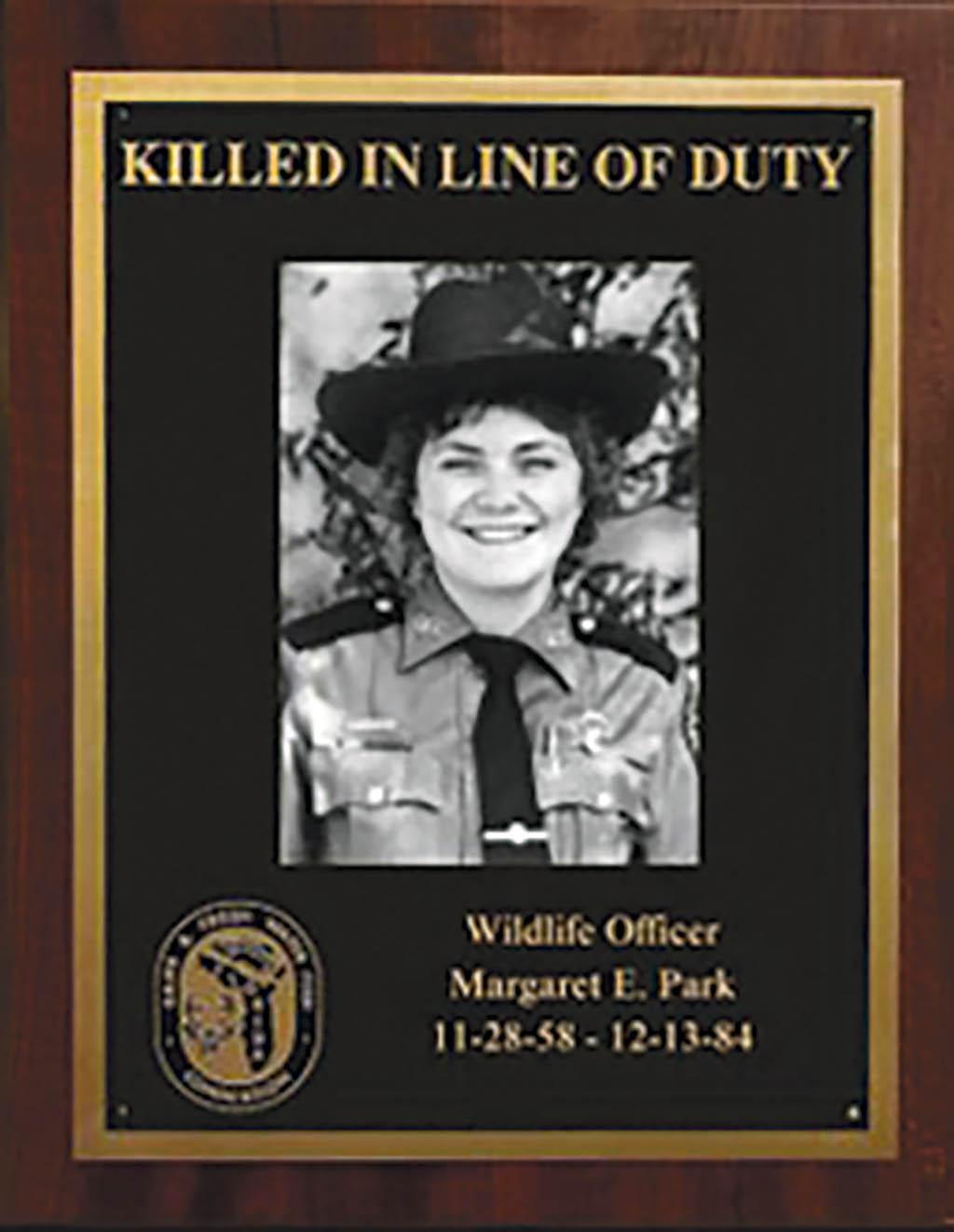
Margaret Park, better known as Peggy, was in those ranks. Born in Columbus, Ohio, she attended Bexley High School and went on to graduate from Ohio State University in 1981. The degree she earned was in natural resources and wildlife management, equipping her well to fulfill her aspirations of becoming a naturalist.
We never met, but I know something of what was in Peggy’s heart. She wanted to share her love for nature with others through education and to try and curb what she saw as the neglect, destruction and abuses of our wildlife resources. Her degree also proves that she understood that legal hunting and angling were not the culprits, but that ignorance, apathy, criminal acts, ineffective laws and a lax judiciary were the perpetrators.
In 1982, Peggy accepted the position as a wildlife officer with the Florida Game and Fresh Water Fish Commission; about the same time that I had left Ohio’s Division of Parks in pursuit of my own history within the Ohio Division of Wildlife.
This was a ground-breaking time for women in law enforcement. Once erroneously thought of as a “man’s job,” it was tough to break through those old barriers and misconceptions. But women like Peggy were up to the challenge and we all learned from their persistence, example and dedication. There is no doubt that a little less testosterone has helped defuse many volatile situations.
On the night of Dec. 13, 1984, the 26-year-old wildlife officer was working in northern Pinellas County. She proceeded up Keystone Road and encountered two men shooting a handgun. They were Martin Grossman, 19, and Thayne Taylor, 17.
A relatively routine run-in for a game warden, except in this case Peggy discovered that the handgun was stolen and that Grossman was no stranger to the courts. He was on probation for grand theft and the presence of the firearm certainly violated those conditions. Grossman begged her not to report him to the authorities. Either he didn’t understand that it was her job to enforce the laws, or he was maneuvering for an opening to run or fight. It ended up that the latter was likely his primary motive.
As Peggy used her portable radio to contact the sheriff’s office for assistance, Grossman attacked her, gaining control of her heavy, metal flashlight. He bludgeoned her on the head and shoulders and Taylor stepped in and also struck her. Peggy was able to draw her service revolver and fired one shot, which grazed Taylor. Grossman, 100 pounds heavier and a foot taller, wrestled the gun from her and, while Taylor held her down, he put a bullet into the back of her head. The two fled the scene but were arrested a short time later.
Thayne Taylor was convicted of third-degree murder and was sentenced to 7 years in jail. He was released after serving only two years and 10 months for his part in the attack. Grossman was found guilty of first-degree murder and sentenced to death. It took 26 years before that final debt was paid by Grossman, sending him to his final judgment for that brutal assault.
Peggy’s ashes were taken by helicopter and scattered over the eagles’ nests she loved to watch and a memorial was later erected near the spot she died. The study of the deadly encounter is still used as a focal point in enhancing wildlife officer training nationwide so that future incidents might be avoided.
I pray that as Peggy keeps her eternal watch over her beloved eagles as they now flourish, that she proudly sees the many dedicated women who have joined the ranks of the thin green line which protects our country’s wildlife — a change that her example helped to usher in. That she knows that she continues to be an inspiration for every woman who reaches for the stars, and that her touch is felt as she reaches down to them.
You can learn more about the incident, memorial and interviews with responding officers at the website hosted by Florida Fish and Wildlife Conservation Commission at https://tinyurl.com/5n7p5h9c.
“Loyalty and devotion lead to bravery. Bravery leads to the spirit of self-sacrifice. The spirit of self-sacrifice creates trust in the power of love.”
— Morihei Ueshiba
(Jim Abrams was raised in rural Columbiana County, earning a wildlife management degree from Hocking College. He spent nearly 36 years with the Department of Natural Resources, most of which was as a wildlife officer. He enjoys hunting, fly fishing, training his dogs, managing his property for wildlife and spending time with his wife Colleen. He can be reached at P.O. Box 413, Mt. Blanchard, OH 45867-0413 or via email at jimsfieldnotes@aol.com.)




