




Bob, a friend whom I worked with in the Division of Wildlife, and I were rowing a little motorless johnboat across the waveless, pristine lake. Actually, Bob was rowing while I was getting ready for my first cast — he’d already seen me back the trailer, and he had little interest in risking any of my other skills.
Something special. It had been a while since I’d fished at Lake La Su An and we were both eager to get started. If you’ve never visited the area to catch its giant bluegills and over-eager bass, you’re missing something special.
The 2,626-acre Lake La Su Wildlife Area sits just four miles west of Pioneer in Williams County, near the northwestern most edge of Ohio. The area includes 13 small lakes and ponds, from as small as 1 acre on up to 82 acres. The rest of the wildlife area is maintained similarly to the upland habitat that once covered much of northwest Ohio.
Cool and warm season grasses, scattered share-cropped farm plots, and woodlots offer a sampling of what your great-grandfather experienced while he was hunting pheasants and rabbits. It’s also a great spot to visit if you’re a birder, the area providing opportunities to view a wide variety of species during the spring and fall migrations.
Bass management
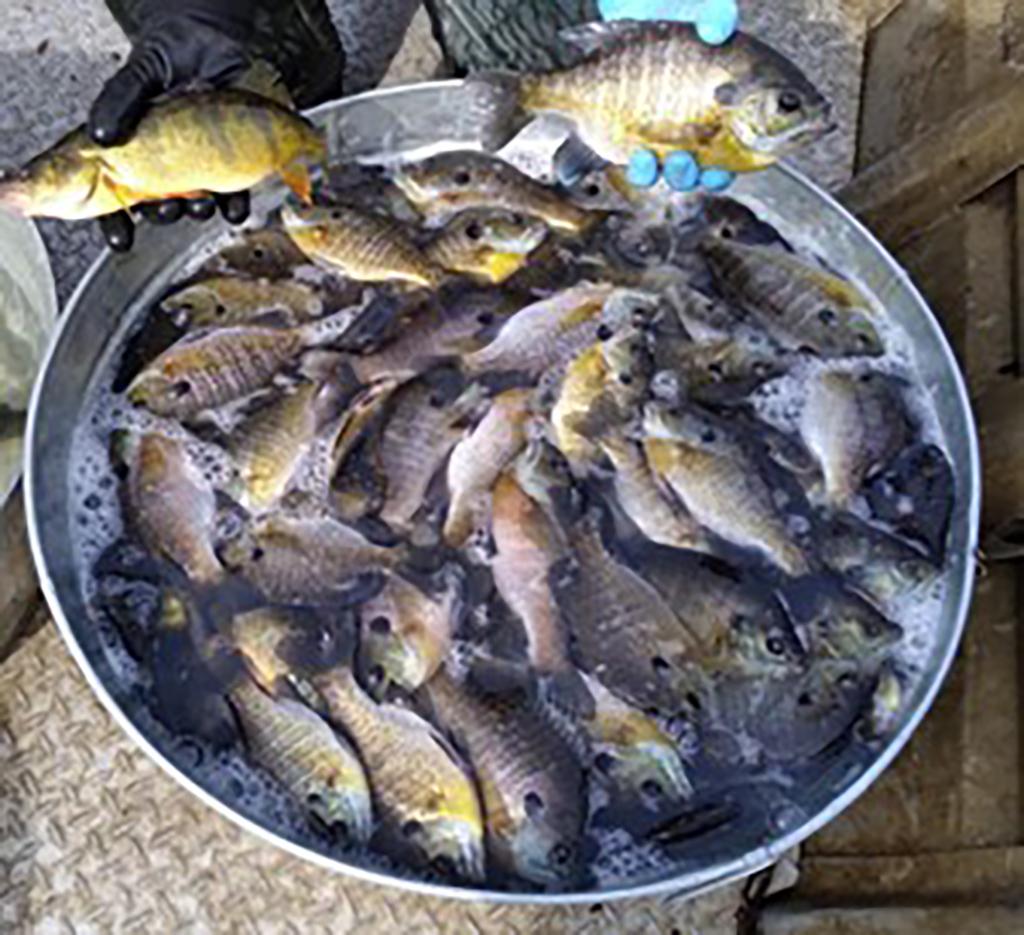
Let’s get back to that boat. Bob and I were having a fine time catching some dandy slab-sided brim. We were using small redworms and spikes on ice-jigs suspended below tiny bobbers. The fish were eager to snap up the little wrigglers, and within a couple of hours, our cooler contained our limit. The rest of our trip would be fishing for fun, just educating the fish and then tossing them back into the water. But a funny thing kept repeatedly occurring — bass were attacking our red-and-white bobbers.
The area’s fishery has been historically managed to favor big bluegills, which meant managing the predatory largemouth bass to ensure that they kept pressure on the smaller bluegills. That meant that a size limit on bass was being used, a method that preserves bass shorter than 18 inches.
The science behind that idea is actually pretty simple. The voracious bucket-mouth enjoys a meal of bluegills. The larger the largemouth, the bigger the bluegill it will eat. The smaller the largemouth, the smaller its prey shrinks accordingly.
A maintained population of smaller bass keeps the pressure on smaller bluegills, helping to keep the prolific gill from over-populating the lake. Those fish that dodged those gaping bass jaws would continue to grow into a 9-inch Fish Ohio trophy — though Bob and I had caught some larger than that.
Those big bluegills also have a lot less to worry about from the bass in the lake. They may be called largemouth, but those bass can’t swallow what doesn’t fit in their mouth. This leaves the lake teaming with some very hungry, stubborn and perpetually angry bass.
Once again, let’s get back to the boat. Bob and I stopped bothering to bait the hooks and we were just casting our bobbers onto the water. We wanted to see if we could catch a bass without a hook. The little red-and-white orbs would hit the water and bass would rush in and, with a splash, suck them under the surface. We’d pull back and the fish would fight to hang on as we tried to lift them into the boat. Most let go and flopped back into the water, but one overly tenacious individual struggled to hang on until it was on our side of the gunwale. I thought it might have swallowed the bobber — nope, just a really persevering piscavore.
Inaugural adventure
A few days after this outing, I was telling a few of the guys at the local sheriff’s department about the trip. Most of them had little idea of exactly what a game warden did for a living, but a couple must have thought that part of my job was to offer guide services. Before I knew it, I’d agreed to escort one of them to Lake La Su An for an inaugural angling adventure. I’ll just call him Chuck.
A few weeks later, we arrived at the same location Bob and I had fished and proceeded to row across the lake. This time, rowing was apparently part of being the guide. Chuck, an easy-going guy, seemed to be having a great time as he hauled more than a few skillet-sized bluegills into the boat, as I worked on doing the same.
It wasn’t long before the bass began whacking our bobbers, just like I’d told him would likely happen. Since keeping any more bluegills would now violate limit laws, Chuck thought it might be fun to fish for the overly aggressive bass. I was good with that idea; I was having as much fun watching him fish as I was fishing.
Chuck tied a bass plug onto his line and began casting. As I watched him catch a few fish, he suddenly stopped to look at me. “I was a little suspicious of those fish stories, but you were right about these bluegills and bass! Uh – why aren’t you fishing?”
I confessed that I’d come only for the bluegills and hadn’t brought any other bass-catching type gear. That stuff was in my other tackle box. “You have two tackle boxes?” The envy just oozed in that questioning statement. I suppose he thought they were state-issued.
Heirloom
Not wanting to fish alone, he reached into his own tackle box and pulled out a lure that looked like it either belonged in a museum or a trash can.
“This one is my favorite. I think I bought it when I was in high school…give it a try,” he said as he handed me the plug.
Thanking him, I tied the old top-lure onto my line, though I had doubts about its hook’s sharpness and even the thing’s ability to float. Regardless, I knew it could catch a bass on this lake.
Out of the corner of my eye, I could see Chuck smiling as I set the bail on my reel. The overhand cast sent the lure arcing toward the shoreline; its target was the edge of a partially submerged log. Apparently, my cast was more of a launch than an arc. The plug went a bit higher and a little farther than I anticipated — finding tree branches about 20 feet higher than a twelve-foot ladder. It was still over the water; it was just in the branches hanging over the intended target.
“Well, darn,” I said (maybe not darn). “That one got away from me. Well, that’s the risk when you’re casting to fish-holding areas.”
Chuck sat there looking stunned. He looked up into the tree, then at me, then into the tree, then finally back at me. “Fish can’t climb,” he murmured.
In the quiet two-hours it took us to load the boat and return from the trip, that lure had grown into a family heirloom. It was no longer some plug he bought as a high schooler; it had transmogrified into a relic brought across on the Mayflower and had been handed down through generations — something the Smithsonian may someday try to retrieve. I’m sure Chuck’s over it by now … probably.
Plan a trip
If you think you’d like to visit Lake La Su An Wildlife Area and its ponds, remember there are some specialized fishing regulations in play and that they can change annually. This year, the area’s fishing season began May 1 and will last through Sept. 7. Absolutely no fish or minnows may be used as bait.
The sunfish daily limit is 15, with no more than seven that are 8 inches or longer. Largemouth bass have an 18-inch minimum length and a five-fish limit. Channel catfish have a two-fish daily bag limit. All limits are posted on site and are in effect area-wide. Reservations aren’t needed, but fishing is only open on Mondays, Fridays, Saturdays and Sundays from sunrise to sunset. Lake La Su An Wildlife Area is closed to fishing at all other times.
Beside bluegill, largemouth bass and channel catfish, you will also find out that redear, pumpkinseed and yellow perch are abundant. That’s a nice mixed stringer! Lake La Su An also has an ADA-compliant fishing pier to facilitate fishing by disabled anglers.
The Fish Check station is located on Williams County Road R off SR 576. The area is 6 miles from Pioneer, 7 miles from Montpelier, 20 miles from Bryan, 41 miles from Defiance, 59 miles from Toledo, and 86 miles from Findlay. Learn more by visiting www.wildohio.gov.
If you do go, watch out for an old fishing plug hanging high in a tree. That area directly beneath it ought to be a good spot to catch a bass.
“What is it about us human beings that we can’t let go of lost things?”
— Leslie Marmon Silko