




Whether you think of “hats off” as an expression of respect or one of congratulations, it fits all sizes for the dairy industry. Recent media attention appears to support the “one size fits all” when it comes to giving credit to the dairy industry, whether a small farm of a few cows that produces artisan cheese or a one 1,000-plus cow herd.
Each has a role in feeding a hungry world and supporting choices among today’s consumers, whether the focus is on local foods or higher shopping power.
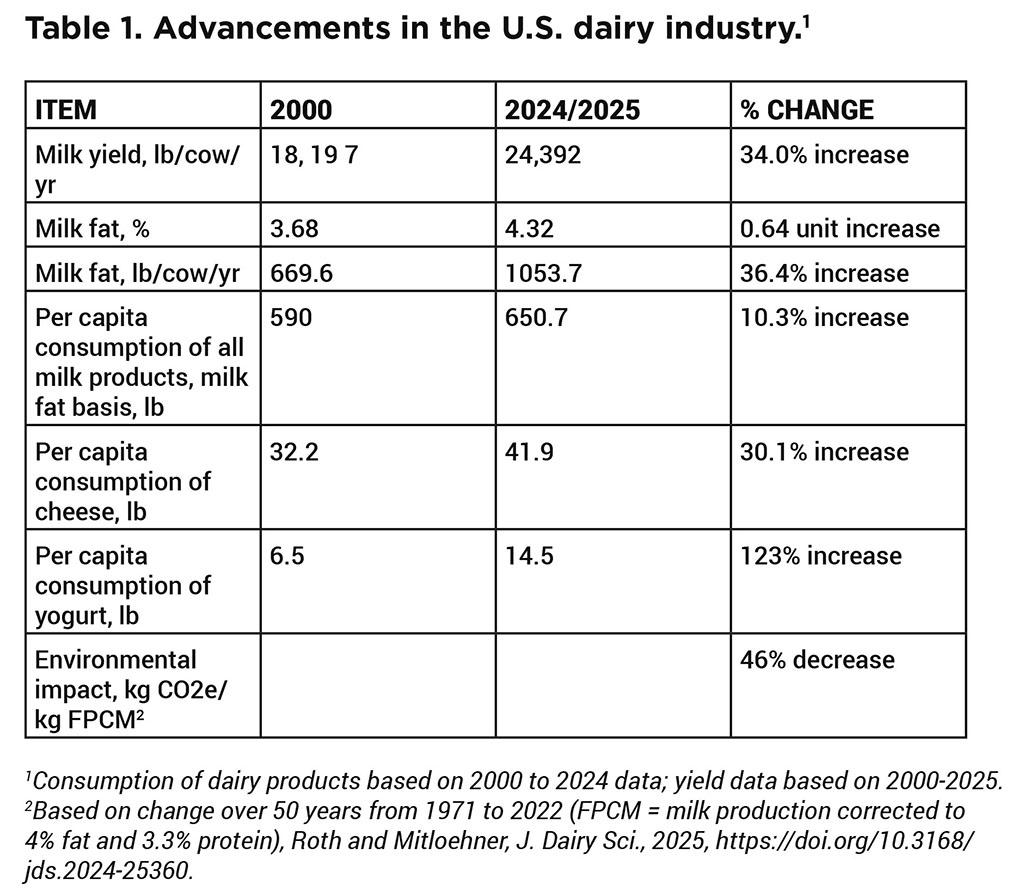
There is much to celebrate for the dairy industry as June is Dairy Month. Over the past 25 years, the milk and milk fat yield per cow has increased about 35% (Table 1).
This has occurred through advancements in genetics, feeding, animal comfort and management skills, including accessibility of data for making decisions.
It continues to be astonishing that we have been able to make these strides in milk yield, while today milk fat percentage is over 4% and milk protein over 3.2% for dairy herds. A lot of this progress in milk solids can be attributed to genetics and feeding.
As the dairy industry continues to focus on being net zero for carbon by 2050, it is important to recognize that the industry has experienced a 46% decrease in carbon output per unit of milk yield during the past 50 years. Continued advancements will occur as additional efforts are focused on improvements in feed production, nutrient management from manure, energy efficiency and cow performance and well-being.
It is equally valuable to recognize the importance of dairy products to the human diet, even as revealed in the recent release by the USDA of the 2025-2030 Dietary Guidelines for Americans. The protein and mineral contributions of dairy products are well recognized, as the general guideline of three servings per day still exists.
The recent efforts to return whole milk to the school system and continued research on the value of dairy products to the human diet for the growth of children and sustained health for adults continue to drive consumption. The primary driver of the 10% increase in the consumption of all milk products is cheese consumption; there was a 30% increase in per capita of cheese consumption during the same time period.
One might think that the per capita consumption of cheese has reached a maximum; however, there remains potential for growth when you consider that the per capita consumption of cheese is 43% higher in the Netherlands compared to the United States.
Total consumption of dairy products is being positively impacted by the focus on protein intake, as evidenced by the increase in cottage cheese consumption.
Another key factor will be the variety of dairy products available today for individuals with health issues, whether lactose intolerant, needing to control energy/fat intake by no-fat and low-fat products and sensitivity to certain proteins in milk. New products are constantly being developed.
The retail space for dairy products today is very different than 25 to 50 years ago. Many options exist based on production claims, level of fat, different fortifications, etc.
However, it all starts back at the dairy farm, where many advancements have been made in animal genetics and management and environmental stewardship to ensure that wholesome and sustainable dairy products are available to provide nutrients for human health and meet consumer preferences.
There is much to celebrate as we salute the U.S. dairy industry.