

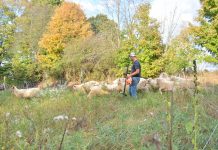
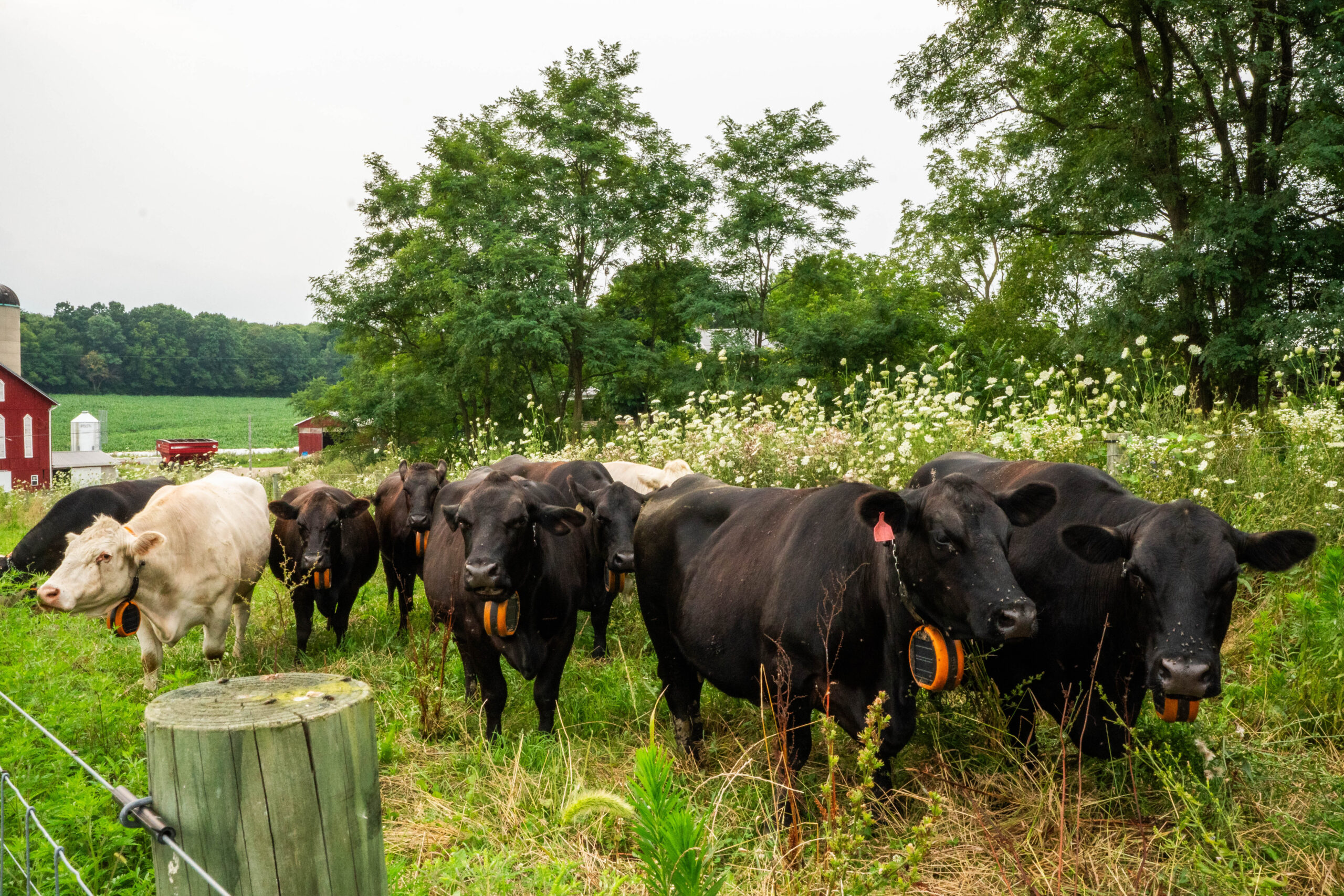
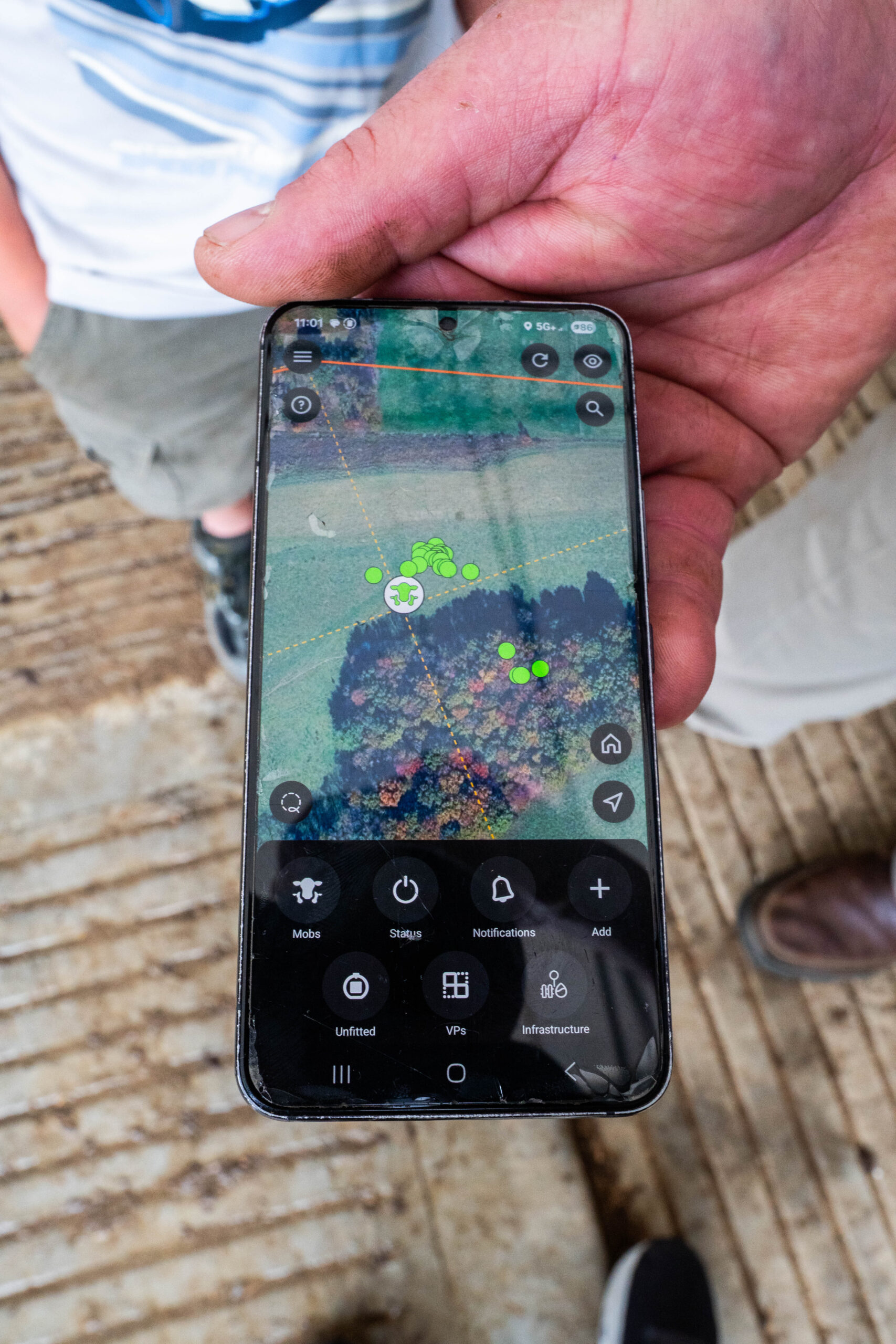
ENON VALLEY, Pa. — William Kolehmainen uses his smartphone to move his cattle from paddock to paddock.
On the screen, the cows appear as green dots. In the field, the cattle wear GPS collars, connected via an app on Kolehmainen’s phone, that tells the animals where and when to move.
The Kolehmainens raise roughly 320 head of beef cattle and grow corn, soybeans, barley, oats and hay on 800 acres in Enon Valley, Pennsylvania.
But with such an expansive farm, fencing off cover crop land and keeping track of each paddock — the Kolehmainens use rotational grazing methods — is often time-consuming and unfeasible.
That’s why they started using GPS collars on their cattle.
“We could take these cows anywhere in the world and make a fence, and they would stay right there. It’s a universal type thing,” Kolehmainen said.
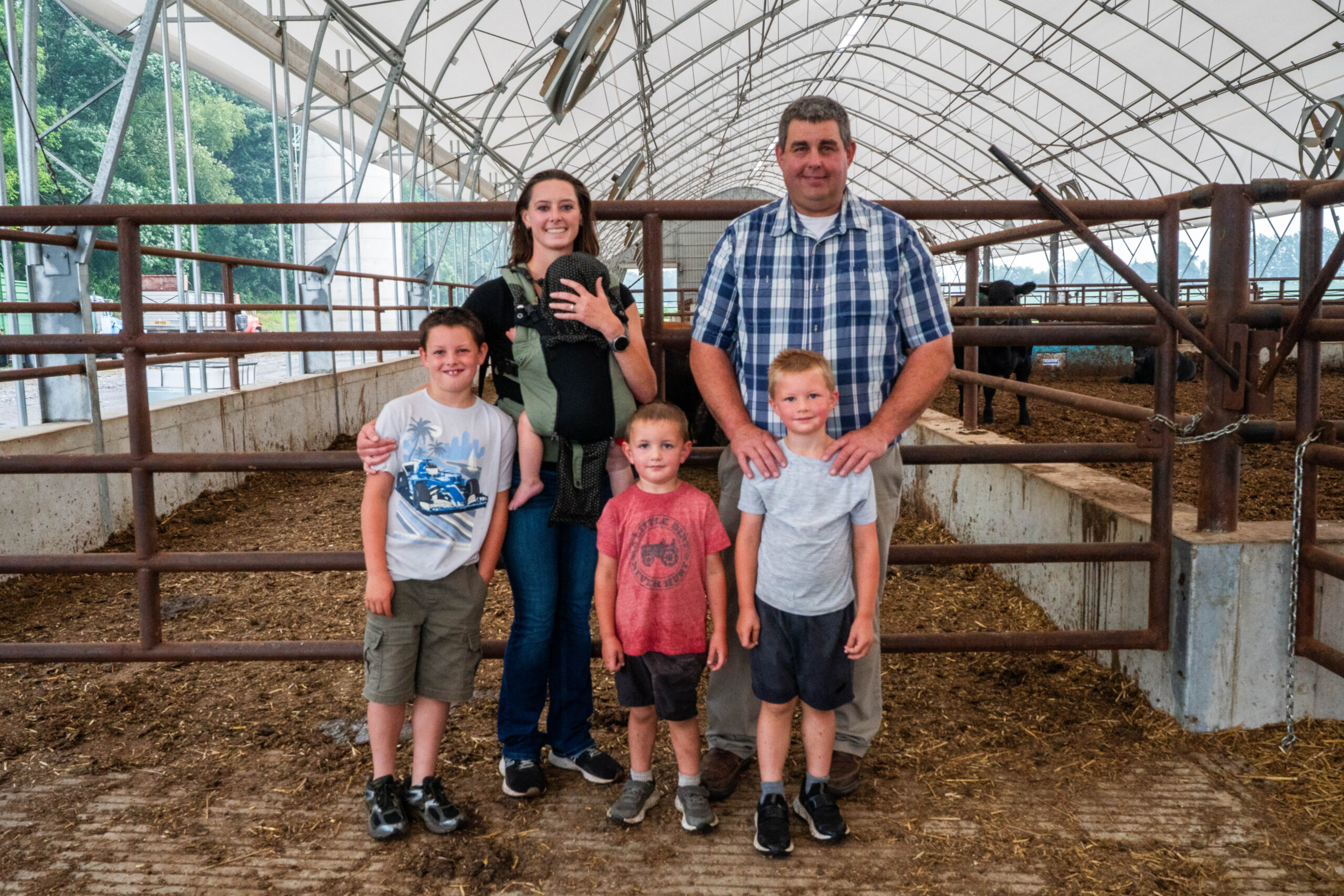
Kolehmainen Cattle Company
Kolehmainen grew up less than a mile down the road on a grain farm in Enon Valley. His wife, Mackenzie, was raised on a hobby farm in New Springfield, Ohio, participating in 4-H as a kid.
The farm the couple owns today was Kolehmainen’s uncle’s dairy farm; Kolehmainen started working there in third grade, helping with various tasks during the summertime.
Roughly eight years ago, Kolehmainen and Mackenzie bought the property. Their first order of business was updating the buildings on the property, including installing a new roof, floor and siding on the barn; putting in a new unloader in the silo; and setting up new fencing.
The Kolehmainens purchased Angus and Wagyu beef cattle in 2019. But with livestock came more necessary updates.
“Everything was built right on the creek down there, so cows were always within 15 feet of the water,” Kolehmainen said.
When cows congregate near streams, there is an increased risk of disease and parasite transmission. This access can also impact stream health; feces can contaminate the water, leading to poor water quality and increased algal blooms, according to Illinois Extension.
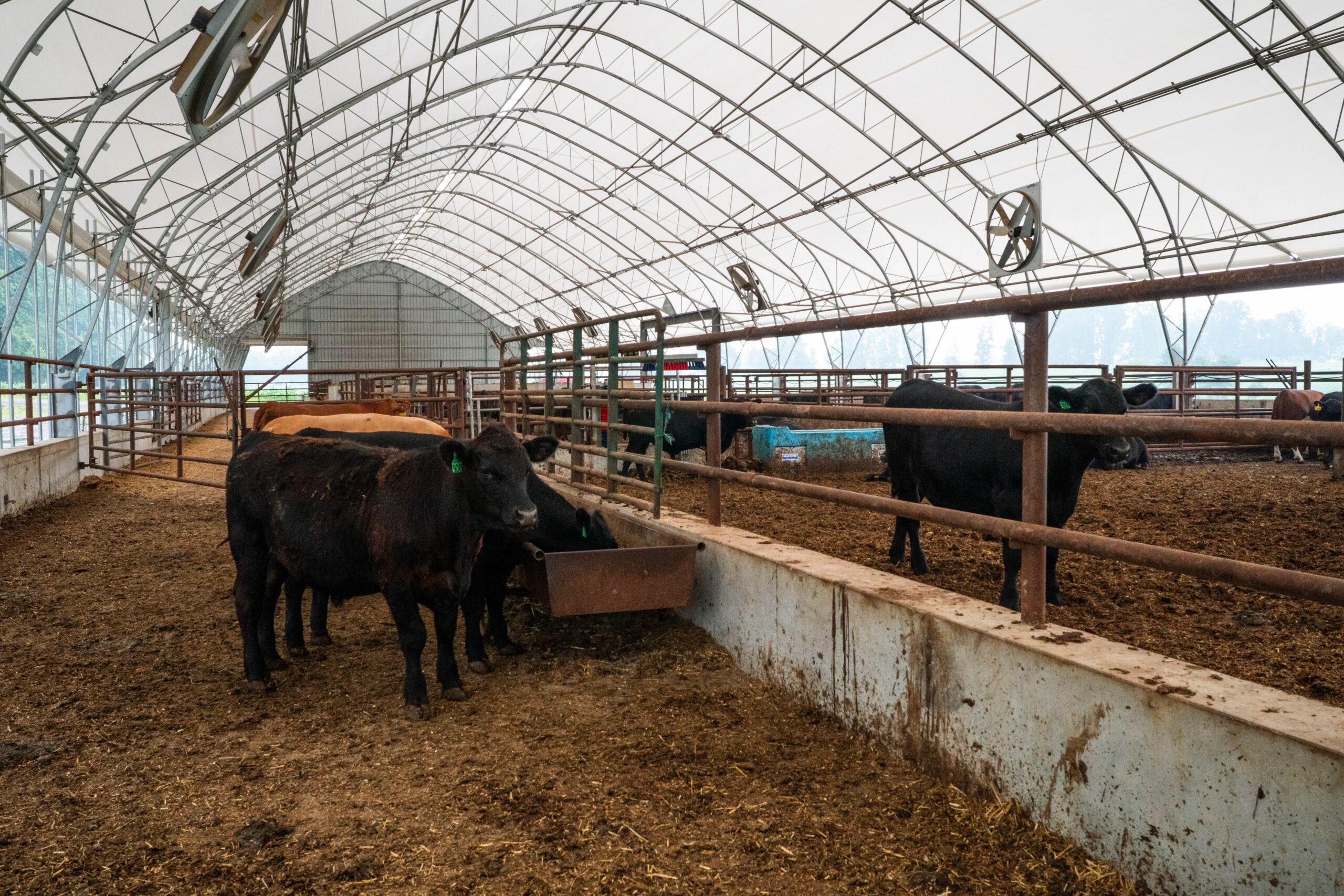
To fix this issue, the couple fenced off access to the stream, and recently built a new feedlot that is farther away and has under-barn manure storage and a dry pack, which stops sediment and nutrient flow to the tributary.
Kolehmainen was recently honored with the 2025 Conservation Farm Award from the Lawrence County Conservation District for these conservation initiatives.
According to Mackenzie, the barn they had before was too small; the new facility has also allowed them to expand their operations.
But the biggest game-changer would be getting GPS collars.
How the GPS collars work
The Kolehmainens got the GPS collars in March after reading about them in a magazine and online. The Kolehmainens bought 64 Gallagher collars, 38 of which they are currently using, for $250 per collar.
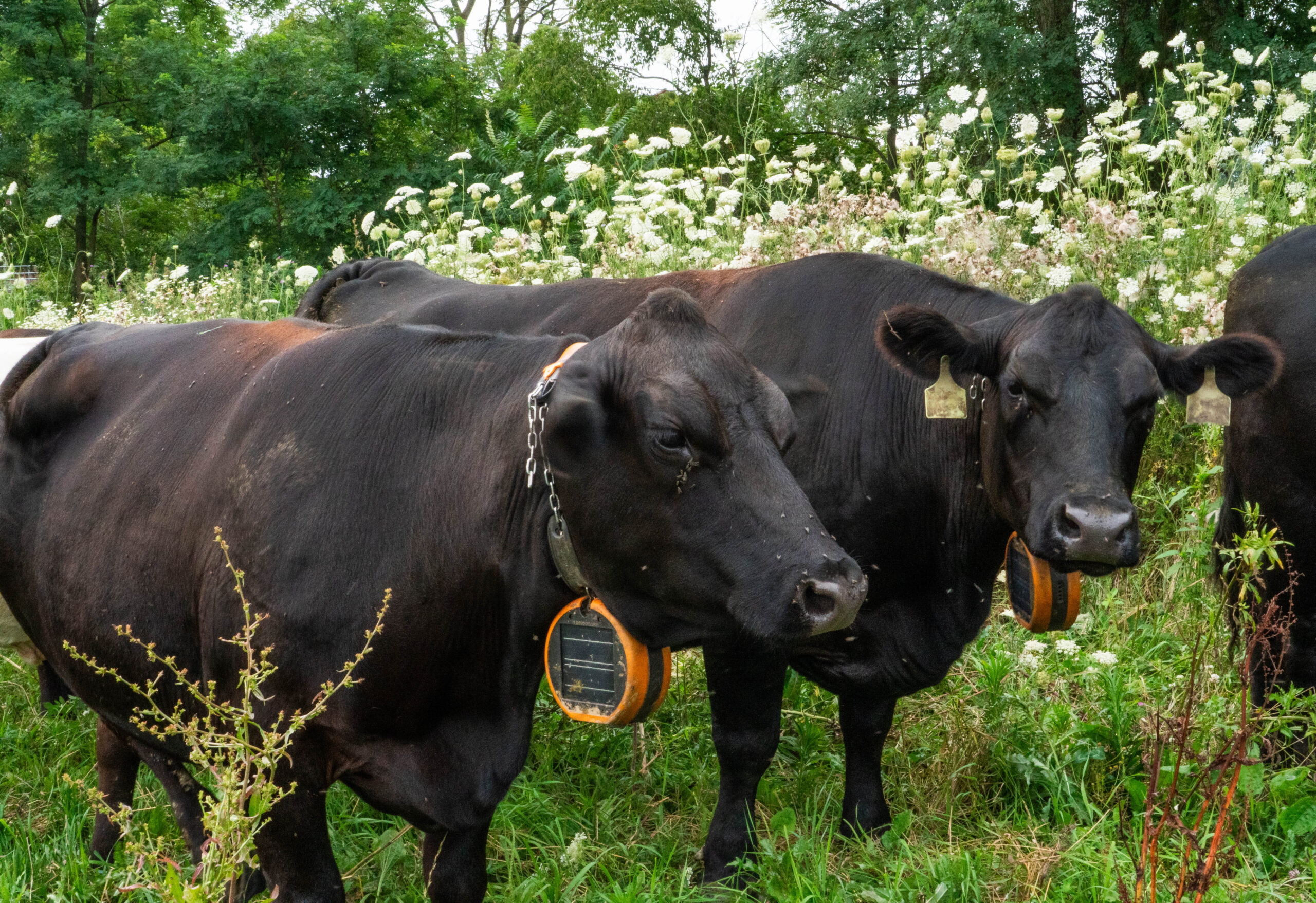
The cattle wear five-pound collars that have solar panels attached to keep the devices charged.
Through the GPS collar app Gallagher eShepherd, Kolehmainen can see where the cattle are on a map and can draw on the next paddock he wants them to relocate.
The Kolehmainens move their cattle once a week or up to 10 days, depending on pasture conditions.
When the cattle get within 6 feet of the virtual GPS fencing boundary, they will hear a loud buzzing sound as a warning. If they try to cross the fencing, they get a slight electric pulse.
Kolehmainen says moving the cattle from paddock to paddock requires minimal effort, as the cattle move on their own.
“They’re so used to grazing up right against that edge that the day you turn that paddock off and open a new one, they go up to that edge, and if there’s no sound, they just keep walking,” Kolehmainen said.
It didn’t take long for the cattle to get used to the collars. The couple put the cows in a chute to fasten the collars. “The first minute or two, they’re like, ‘What is this thing on me? But they could not care less now,” Kolehmainen said.
Getting used to the new grazing system would take a little longer, about a week
To train them, the Kolehmainens put the cattle in a paddock with fencing and drew a GPS virtual fence line on the visible fence, so the cattle would get accustomed to the warning noise and subsequent electric pulse.
The app shows users how many times cattle get shocked from trying to leave the boundary.
“After the first couple of weeks, definitely after the first month, almost all of them, 90 or 92% of the time, never get shocked,” Kolehmainen said. “They hear that sound, and they just turn right around.”
The benefits
The collars have allowed the Kolehmainens to expand their rotational grazing and save time.
For years, the cattle were unable to graze their cover crops because there was no fencing in those fields, and adding permanent fencing to every farm field would’ve created an additional obstacle.
“It’s different every year where we put cows in the summertime; to build fence and work around the crop operation is just not very efficient,” Kolehmainen said. “There’s no simple way to farm (land) and still graze it efficiently without really making a mess of things.”
Before the collars, the cattle were grazing 10 out of the Kolehmainen’s 25 paddocks.
Today, the cattle roam all 25 paddocks, 20 of which do not have fencing. In the past, the couple have tried fencing with wheels to roll through the paddocks and temporary fencing. While these options worked great, it was labor and time-intensive.
“There’s about 50 acres of permanent pasture that we do rotationally graze through,” Kolehmainen said. “But on the cover crop side of things, anywhere from 100 to 200 acres a year is opened up now to grazing with the collars.”
In the fall, the couple hope to graze on corn stalks, something that would open up an additional 300 acres of their farm.
Kolehmainen says the GPS collar and app also allow him to check in on the cattle, even when they might be far away from him. For example, a pregnant heifer might appear alone in the field, signaling she’s getting ready to have a calf.
There is a cost to operate these collars: its $2 per month to provide cellular service to each collar. But Kolehmainen says it is a minor cost in the long-run when they consider the money they are saving on having more pasture as feed versus supplementing with hay.
The uncertainty of trying a new product can be scary, and while they are still in the beginning phases of learning this new technology, “It’s definitely made life a lot easier,” he said.
(Liz Partsch can be reached at epartsch@farmanddairy.com or 330-337-3419.)




I like seeing how many different parts of farming are covered, from crops and livestock to markets and farm management.
I recently started a new farm and found that keeping track of both production and resources helped me stay organized, so checking each area regularly is a useful habit.