

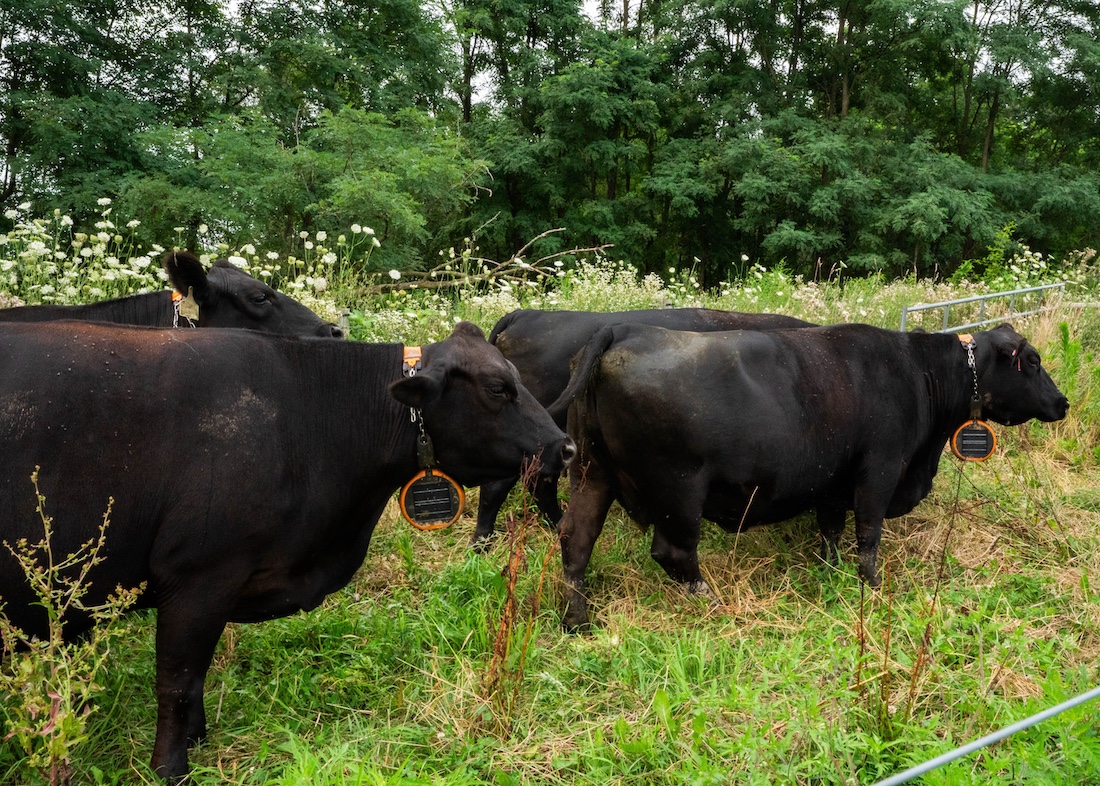
If you read Wyatt Feldner’s Farm and Dairy “Dirt on Conservation” column in last week’s edition, you already know virtual fencing is generating interest among livestock producers. That conversation is part of a larger movement toward remote grazing technologies, a growing category of tools that includes virtual fencing, GPS livestock tracking and other precision livestock management systems.
Across the country, beef, dairy and small ruminant producers are exploring whether these technologies can improve labor efficiency, grazing management and environmental stewardship on their operations.
About remote grazing technologies
Remote grazing technologies comprise a growing field known as precision livestock management, which uses GPS technology, wireless communication, sensors and software to help producers make more informed livestock and pasture management decisions. Depending on the system, producers can track livestock locations, monitor animal activity, receive alerts about water systems or infrastructure issues, establish virtual fence boundaries and collect information about grazing patterns and pasture use.
These tools generally fall into five categories: virtual fencing, GPS livestock tracking, remote water and infrastructure monitoring, animal health and behavior monitoring and integrated management platforms that combine multiple sources of information into a single dashboard. For operations where labor is limited or livestock are managed across multiple pastures or locations, these technologies offer another way to stay connected to both animals and grazing resources while supporting more timely management decisions.
Remote versus traditional
Traditional grazing systems often require significant investments in fencing, water development and labor. Moving temporary fence, checking livestock across multiple paddocks and monitoring pasture conditions can be time-consuming, particularly on operations with limited labor. At the same time, producers face increasing pressure to improve forage utilization, protect natural resources and adapt to changing weather patterns.
Remote grazing technologies have emerged as one potential tool to help address these challenges. However, they should be viewed as another tool in the grazing toolbox, not a replacement for sound grazing principles, stockmanship and animal management.
Benefits and opportunities
Much of the interest in remote grazing technologies centers on three potential benefits: labor savings, management flexibility and environmental stewardship.
Perhaps the greatest advantage of these “techy” tools is their ability to assist in making grazing management decisions more quickly when conditions change. Producers can adjust grazing plans in response to forage availability, weather, drought or conservation objectives while improving livestock distribution and protecting sensitive resources.
Remote grazing technologies are not a substitute for routine livestock and pasture checks, which remain essential for monitoring animal health, forage and water resources and identifying emerging threats such as the Asian longhorned tick and New World screwworm. Good stockmanship remains the foundation of every successful grazing operation.
Challenges and limitations
Remote grazing technologies come with limitations that producers should carefully evaluate before adoption. Cost is often the first consideration, including expenses for equipment, software subscriptions, communication infrastructure and ongoing maintenance. Depending on the system and operation size, costs are typically evaluated on a per-animal basis, and farms with limited cellular coverage may require additional infrastructure to support reliable connectivity.
There is undeniably a learning curve. Battery charging or replacement, equipment maintenance and routine monitoring become part of the management routine, while both livestock and producers need training to use the technology effectively. Ultimately, the value of these tools depends not only on the technology itself, but on a producer’s ability to interpret and apply the information it provides within their production scheme and grazing management system.
Beyond the fencerow
Remote grazing technologies offer new opportunities to improve labor efficiency, management flexibility and environmental stewardship. Like any innovation, their success depends on how well they fit a farm’s goals, resources and management style. The best tool is not necessarily the newest one, but the one that consistently helps producers better manage livestock, forage and labor while supporting the long-term sustainability of their operation.
Want to learn more?
Several university Extension and U.S. Department of Agriculture resources provide research-based information on virtual fencing, GPS livestock tracking and precision grazing management. Recommended resources include
- North Dakota State University’s Grazing with Virtual Fence (AS2293)
- University of Arizona Cooperative Extension publication What is Virtual Fence? Basics of a Virtual Fencing System
- USDA-NRCS fact sheet Virtual Fence Systems for Managing Livestock (SD-FS-126)
- Oregon State University’s Virtual Fencing Research Seeks to Modernize Ranching
- University of Wisconsin Extension video Grazing and Virtual Fencing on Dairy Farms
These publications offer practical information on technology functionality, animal training, management considerations, economics and current research findings.
If you are interested in participating in a small-group conversation about remote grazing technologies or other emerging grazing management tools, I would enjoy hearing your perspective. Please contact me with your questions, experiences or observations as these technologies continue to develop within our region’s grazing systems.