




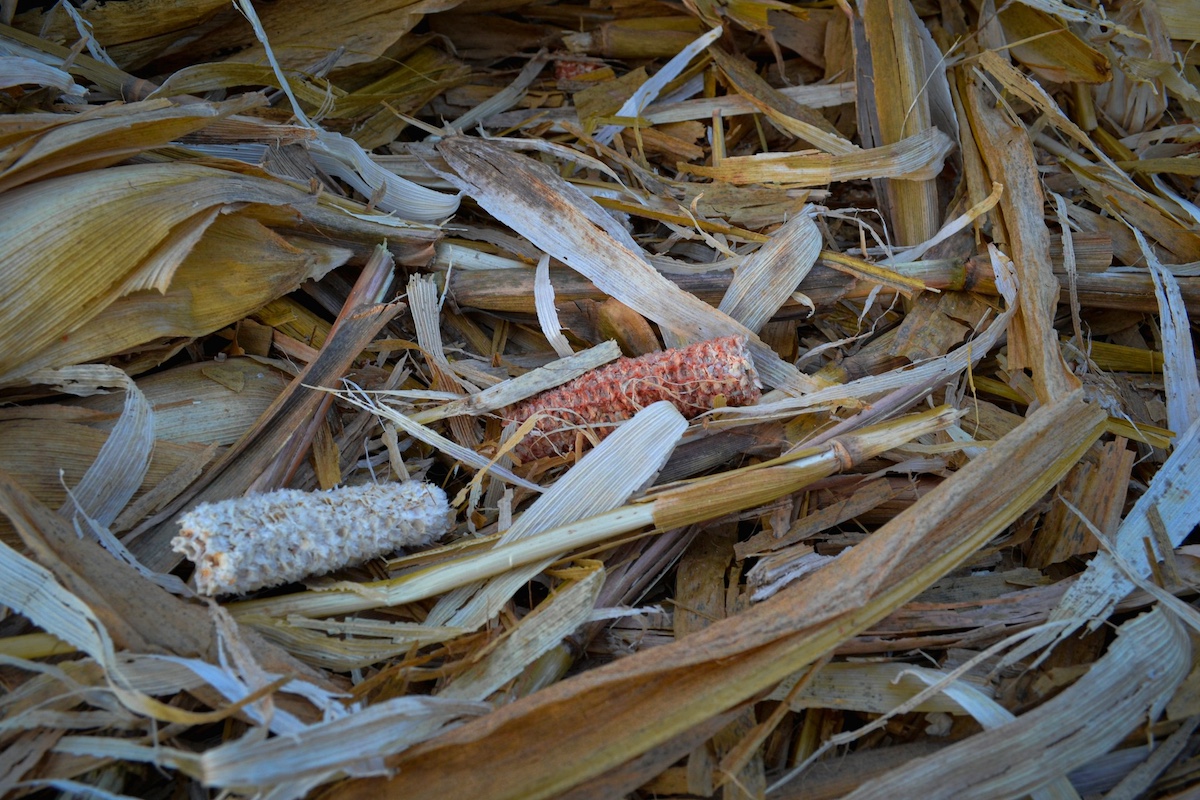
Corn residue can provide an abundant, moderate-quality feedstuff for ruminants. If you have fencing available or can easily erect temporary fence, it can be a cheap feed alternative prior to digging into your more valuable, harvested hay.
If you are short on hay supplies, you can use stalks in a grazing scheme or you can bale them to feed as another harvested forage. Although it isn’t an exact calculation, we estimate that for every one bushel of grain production, you have 16 pounds of corn residue left in the field.
So, if you averaged 200 bushels of corn, you could estimate that there is about 3,200 pounds of dry matter per acre. We assume that only half of that would be available for an animal to consume, which leaves about 1,600 pounds of dry matter per acre. Considering that a ruminant will eat about 2.5% of its body weight every day, you could graze 1,000 pounds of animals for about 60 days on each acre.
Nutritional quality
The average nutritional quality of the total residue available is low. However, the different parts of the plant vary in crude protein and digestibility, and you can use this to your advantage through your grazing management.
The grain will have the highest protein (10%) and digestibility (90%), followed by the leaves (6.5% CP, 46% digestibility), husk (3.5% CP, 61% digestibility), the cob (2.8% CP, 35% digestibility) and the stalks (4.1% CP, 45% digestibility).
The absolute quality of the stover is dependent on the growing conditions throughout the year, disease pressure, post-harvest weather and the efficiency of your combine.
The good news is that ruminant livestock are selective eaters and will choose to eat the leftover corn grain, leaves and husks first. If forced to stay in an area long enough, they will consume the less desirable parts of the plant. That is also good, considering if there is a chance of higher stalk nitrate concentrations, they would consume that portion last. However, drier growing conditions also lead to residue with above-average quality indicators.
Concerns
If your cattle or sheep are in good condition, and you allow them to graze through quickly, minimal protein, mineral and vitamin (Vitamin A) supplementation is required. If you want them to thoroughly glean the fields, you will need to provide additional energy supplementation the longer they are out. I would suggest you consult with your nutritionist to develop a supplement that meets the needs of your herd or flock.
You should be aware of areas of downed corn, where the majority of the grain was left in the fields. The animals will be attracted to these areas and may consume enough grain to lead to acidosis and other digestive upsets. Strip grazing is generally recommended to prevent overfeeding in these areas and allow for better use of the residue over the entire field.
Looking ahead
You may ask what concerns you should have about next year’s grain production following grazing residue. Research conducted at the University of Nebraska and South Dakota State University both indicate that grazing corn residue has no impact on the production of grain the following growing season. The normal freezing and thawing of winter typically loosens any compaction created by the animals. Grazing will also recycle nutrients to make them more readily available for next year’s crop.
If you choose to bale stalks off, you should consider the nutrients being removed when you are planning next year’s fertilizer applications. Rates should be similar to corn silage rather than corn for grain.
I have seen producers be very creative with their residue grazing strategies. If you want to provide a higher level of nutrition through grazed forages, you can consider planting alternative crops adjacent to residue acres.
Future options would include planting strips of brassica crops (kale, turnips, etc.) or small grains (wheat, rye, triticale, etc.) next to corn acres that will be grazed. You could also have an adjacent area of stockpiled cool-season grass.
Producers who use this option will strip graze so that their animals have a portion of residue and a portion of the annual crop or stockpile forage. Some have attempted flying on an annual crop earlier in the summer prior to corn harvest so that both forage options are available on the same acre.