


She was stately. She was massive. Weathered, yet beautiful with the sunlight illuminating her strength and longevity, she was a silent sentinel bearing witness to the sun’s rising and setting, season after season, decade after decade. And then one day … she was gone.
The lots sold quickly. The land that for so long supported acres of crops was now sprouting up houses with vinyl siding in treeless yards with trampolines and flowerpots. Field fertilizer was replaced by lawn chemicals. Without a trace, that landmark beautiful barn I admired while driving by for so many years had completely disappeared. Even her foundation stones were hauled away.
When that barn was young, so were our soil and water conservation districts, brought to life by public outcry and congressional action after our nation experienced the frightening and fatal effects of severe soil erosion. During the 1930s, our food, farms, homes, livestock and health were smothered by black blizzards of blowing sediment originating in the Great Plains.
Prolonged droughts, intensively plowed prairies and unsustainable farming practices left the topsoil exposed and vulnerable, causing an environmental and financial disaster of mythic proportions.
Conservation districts were born as a catalyst for stewardship from the urgency to protect our soil resources with practices that prevent erosion.
Overall, four core principles to maintain healthy soil took root: 1) Keep the soil covered as much as possible; 2) Manage soils more by disturbing them less; 3) Use plant diversity to increase diversity in the soil; 4) Keep plants growing throughout the year to feed the soil.
A few examples of farming practices that support and achieve these include no-till or reduced tillage, cover crops, contour farming, crop rotation, buffer strips, mulching and nutrient and manure management.
Land development
Decades have passed since the catastrophic Dust Bowl, and now farmland tractors and tillers seem to be outnumbered by construction site backhoes and bulldozers. Initially committed to agricultural soil erosion issues, conservation districts have since pivoted to address minimizing soil disturbance and pollution from land development. As our communities continue to grow and suburbs sprawl full speed ahead, even less populated regions are witnessing significant landscape shifts. New homes, retail hubs, restaurants and dollar stores continue to crowd out what was once open space. Patchworks of excavated brown lots have replaced the lush green of fields and forests, and more and more sediment now blankets our streams.
Today, Ohio’s soil is now our waterways’ paramount pollutant. The Environmental Protection Agency lists sediment as the most common pollutant in U.S. rivers, streams, lakes and reservoirs, and while natural erosion produces 30% of the total sediment, accelerated erosion from human use of land accounts for the remaining 70%!
This type of sediment pollution can be generated from any land- or soil-disturbing activity such as the clearing, grading or excavating of a construction site. In fact, even small-scale construction activities account for the most concentrated sediment releases.
Many studies throughout the nation document sediment loads to be as much as 1,000 times greater from construction sites than from static land-use sites.
The negative impacts of excessive sediment pollution are many and immense. Sediment smothers aquatic life, degrades drinking water, increases turbidity and temperature, alters stream channels and flows, disrupts food chains, increases harmful algal blooms, accumulates in storm drains and catch basins, decreases property value, increases flooding and costs billions of dollars annually.
Seed it
These impacts, however, can be drastically reduced from construction site activities with a relatively simple and effective practice to ensure sediment remains onsite. Just seed it!
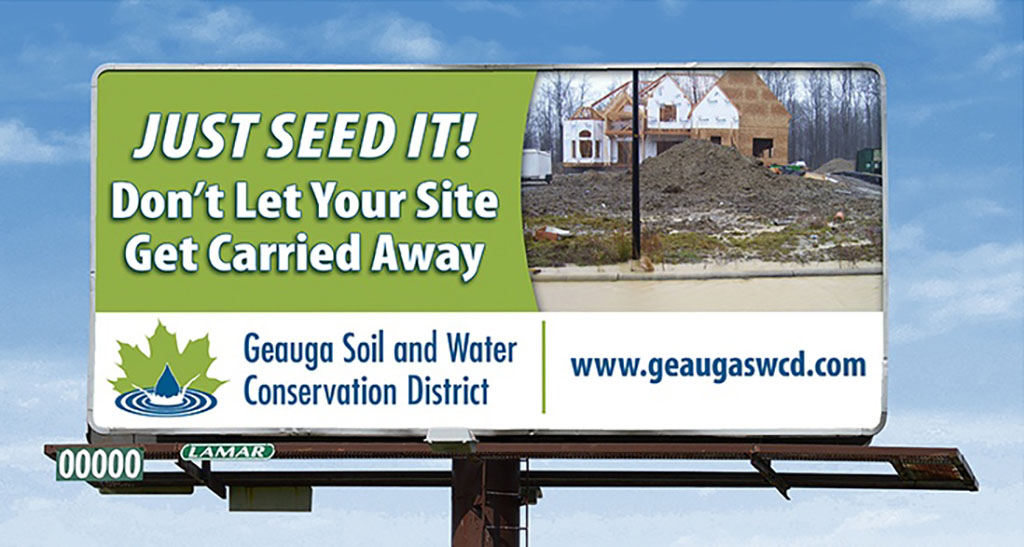
No matter the size of the construction project, Geauga Soil and Water Conservation District wants to help residents realize the importance of stabilizing sites through the simple act of seeding. Last year, the district launched a new outreach message: “Just Seed It! Don’t Let Your Site Get Carried Away.”
By using prominent billboards in targeted areas with increased development and growing populations, the district continues to promote the importance of protecting topsoil. Stabilizing soil is imperative to minimize erosion and off-site sediment from development sites, and seeding and straw mulching are relatively inexpensive and easy to implement and require minimal maintenance.
Temporary seeding establishes a cover on disturbed areas by planting rapidly growing annual grasses or grains for areas temporarily being unworked or prior to the onset of winter. It is the most effective, best management practice to reduce erosion and prevent sedimentation. Seeding is not as maintenance intensive as other BMPs and is a more permanent solution. Be on the lookout as two new billboards roll out in Geauga County next month.
For many of us, old barns represent a tangible link to the past and serve as powerful reminders of days gone by. Though we are losing these structures, let’s not lose the lessons they have taught us.
Sediment pollution in our watersheds continues to compromise two of our most critical resources — our soil and our water. Regardless of the land use, let us commit to reduce sediment, eliminate soil erosion and anchor it with roots before it pollutes.