





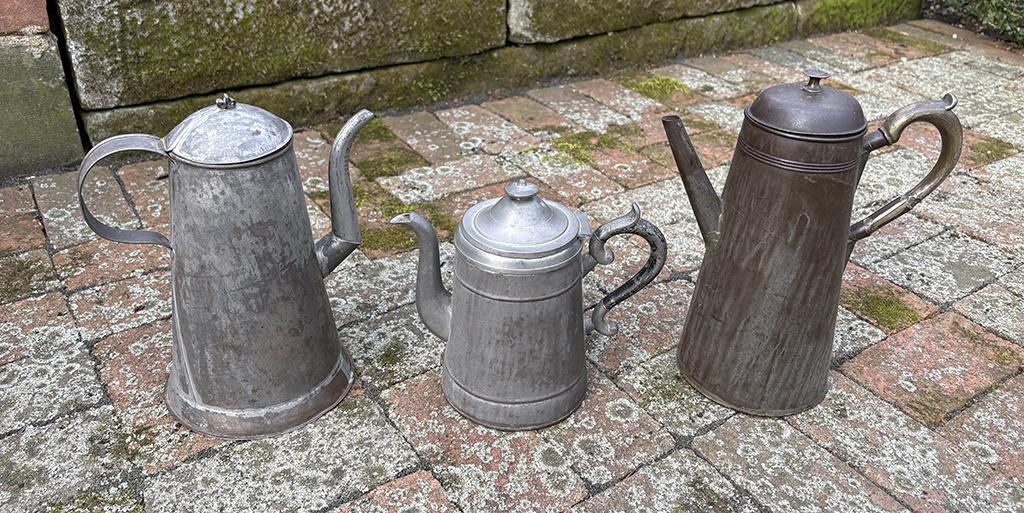
A recent column talked about the coffee roasters used by Ohio country settlers in preparing that increasingly popular frontier beverage.
But what was coffee served in? To a great extent, that depended upon one’s ethnic background.
As we know, the Ohio country was primarily settled by two major cultural groups: New Englanders who migrated from the northeastern states and Germans who came from the southeastern Pennsylvania region.
Both of these groups had their own distinct ideas about what a coffee pot should look like and how it ought to be constructed.
Regardless of the culture, however, the crafting of coffee pots was the exclusive domain of the local tinsmith, who typically used patterns passed down from one generation to the next. There were patterns for the main body of the pot, the bottom, top, spout, handle, hinge and so forth.
Plain pots
As a rule, the coffee pots favored by the New Englanders were fairly plain. Their shape was often characterized as being like that of a lighthouse, with a conical body larger at the base than the top. The spout was usually tapered as well, narrowing as it projected from the body of the pot to the end. Such pots also had a tapering strap handle soldered at the upper rim of the pot and about two-thirds of the way down the body.
New England coffee pots were usually unadorned, with the exception of some crimping in larger pots to increase the strength of the metal. Sometimes, however, the lids were adorned with a decorative cast pewter finial that had a floral or classical motif.
Highly detailed
Pennsylvania German coffee pots, however, were the exact opposite when it came to embellishment and decoration.
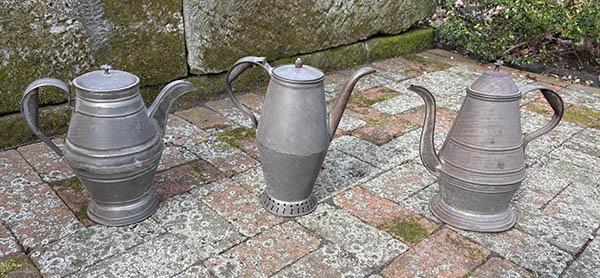
In terms of basic structure, Germanic coffee pots were much more detailed all around. The body was usually formed by two tapered cup-shaped pieces soldered together to create a waist-shaped profile. To this was added a base piece to enhance the stability of the pot. The tapering strap handle invariably had a C-shaped piece of tin soldered into the curve, both to provide the user with a better grip, as well as to give it more strength. There was also a thumb rest for better control of the pot.
Spouts were crafted from multiple pieces of tin soldered together to create flowing, tapering curves. The ends of the spouts usually had V-shaped cutouts to give the appearance of delicacy.
The tops of these pots were dome-shaped — some being raised quite high — with a brass knob or multiple small tin loops serving as finials.
As time passed, more Pennsylvania German coffee pots were embellished with decorative cast pewter spouts, handles and finials, although the basic profile remained unaltered.
Types of decoration
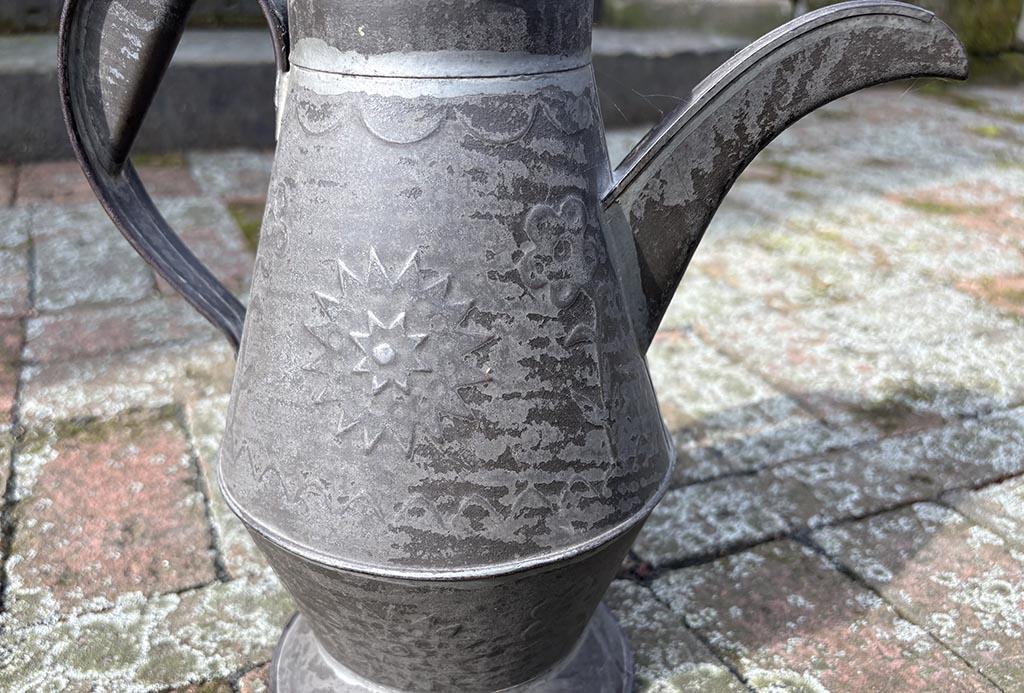
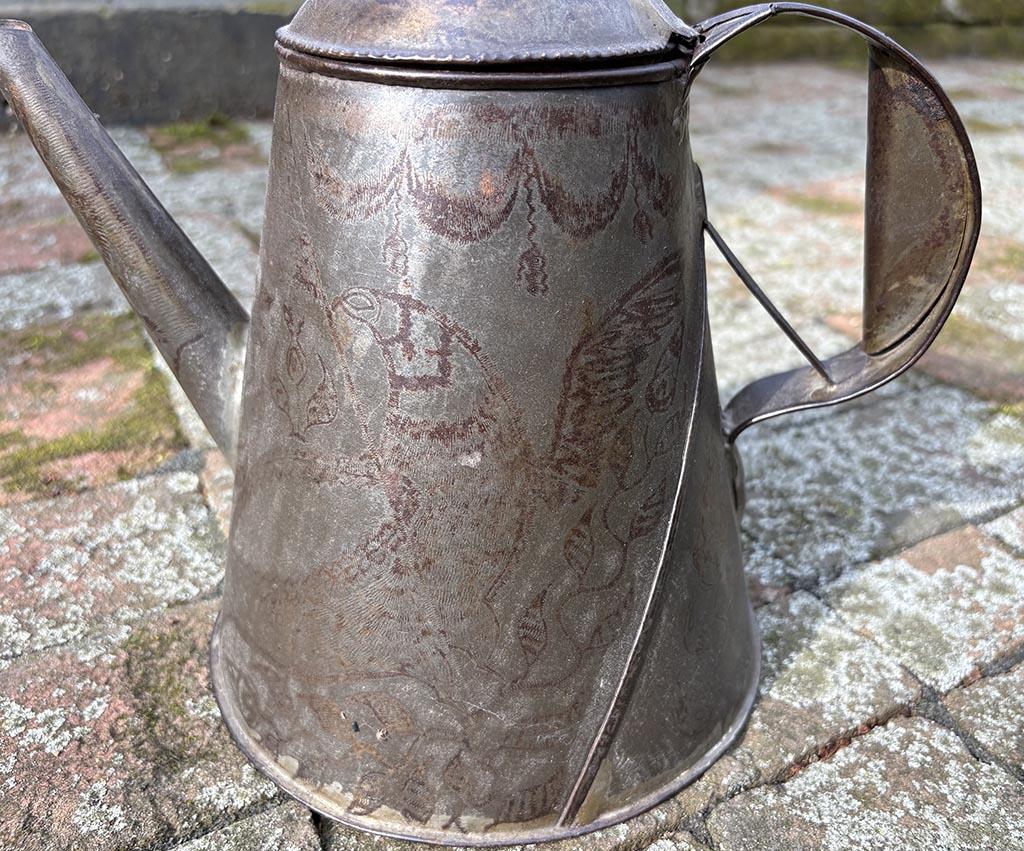
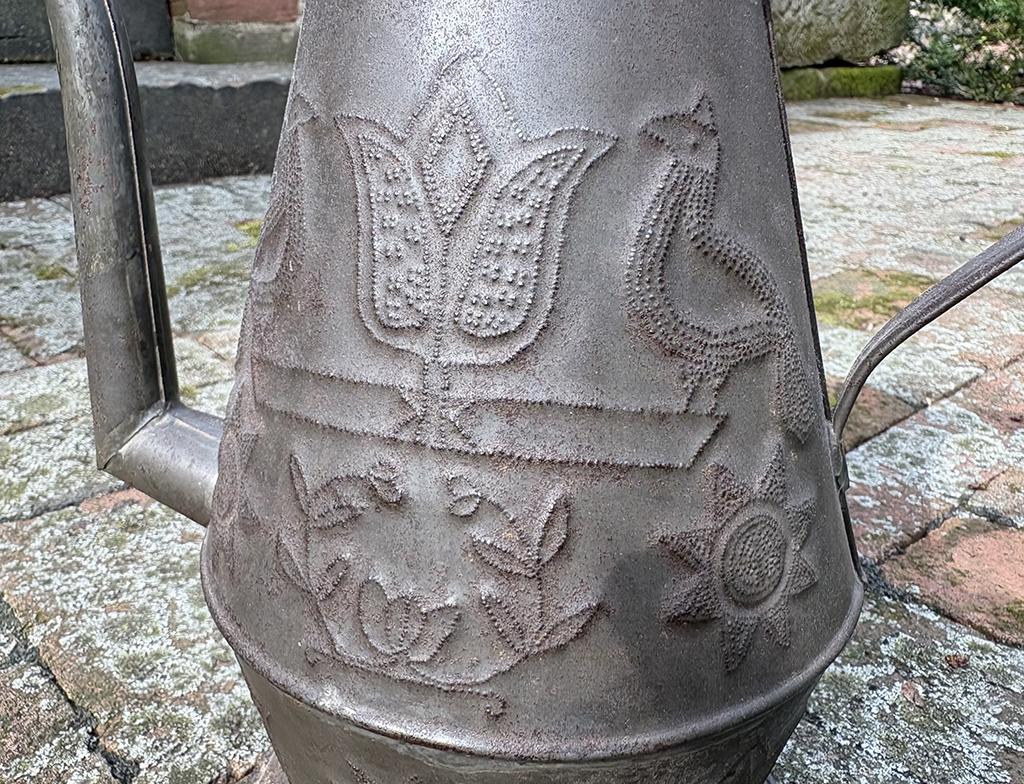
Because the Germans loved detail, many of their coffee pots were adorned with one of three kinds of decoration: punchwork, blockwork or wrigglework.
In punchwork decoration, the tinsmith used a pointed tool like a nail or an awl to create lavish decorations such as birds, tulips or other flowers, animals, dates and so forth. This punchwork was done from the inside out, the purpose being to slightly fracture the tin coating on the sheet iron, allowing the punched portion to oxidize over time, better showing off the punched pattern.
In blockwork, small carved wooden blocks were struck into the tin to create a repousse effect, raising the designs slightly above the surface.
Wrigglework was the most difficult of the three techniques and attempted only by the most masterful craftsmen. Because of this, comparatively few examples of this art form exist.
In wrigglework, the tinsmith employed tiny chisels, struck lightly to created highly detailed motifs that often included eagles, banners, stars and swags, as well as floral motifs. As in punchwork, the idea with to slightly break the surface of the tin plating to allow oxidation to reveal the design.
In addition to decorative work that was an inherent part of the coffee pot’s structure, both the New Englanders and Pennsylvania Germans decorated their coffee pots with vibrant and highly detailed tole painting. Common subjects included floral motifs, vining foliage and birds.







Thanks, Paul! Good read.
Those German two-piece java pots? I’m sure the tinsmith back in the day used “100% LEAD FREE SOLDER” joining them, right?