





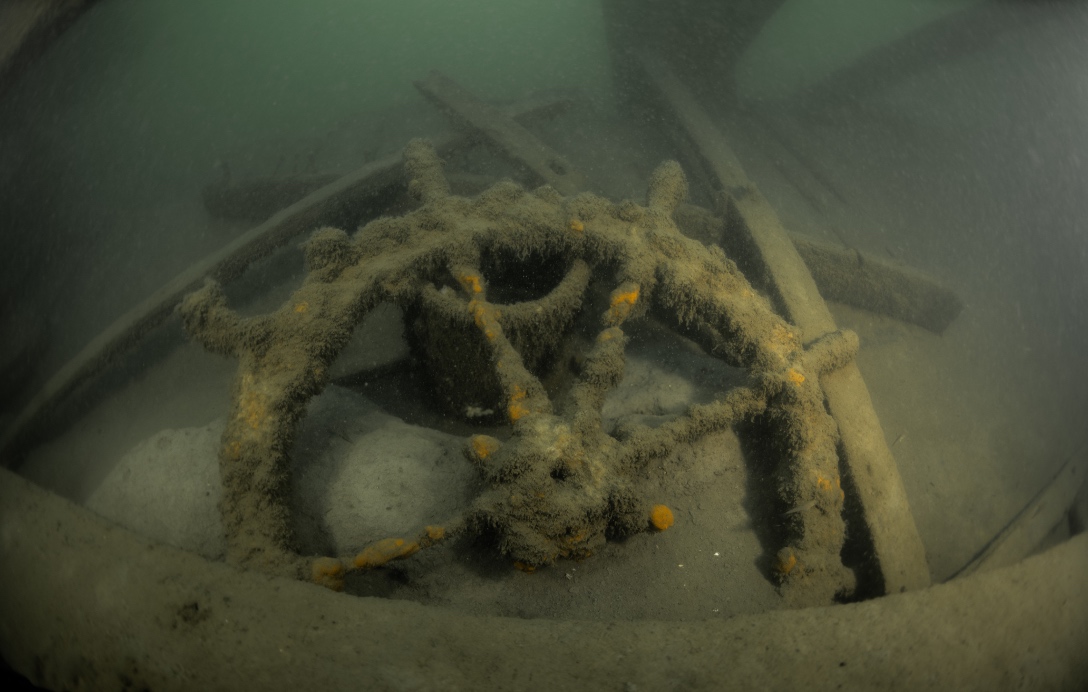
CLEVELAND — Seventy feet down, on the dark, cold bottom of Lake Erie, the nameless wreck of a three-masted ship juts out of the sediment where she’s rested for more than a century, a hulk of rust, algae and muscle-encrusted wood half-swallowed by sand straining upward like a hand reaching from a shallow grave. She lies in the same spot where she crashed down after losing the fight of her life against gale-force winds and towering waves.
Her remains were first spotted in 2022 in a side-scan sonar image captured by Cleveland Underwater Explorers (CLUE). But no one knew her story until now.
On Feb. 18, the National Museum of the Great Lakes, working with CLUE, announced that they had finally put a name to this unidentified “Jane Boat” of the lake. She is the Clough (pronounced “Clow”), a 125-foot stone-hauling workhorse distinguished by her unique sail rigging, which would have combined square sails with traditional triangular ones. This configuration was ideal for helping the ship catch wind at high speed like deploying a parachute, while the other sails acted as wings, helping her cut more easily across the water. These design innovations, along with her maneuverability, would have made her especially efficient in the 19th century: easy to handle, capable of crossing long distances and requiring only a modest crew.
No decorative figurehead adorned her bow; she had no grand interiors or appointments. Instead, on her decks and in her holds, she bore a punishing load of circular grindstones and huge, rough-hewn sandstone blocks mined from the quarries of northwest Ohio and Michigan.
“CLUE looked for this shipwreck for more than 10 years. They surveyed 248 miles of lake bottom to eventually find it,” said Carrie Sowden, director of archaeology and research at the National Museum of the Great Lakes. But the sonar image was only the beginning.
“There was a lot of diving; they did a lot of basic introductory measurements, and… more research to kind of confirm the size of the vessel versus what the Clough was. (There’s) lots of different things that help identify something like this.”
Dedication
That painstaking work fell largely to a small team of volunteer divers, chief among them being CLUE founder David VanZandt, an aerospace engineer by day and, as Sowden put it, “a truly renaissance man” who devoted his nights and weekends to shipwrecks and history. A highly experienced technical diver, VanZandt was the first person ever to descend to the wreck in 2024, but died after suffering what was later described as a medical emergency.
“The rest of CLUE had a lot of discussions about what they wanted to do and what they thought Dave would want,” Sowden said. They agreed the organization should carry on and finish its mission of confirming the ship’s identity.
Today, at the National Museum of the Great Lakes, the work on the Clough has already been woven into a new micro exhibit that doubles as a tribute to VanZandt. The display focuses on the museum’s long partnership with CLUE, VanZandt’s role in founding the group and leading its survey work and the years‑long effort to identify the wreck.
CLUE members are like modern-day treasure hunters, but they don’t search for chests of gold. Their prize is lost history. They crisscross Lake Erie, studying pixelated splotches on their computer screens and scanning for shapes that might signal something important resting on the lakebed.
“We’re really at the mercy of the weather,” explained Chris Kraska, a maritime archaeologist and teacher. Shifting winds and rough waters can quickly disrupt equipment and bring work to a halt. For Kraska, though, the action isn’t only beneath the surface.
“Historical research is actually one of my favorite things to do, because you’re looking for clues. It’s kind of like a mystery.”
Ship’s story
In her day, the Clough probably inspired about as much admiration as a modern 18‑wheeler does on the road now. Yet the cargo ship’s short life was remarkable for the sheer amount of misfortune she endured.
In 1867, the year she was built, the Clough got into trouble going up the Black River, running aground and suffering damage before she began to take on water. She narrowly escaped after crews fastened a metal patch over the break in her hull and refloated her. But her luck ran out just a year later, on Sept. 15, 1868, when the Clough was caught in a brutal storm. As she was battered by waves, the massive stone blocks she carried on her decks — some roughly 12 feet long and weighing as much as 20 to 30 tons apiece — suddenly shifted to one side, fatally throwing off her center of gravity.

For about half an hour, her crew of nine, which included Captain J.S. Reed, 1st Mate George Derick, Stewardess Catherine Sullivan, Arthur Chapman, David Bleer, Andrew Fitzpatrick and Benjamin F. Leighton, fought to right the vessel, but she never recovered. The ship floundered before slipping beneath the waves, and all but one man were lost. According to a Sept. 17, 1868 article in The Plain Dealer, the survivor, Rush Reed — the captain’s brother who was serving as 1st mate — was in the water for 36 hours before he was rescued. Leighton’s body was later recovered, washed ashore in Euclid, Ohio, carrying a gold watch with his name engraved on it.
Icy depths
Kraska has seen the wreck up close, and down there, it’s a different world. As you descend, the water around you slips from light into near‑darkness. Somewhere along that drop, you cross the thermocline, the sharp boundary where the warm surface layer suddenly gives way to the lake’s icy depths.
“When you’re going down to that wreck, and you get past, say, 50 feet, all of a sudden, it’s like you’ve jumped into an ice bath,” he said.
To withstand that cold, divers wear thick wetsuits or fully sealed dry suits layered with insulating garments. They carry multiple lights, along with measuring reels, cameras, clipboards fitted with waterproof Mylar sheets and mechanical pencils for sketching. Redundancy is critical.
“You always want to have more than one way of doing anything,” he said. “More than likely something’s going to go wrong on a dive.”
A reel of nylon connects them back to the main anchor line from the dive boat, ensuring they can find their way through silt and low visibility. Gloves protect hands that can quickly go numb in the cold.
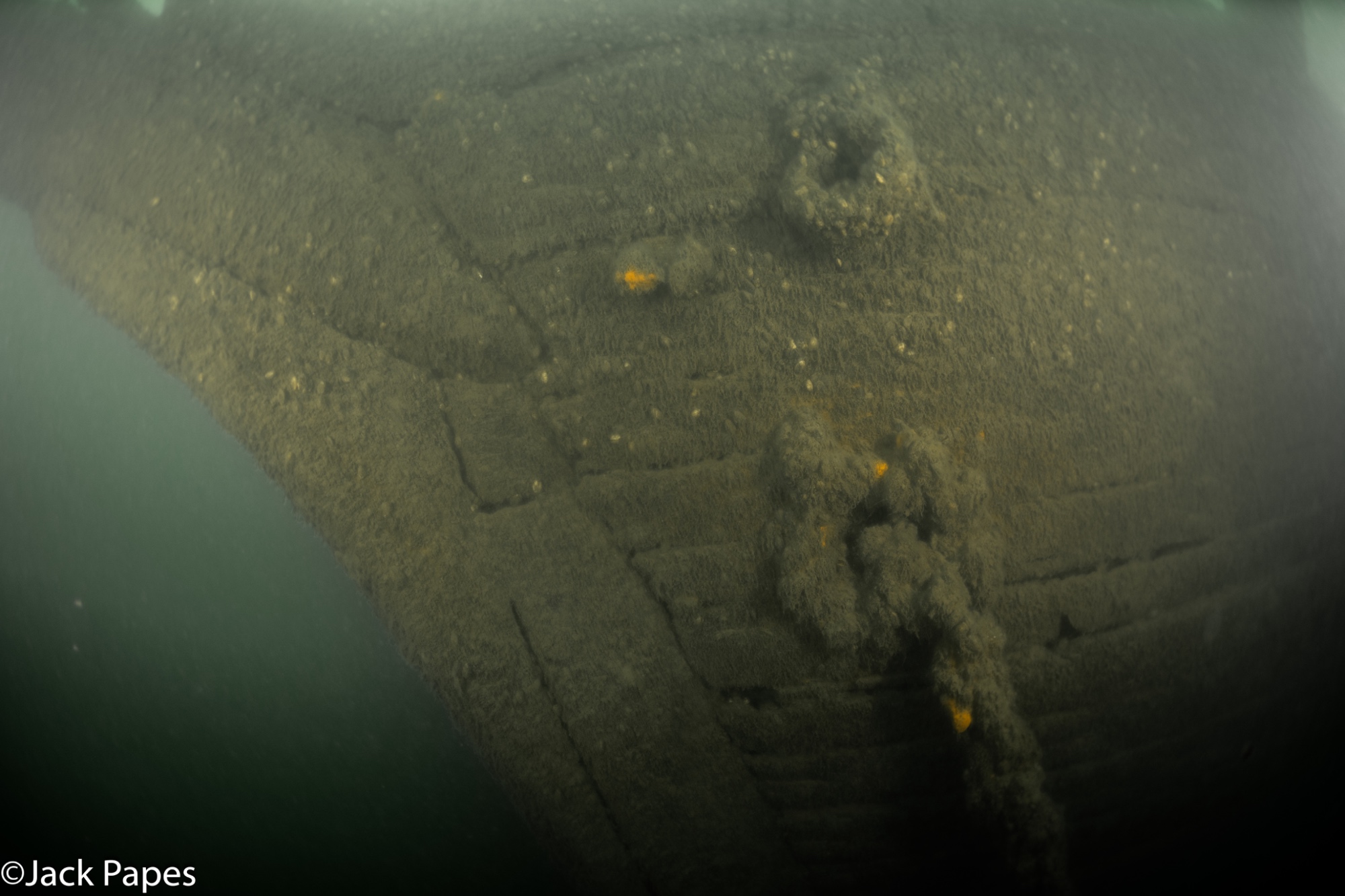
When divers first reached the wreck believed to be the Clough, several features immediately stood out. The cargo was key. There weren’t a lot of stone-moving ships that were lost at that time. All three masts were missing, a detail that aligned with historical records showing the Clough had been salvaged the year after she sank, her masts removed while her cargo was deemed too heavy to recover. Measurements of the hull length and beam matched enrollment records. The bow bore no decorative carving, consistent with documents listing the Clough’s figurehead as “plain.”
Then came the final confirmation: a metal patch covering a hole in the hull after a close call in the Black River. That sealed the deal.
Sense of accomplishment
For the team, the identification is the culmination of years of work in the water as much as in archives and libraries, combing through 19th-century newspaper accounts and shipping records in places like Buffalo and Cleveland, cross-referencing dimensions and cargo descriptions until by process of elimination only one viable candidate remains.
“It’s fun,” Kraska said. “You get done with it, and you’re able to say, ‘this is what this is.’ It gives you a sense of accomplishment.”
For those who dive at such wreck sites, the loss of a crew is never far from mind.
“To me, I always go on wrecks with the knowledge that possibly, or in some cases, certainly, people have lost their lives,” he said. “Often, I consider it a gravesite.”
Under Ohio’s shipwreck protection laws, artifacts are considered state trust property and must remain in place. Divers may document, measure and photograph but cannot remove anything.
“When you come up, you come up with what you went down with.”
While Lake Erie’s relatively shallow waters mean wrecks here rarely achieve the pristine, mast-upright preservation seen in the deeper, colder reaches of Lakes Michigan or Superior, the Clough stands out for its condition. Much of her hull remains intact. Railings and portions of the deck are visible. The windlass at the bow and deck pumps still sit where they were last handled.
“We don’t get a whole lot of this beautiful ship sitting on the bottom in good shape,” Kraska said. “So when we get something like the Clough, it’s approaching that. We’re just happy to be able to find it in that kind of shape.”
For Sowden, the discovery brings to a close a long arc of history shaped by tragedy, a story the living are now duty-bound to tell.
“To me, the stories of maritime history are the stories of the people,” she said. “This is a story that touched a lot of people.”





Good story. May all her crew and Dvid Van Zandt rest in peace. <
Thank you for your tenacious interest in history and for sharing this story!