





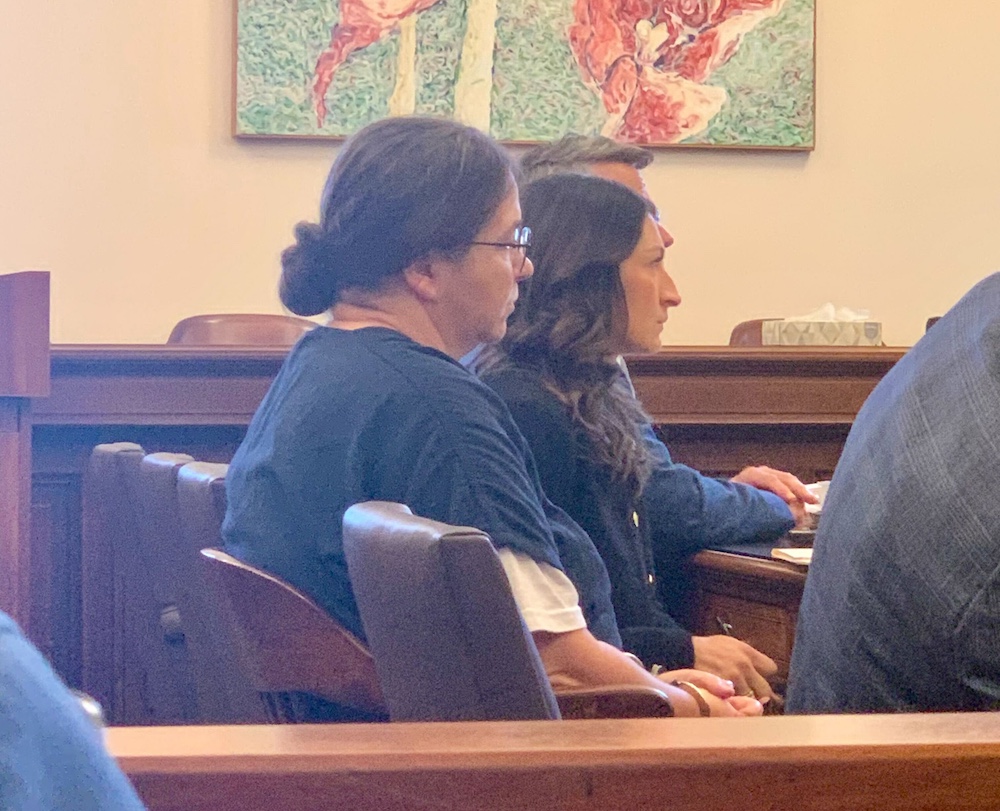
NEW PHILADELPHIA, Ohio — A judge ruled that a Millersburg Amish woman will remain jailed without bail after a Tuscarawas County grand jury indicted her earlier this month on charges including aggravated murder in the drowning death of her 4-year-old son at Atwood Lake Park and Campground on Aug. 23.
At an evidentiary hearing on Sept. 29, Detective Captain Adam Fisher testified that 40-year-old Ruth Miller, who he said was in the midst of a mental health crisis, admitted to authorities that she had taken her son to a dock where the family’s pontoon boat was moored and “thrown Vincen into the lake to give him to God.” According to Miller’s account, after the boy was in the water, the voice she believed was God spoke to her again, questioning why she was still watching her son after she had already done what He asked.
“And at that point, she turned around and walked away,” Fisher said.
When pressed by Prosecutor Brian Stier if that meant she saw her son drown, Fisher replied, “Essentially, yes.”
Vincen’s death came only hours after his father, 45-year-old Marcus J Miller, was last seen by a witness on the same dock before apparently attempting a swim he believed would prove his devotion to God. His body, along with his son’s, would later be recovered nearby in the lake.
The judge’s decision on the matter of Miller’s bail sets the stage for a coming trial after hours of tense courtroom testimony.
The case
Ernest laid out the process before the courtroom, explaining that under Ohio law, the burden was on prosecutors to prove by “clear and convincing evidence” that Miller not only committed the offenses she’s charged with, which also include child endangering and three counts of domestic violence, but also that her potential release posed “a substantial risk of serious physical harm” to herself or the community, and that no release conditions could reasonably assure their safety.
Stier wasted no time in his opening statement.
“This is not a who-dunnit or what did she do,” he told Judge Michael Ernest, adding the “proof will certainly be evident,” and “that Ruth Miller admitted to and committed the crime of aggravated murder with regard to her 4-year-old son.”
He went on to argue that Miller was a danger not only to herself but also to her three surviving children — a 15-year-old daughter and 18-year-old twin sons — who, according to Fisher’s testimony, had later followed their brother into the lake on Miller’s instruction. He said that after she was hospitalized, Miller found it all hard to grasp and expressed disbelief at what she did.
“At one point, she said, ‘The devil got to me in the moment,’” Stier said. “Was God making her do it? Was the devil making her do it? Whether she’s faking it or whether she’s honestly delusional, for the purposes of this day, it doesn’t matter. What matters is there’s nothing that can assure this court she’s not going to have some break again.”
The most prudent course of action, he said, would be for the court to order Miller to have no contact with her children until a mental health therapist could endorse a plan.
Concerning her bail, defense attorney Ian Friedman countered, focusing on Miller’s mental state. While he acknowledged that there was no question Miller carried out the act that led to the death of her young son, he argued that the question was whether Miller had the intent, or mens rea, to commit the crime.
He further contended that Miller was not a “cold-blooded murderer who poses a threat to those around her,” arguing that the incident was an isolated event that “would not have happened but for significant mental health issues.” The defense maintained that release conditions could be set to reasonably assure the safety of the community.
Friedman stressed that Miller does well when she is under professional care, taking prescribed medication and receiving treatment. He pointed out that she caused no problems while hospitalized and argued that Ohio jails do not have the resources to address her level of illness. A secure inpatient facility, he said, would both provide the treatment she needs and ensure the community’s safety.
The decision
Turning to the broader bail considerations, Ernest said that despite Miller’s lack of prior criminal history and strong community ties, members of her own family, along with her Amish bishop, had tried to intervene before the tragedy and were unable to persuade her to change course with her thinking, spurred by concern over her and Marcus’s misinterpretations of the Bible and fantasies of the coming end of the world.
“They tried to intervene. They tried to have you listen to reason with them,” Ernest said. “And I think by clear and convincing evidence, you did not listen to the bishop, you did not listen to your family. And Ruth, I don’t think you’d listen to me if I put conditions upon you in the community.”
Ernest also declined to impose a no-contact order between Miller and her children, saying that such an order would not be enforceable given that she was already being held without bail on aggravated murder charges.
Miller will remain in the Tuscarawas County Jail while the case is pending. Looking ahead, Judge Ernest indicated he is open to exploring alternatives to jail, including placement in a facility where Miller could receive proper treatment while the community’s safety is maintained and her treatment is managed.
Related content
Details emerge in the deaths of Amish father and son at Ohio lake




