



WILMINGTON TOWNSHIP, Pa. — After years of working their 103-acre crop farm, longtime Wilmington Township couple Bill and Carol Heinz wanted to ensure their property would remain the way it was. So they turned to Lawrence County’s Agricultural Land Preservation Board, seeking to protect their farmland from development and preserve it for generations to come.
But preservation wasn’t their only goal. With deep roots in the neighboring Wilmington Area School District, where Carol’s mother taught for years, the Heinz family hoped students would one day walk the fields, learn from the land and take something from it.
Thanks to a state and county partnership that purchases development rights to farmland, that vision is now coming together just outside the classroom as part of the district’s “Cultivating a Sustainable Future” project, made possible through a joint $273,909 investment from Pennsylvania and Lawrence County to preserve the Heinz’s property.
Brendan Hathaway, junior/senior high school principal, said the district’s goal is to expand agricultural education across all grade levels, giving students a deeper understanding of how farming impacts both their local community and the wider world.
The Heinz’s parcel includes about 75 acres of farmland and 30 acres of forest with two small streams.
“They could have put 100 homes on that thing,” Hathaway said in an interview, standing at the edge of a corn field adjacent to the school.
He sees the project as more than just a local initiative. To him, it’s part of a much bigger picture.
The U.S. Department of Agriculture says that given population growth and rising incomes, it is estimated that the demand for food will rise by 70 to 100% by 2050. Hathaway believes the efforts underway at Wilmington, teaching students how to plant and grow crops, are vital for preparing future generations to face what’s ahead.
“That’s a lifelong skill that I think is going to be very, very beneficial,” he said.
Groundbreaking
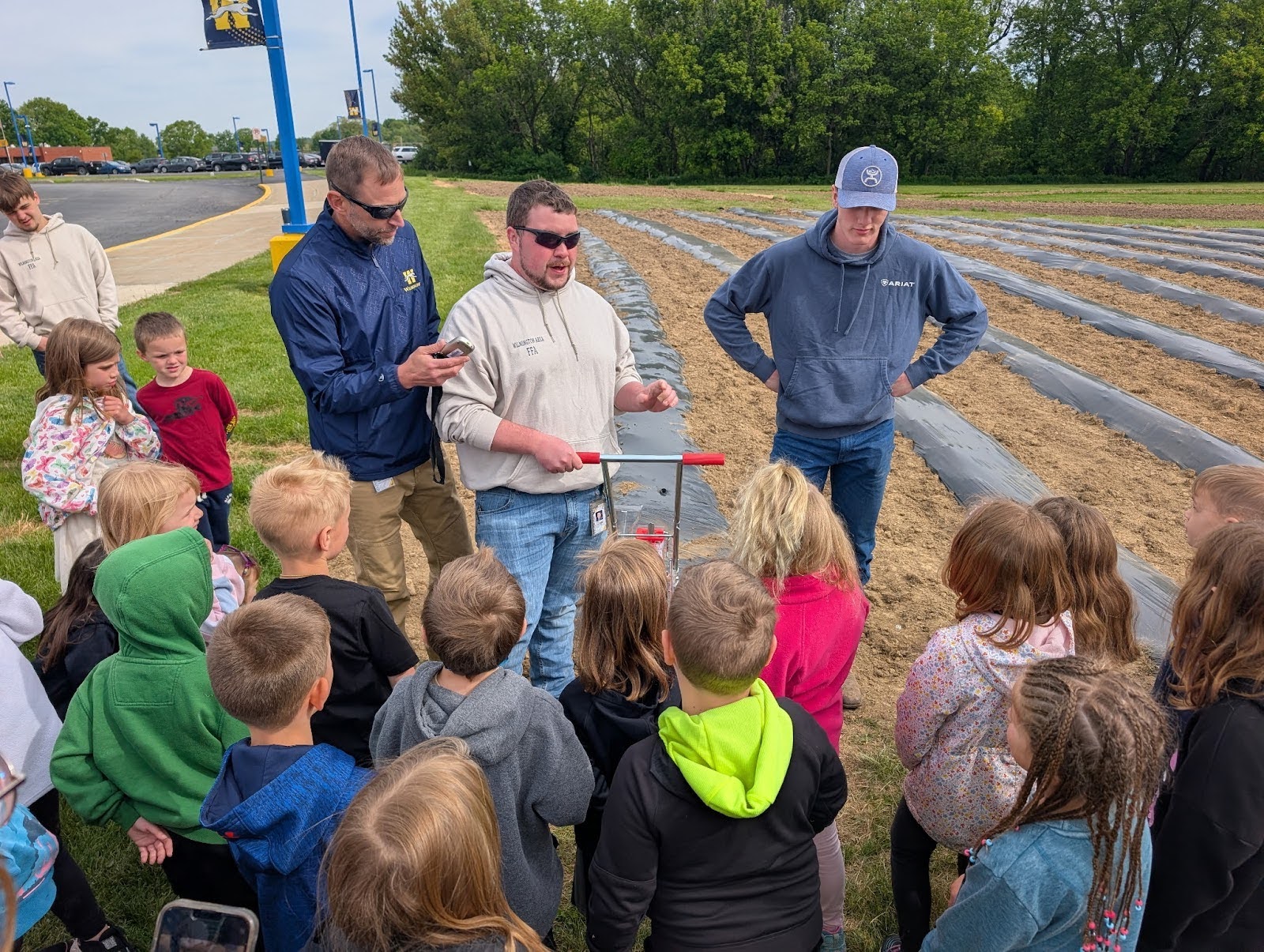
On May 12, just weeks before school let out for summer, students from every grade rolled up their sleeves and got their hands in the dirt, helping to launch the district’s future as an agricultural learning hub. In a field beyond the school parking lot, they planted everything from pumpkins and sunflowers to corn and even started a pollinator garden.
High school students with tractor certifications tilled the land themselves using equipment lent by Watson’s Inc., a local business owned by a district graduate. The effort also drew support from other community partners eager to help students dig in.
Ferris Farm, based in New Wilmington, donated a Poly Planter Jr., an $850 push-style planter designed to sow seeds through plastic mulch. Jeanice Ferris Britvich, whose family has been in the produce business since the 1970s, delivered it in person and joined students as they broke ground.
“It’s a cool initiative,” she said. “I think that kids need to experience what it’s like to grow things… instead of just going into a grocery store and saying, ‘Oh, I’m getting my broccoli from, you know, the cooler.’ With this, you know where it comes from, you’re more apt to appreciate how much time and effort is put into it.”
Visitors at the groundbreaking on May 12 included Pennsylvania educators, county commissioners, and staff from local legislative offices, all witnessing students as they began to transform the land into a living classroom.
To build on this momentum, the district is seeking $2.5 million to $3 million in funding to expand its agricultural program. The goal is to blend traditional farming with cutting-edge Controlled Environment Agriculture practices like hydroponics and aquaponics, which use technology to maintain ideal growing conditions in enclosed spaces. From there, students will gain hands-on experience with sustainable, year-round food production. The produce and fish grown through the program will help supply a new food distribution center supporting both the school cafeteria and local families.
The initiative has already earned strong support. In letters submitted to state and federal officials, organizations including the Pennsylvania Department of Agriculture and the Mercer County Food Bank praised the scope of the project.
State Agriculture Secretary Russell Redding called it “a remarkable opportunity to transform agricultural education and community engagement,” adding that it aligns well with the state’s workforce and sustainability goals. State Sen. Michele Brooks and State Rep. Marla Brown’s offices also voiced support, emphasizing the program as a powerful way to equip young people with critical skills while tackling food insecurity close to home.
From the soil to the sky
While the district’s farm dreams may be the centerpiece of its goals, Wilmington’s ambitions for student learning are already taking root on campus. Environmental science and agriculture students have transformed a once-unused courtyard into what Hathaway calls an “environmental laboratory.”
There, students helped dig a pond now teeming with fish, turtles and other wildlife. Quail are housed nearby, and raised beds built by ag construction students serve as composting stations.
To prepare students for future work on the Heinz property, the district has already secured a USDA farm ID number. And through a growing partnership with the Mercer County Food Bank, Hathaway said they hope some of the food grown will soon make its way into the school cafeteria and onto the tables of local families.
“To see our kids be able to grow food that provides for the community is going to be a great thing,” Hathaway said.
Wilmington’s ag program is also branching into some high-tech territory. This year, a new STEELS (Science, Technology & Engineering, Environmental Literacy and Sustainability) teacher will help implement Pennsylvania’s updated science standards, which now include environmental literacy and agricultural systems. The district is launching a conservation class for seventh graders and an agriculture class for eighth graders.

Also on the horizon is a pilot drone certification program developed with the Pennsylvania Department of Education, Department of Agriculture and the PA Technical Training Assistance Network. The course will allow students over 16 to become certified drone operators.
From 10,000 feet above, it’s all a bit dizzying. But Hathaway is undeterred. He sees nothing but opportunity in their cross-disciplinary approach, from drone mapping to ag engineering, welding to coding.
“Our phys ed teacher came to me and said, ‘Hey, can we put a Frisbee golf course in?’” Hathaway recalled. The answer was yes. Welding students can forge the goals; other students can use drones to map out the course.
“We want the kids doing it all,” he said. “If we build an outdoor classroom, we want our engineering students designing it. We want our ag construction and materials fabrication classes building it. Students are going to be the ones planning, designing, doing the research.”
Practical learning opportunities
Wilmington’s Director of Special Education Michael Conglose sees the agricultural expansion as a meaningful opportunity for his students as well.
“One of the challenges we face is community-based instruction,” Conglose said. Getting students vocational training or job experience, he explained, often depends on transportation, scheduling and availability. Sometimes students only have one period in their day to go off-site, and by the time they get somewhere, they only have 20 minutes on the job.
Conglose said the ag initiative will allow students to gain work-based learning opportunities right on the district’s front doorstep.
“We have a lot of students from a special ed perspective that are really good hands-on learners, and this is going to provide them with that opportunity to not just learn it from a textbook, see it on a video on the screen, but actually get to go and get their hands dirty and do those types of things, which I think is going to have a really strong impact.”
Joanna McKelvey, a Wilmington agriculture teacher and 1997 graduate, finds the project especially rewarding. For her, an education in agriculture this rigorous gives students a real advantage, but it also helps them see that growing their own food is more than just practical. It’s empowering. She believes early exposure sparks curiosity and builds lifelong skills that will help students provide for themselves and the people they build their lives around one day.
“And that’ll help them hopefully continue in their young adulthood on, (and go) ‘OK, this is how I’m going to continue to provide for myself and then potentially a family in the future,’” she said.
Meaningful preservation
One of the most fundamental goals of the Sustainable Future project may simply be to keep Wilmington’s agricultural roots alive.
Pennsylvania is a leader in farmland preservation, with more than 650,000 acres protected statewide. In Lawrence County alone, over 4,000 acres are enrolled in the program, according to Loren Elder, president of the county’s Agricultural Preservation Board. A 1999 graduate of Wilmington whose mother taught in the district for many years, Elder now farms in New Castle with his brother Darren, the family’s sixth generation on the land.
Elder was the one who first brought the Heinz’s property to the attention of the district after it was placed into preservation. This fall, he and his brother will harvest corn planted there; students will observe real-world farming practices throughout the year.
For Elder, that kind of exposure will be valuable to them, even if it’s just watching the rhythm of a working farm.
“What the school is doing there has the potential to impact every kid from kindergarten through 12th grade,” he said.
To him, it’s also something beautifully simple: a way to give students — many of whom don’t live on farms — a window into agricultural life.
“When my brother and I were in school 25 years ago, our vo-ag (vocational agricultural) classes were made out of farm kids. But (now) so many of these kids have different interests and so forth,” he said.
Elder emphasized the importance of retaining local talent, noting that the community will depend on its students to fill essential roles someday from agronomists to veterinary assistants and hopes many will choose to stay close after graduation. He sees these young people not just as future professionals, but as the heart of their town.
“These kids are pretty special. They’re community people, and we need them to stay here in Lawrence County.”




