


SCIO, Ohio — Dan Keenan stood before a group of firefighters and farmers in an engine bay at the Perry Township Volunteer Fire Department, explaining the stakes of the rescue exercise they were about to simulate: a farmer and his young son, both unresponsive, were trapped in a confined space with gas levels rising.
As first responders secured their harnesses, Keenan, the director of the National Education Center for Agricultural Safety, reminded the group of the life-or-death realities behind the drill.
“We go by the adage of ‘risk a lot to save a lot, risk little to save little,’” he said.
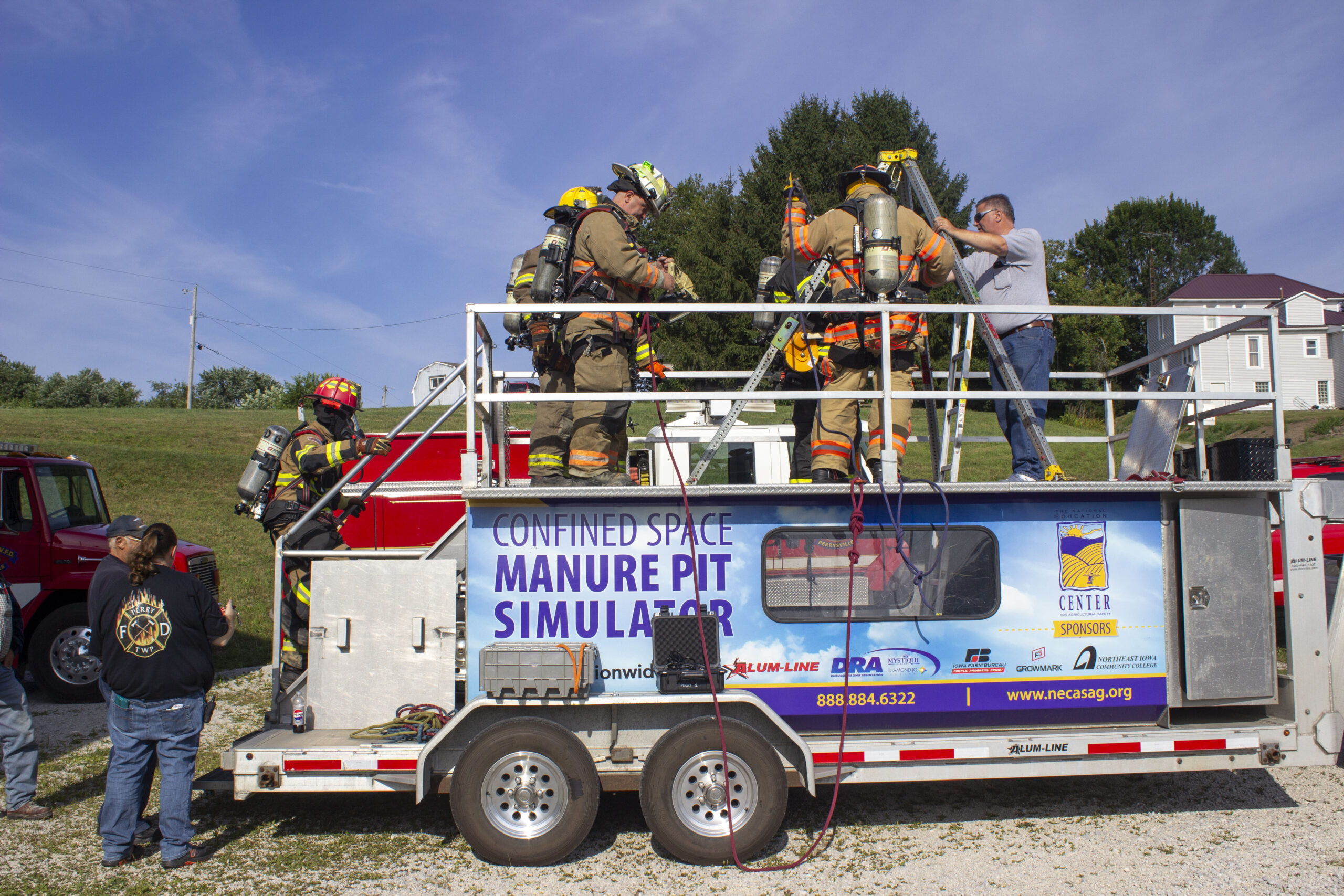
While the rescuers listened for his instructions, a shrill alarm suddenly pierced the air. A firefighter’s personal alert safety system (PASS) device had gone off due to lack of movement. It’s designed to signal when a firefighter may be incapacitated. The firefighter wiggled to reset his and stop the alarm.
Before continuing, Keenan took a moment to lighten the mood.
“By the way, did you know if you look in Webster’s unabridged dictionary (online), the word ‘twerking’? It shows a video of a firefighter doing this,” he said, gesturing toward the shimmying firefighter, “to get the PASS device off.”
The group laughed but quickly returned to focus. Keenan began dividing them into rescue teams. Then he set the scene.
“We’re responding out to the Huey Fudpucker farm,” he announced. “We got 35-year-old Huey Fudpucker Junior unresponsive, and his 3-year-old son, Huey Pucker the Third, is down there as well.”
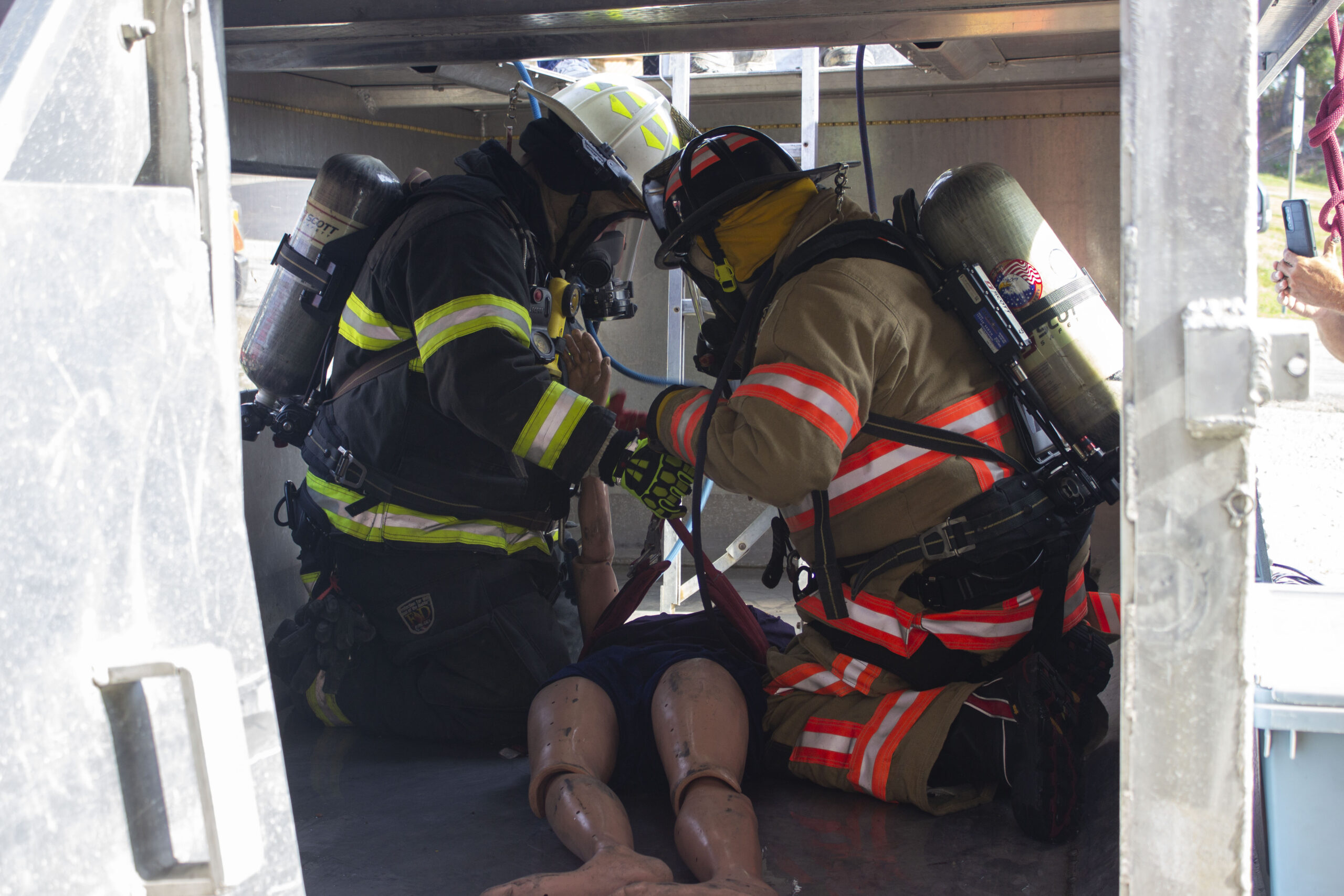
Suited up and wearing self-contained breathing apparatuses, the first two rescuers descended into the simulated confined space. To the uninitiated, it looks like a hollow trailer with windows for outside observers to watch the steps undertaken by first responders inside. Their objective was to assess and retrieve the victims, represented by mannequins. One rescuer was tasked with handling the child and called out gas readings. The other secured the adult with a half-body harness for extraction. Up above, another firefighter cranked a wench to pull the first victim out.
Keenan narrated the process in real time, emphasizing proper equipment use, communication and coordination. Once the mannequins were safely out, he challenged the group to reflect.
“How long did it take us to get dressed and get ready? Long time. How long did it take to do the rescue? Three minutes, maybe?”
Dangerous jobs
The training underscored the unique hazards of confined space rescues in rural communities, especially on farms. According to the U.S. Bureau of Labor Statistics, farm work remains one of the most dangerous jobs in the country. Since 2012, more than 1,500 agricultural workers have lost their lives on the job. Hidden dangers lurk around the corner for both farmers and the first responders tasked with saving them from harm.
In confined spaces, Keenan said, it’s easy to run out of air: methane and hydrogen sulfide are among the biggest concerns, but other gases can also displace breathable oxygen without any visible warning.
“The air you’re breathing right now is 21.5% oxygen,” he told the class. “The minimum amount of oxygen to sustain life is 19.5%. You get down below that, you get down to 18%, you start having hand-eye coordination problems. You get down to 17%, that’s where we get Green Bay Packer fans from every day. Lack of oxygen to the brain.”
Jokes aside, Keenan reminded the group why the training mattered, recounting a tragic incident in St. Henry, Ohio in 2021 where three family members died in succession after entering a manure pit, each one trying to save the last.
Neenan said that recent data points to a disturbing trend in such episodes.
“Sixty percent of the people who die in a confined space were would-be rescuers. Think about that. Sixty percent of the people who died were would-be rescuers, which means they got the person who was trapped out, but then they didn’t make it out.”
Hydrogen sulfide, which is found in areas such as manure pits, is particularly insidious, first dulling the sense of smell before lulling a person into a false sense of safety when they can no longer detect it. Even advanced medical teams have few tools to treat its effects.
“What do we have on the ambulance that can work to reverse the symptoms of hydrogen sulfide poisoning?” he asked. “Oxygen. That’s it.”
Keenan pointed out that rural hospitals often don’t have the resources for specialized care, meaning time is critical.
“Farmers don’t wake up in the morning and say, ‘Today would be a good day to get killed in a farming incident,’” he said. “They wake up and think, ‘I got 100 things to do today. If I have a good day, I might get four of those done.’”
“Be cautious.”
Perry Township Fire Chief Eric Horn said the training brought home just how chaotic real scenes can get, especially when many people are involved. That can make it difficult to keep tabs on everyone, leading to rescuers potentially becoming victims themselves.
“Well, the more people you have, the harder it is,” Horn said, adding that maintaining scene awareness isn’t just a chief’s responsibility.
Getting the training trailer to Ohio was a yearlong effort.
“It comes out of Iowa… and finally, he was in Ohio, so we got him to this area today,” Horn said. Fire departments from at least four counties — Tuscarawas, Carroll, Harrison and surrounding areas — took part.
And while the trailer is labeled for manure pit rescue, Horn said the lessons apply to far more.
“You know, it says confined space for the manure pit simulator, but you know, it could be a confined space for anything,” he said. “It’s all basically the same principles.”
Kevin Arbaugh, a firefighter in attendance, said much of the information in the training hit close to home.
“Well, I’ve been around the farm my whole life,” Arbaugh said. “So I knew a lot of stuff already. And then (I’ve) also been a firefighter for thirty-some years.”
One thing that stood out to him was the discussion about foam buildup and gas pockets in manure pits, something he said he’s seen firsthand.
Arbaugh said one of the biggest dangers around manure pits is simply falling in, especially when they’re not properly marked or secured.
“Some farms, the manure pits aren’t even fenced off,” he said. “Especially your lagoon type.”
His advice to the public: “Be cautious. Be aware of your surroundings.”
And to farmers?
“Try to put fences around your area, keep them clean and safe,” he said. “It costs a lot to put a fence around some of these bigger lagoons. But… it’s worth it.”
For Arbaugh, realistic simulations like this one are more than valuable — they’re essential.
“Especially some of these people who aren’t aware of these types of situations,” he said.