


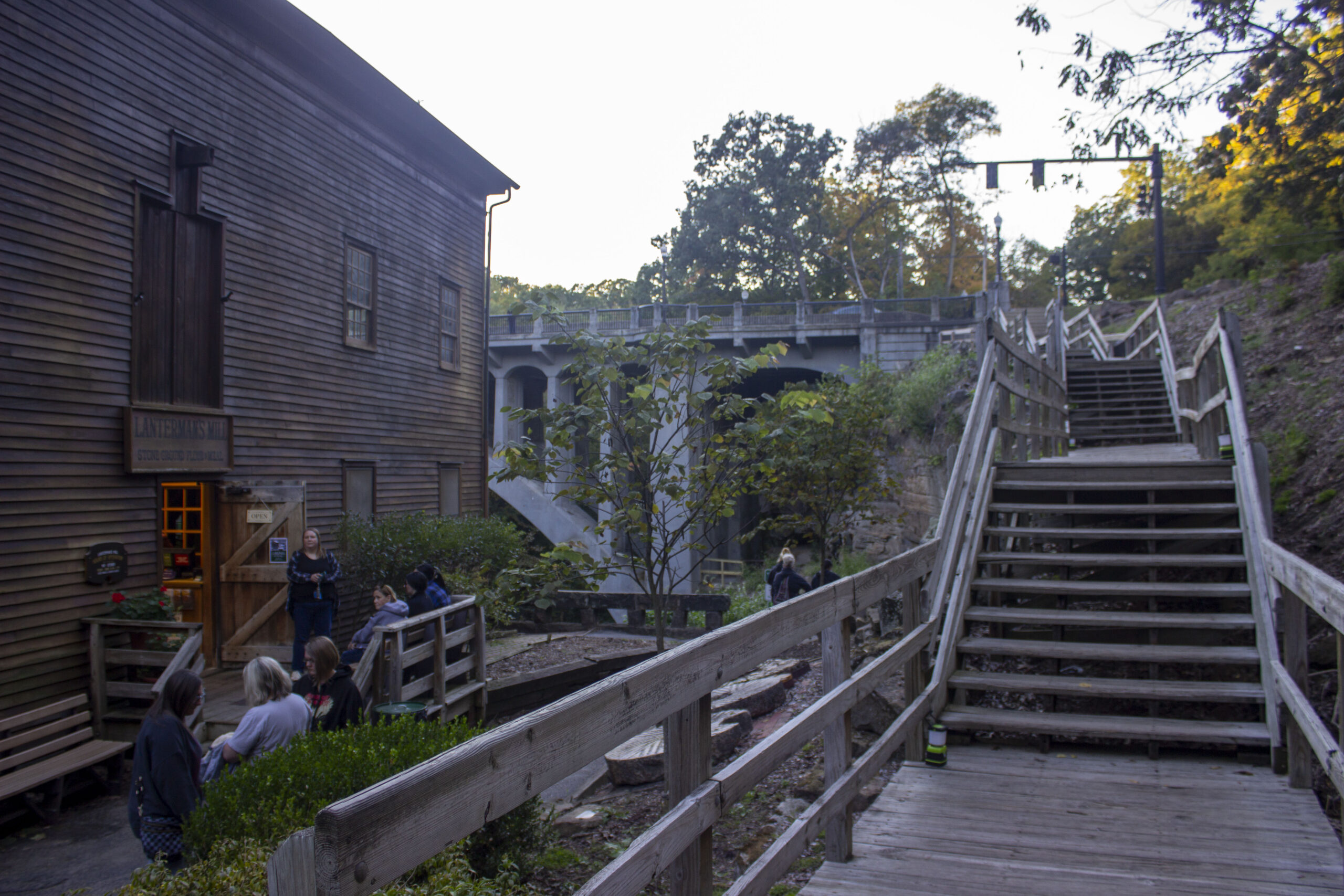
YOUNGSTOWN — There has been a mill standing at Lanterman’s Falls since at least the turn of the 19th century, harnessing the power of Mill Creek with the blessing of Youngstown’s founder and namesake, John Young. His sale of this land helped set the area’s history in motion, as the mill supplied early settlers with essential grain and lumber. But a dark shadow was cast over the story from the beginning.
Amid the picturesque setting, misfortune and tragedy have stalked many in these parts across generations.
At least 18 people have died on the grounds or in the immediate area. Among them were Edward Morgan and his wife, who were killed on July 1, 1897, when their horse-drawn carriage went over a cliff near the mill; their son escaped harm. Others through the years were not as fortunate.
On Sept. 4, 1900, 17-year-old George Cecil Maline drowned in Mill Creek just upstream from the falls. Four-year-old Elizabeth Beck drowned on Aug. 24, 1915. So did 14-year-old Philomena DiBattista, who was swept over the falls on July 27, 1937. On May 24, 1943, Thomas Morley went the same way. It was his 13th birthday. On April 5, 1958, 67-year-old Kayis Backus attempted to hang himself from Saddle Bridge upstream from the falls; when the rope broke, he fell to his death instead. Ida Reed, 22, drowned on Aug. 18, 1992, after jumping into a deep pool to save a friend; her brother rescued their friend and another girl but could not save Ida. And 74-year-old Renee Moye fell to her death from the bridge above the mill on June 29, 2023.
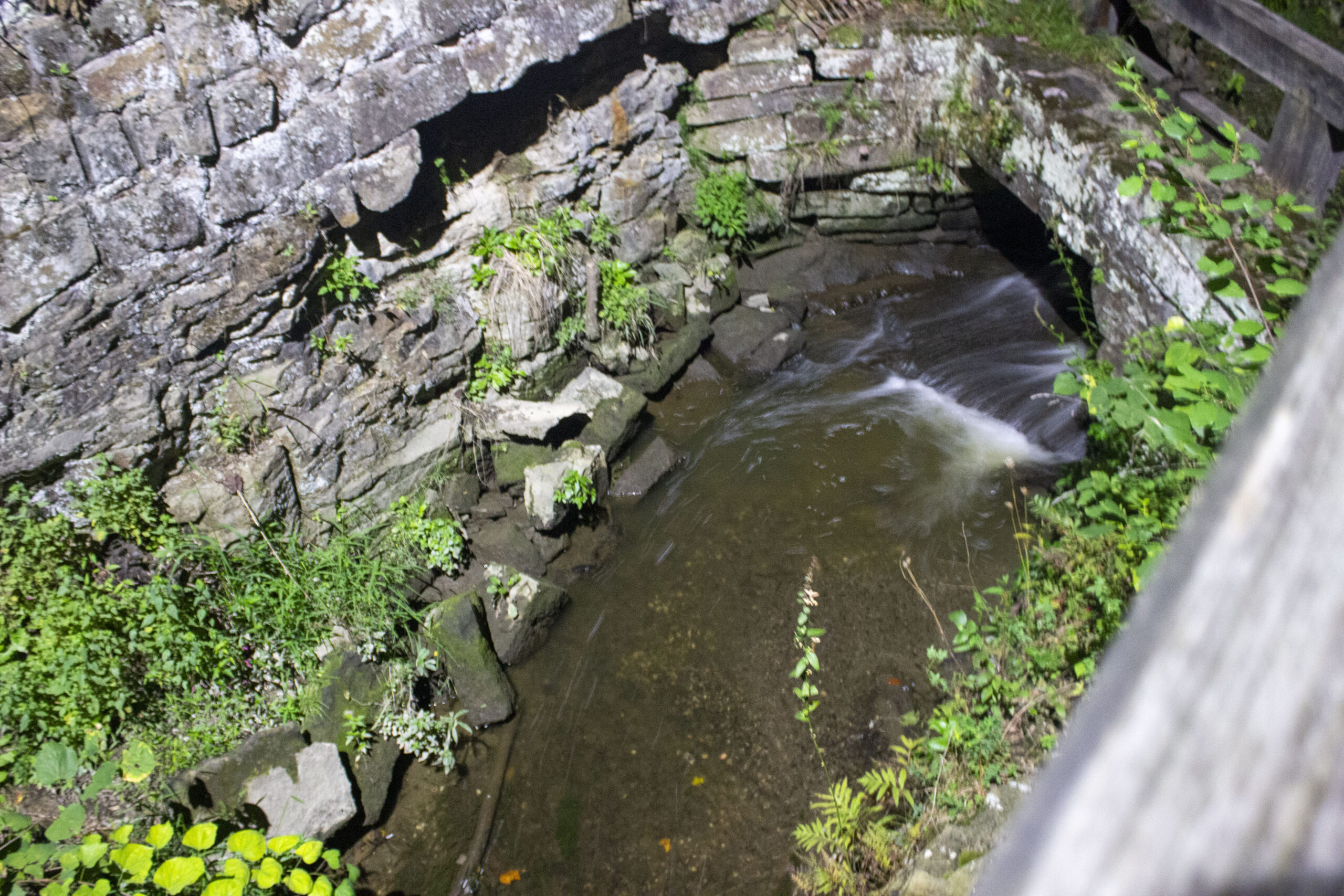
The site has borne witness to other calamities, too: An earlier mill, built from logs, was reportedly destroyed in an explosion — one possibly fueled by flammable grain dust and sawdust — while a later mill was swept away by flood. The current structure was built in 1845.
Restored over a century later, the mill still grinds corn and wheat; when its massive millstones turn, their vibrations can be felt throughout the building, against the constant din of rushing water. It should be no surprise that a few ghosts have turned up.
“We’ve had awesome interaction with the spirits here in the past,” said Lynn Zocalo, senior educator with Mill Creek MetroParks, during a program with a local paranormal group on Oct. 3.
After the mill closed in 1888, it served as a dance hall, bathhouse and boat storage. In the 1930s, it became the Old Mill Natural History Museum. As Zocalo spoke, a bell rang from the lower level.
The bell was among the equipment investigators used to invite a response from a presence: the device can activate when it detects an electromagnetic field. The sound briefly interrupted Zocalo’s account, which continued with the mill’s restoration in the 1980s.
For four years, Mill Creek MetroParks has partnered with the Collective Paranormal Research Society to hold investigations at the mill. Participants climb the steep stairs and move between floors as they try to reach out to the other side. In October, sessions are held each Saturday.
The Halloween investigation runs from 10 p.m. to 2 a.m., with attendance limited.
“That’s when the veil is the thinnest between the living and the dead,” Zocalo said of the Halloween event. “We had great fun last year.”
Deanna Seck has been part of the mill for three years, spending two as a seasonal employee before becoming manager this year. Asked whether she had experienced anything supernatural there, she said her experiences have been subtle but not negligible.
“Even when I’m here by myself, I never feel alone,” she said. A few times, something has caught her eye. “Just shadows, things like that, but unexplainable ones.”
Aside from any paranormal activity occurring there, the building’s age and condition still impress her the most.
“It is absolutely unbelievable. Just the fact that the building is 181 years old. That’s 15 years before the Civil War. It’s still standing. It’s beautiful,” she said.
She encouraged people interested in the tours to book early. “It is beyond worth it to come visit.”
Eric Williamson, founder and lead investigator of the Collective Paranormal Research Society, told guests that the team tries to approach reported activity skeptically.
“We have to be scientific enough to debunk everything that we come across,” he said, noting that most claims can be explained. “It’s the other 5 to 10% that has us scratching our heads.”
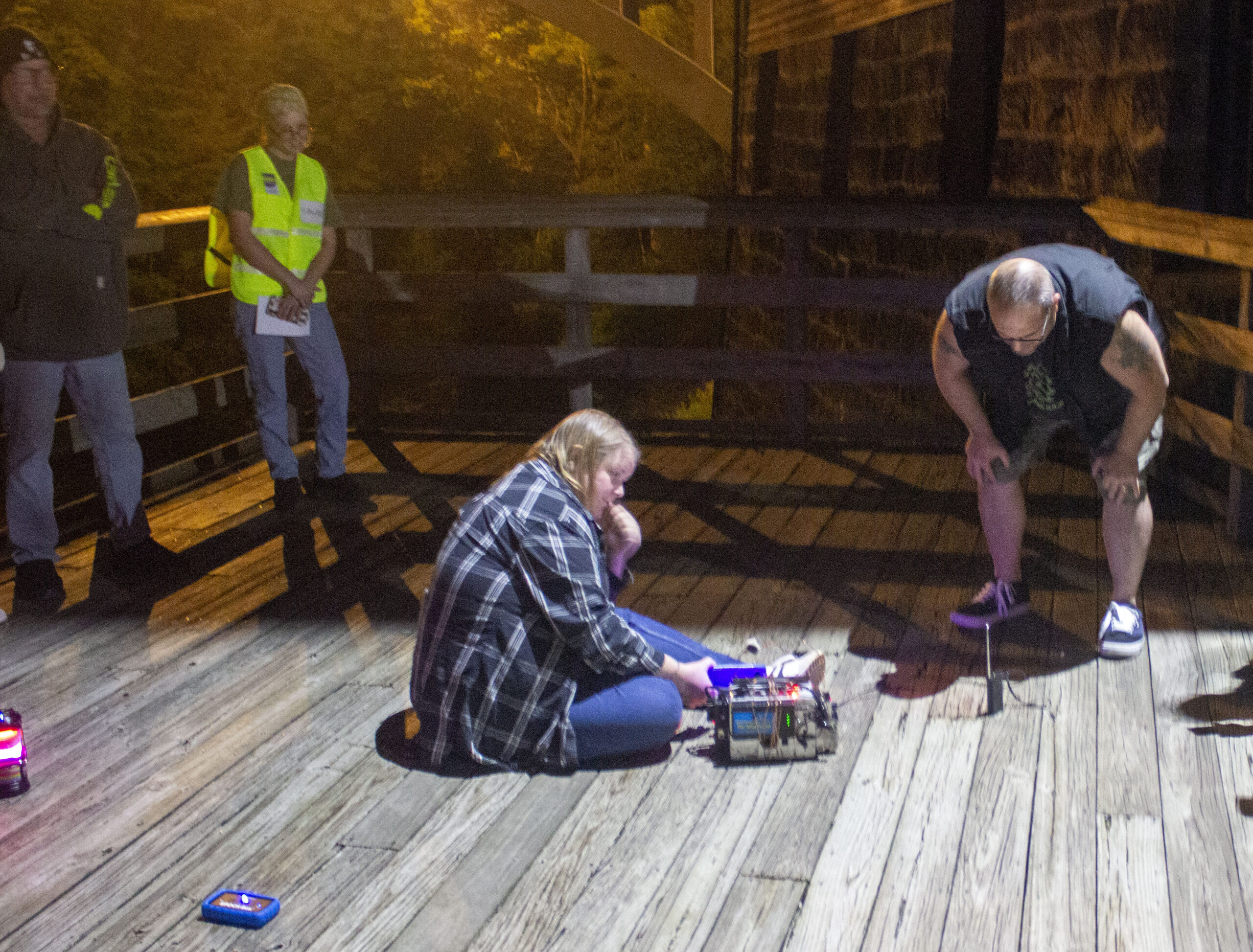
On the attic floor, investigators demonstrated an “epoch box,” which answers direct yes-or-no questions in responses that came across as dry and flat, almost comically matter-of-fact. They asked whether the presence was male and whether it was happy the group was there; the box indicated yes. Investigators also used a device called a portal, which Williamson described as a speaker connected to a two-way radio that rapidly scans radio frequencies. It filters out the wash of white noise, bursting occasionally with brief, scattered, sometimes intelligible sounds. The investigators ask questions and listen for those fragments to resolve into words or phrases, like assembling a message out of alphabet soup.
The highest room of the mill was especially stuffy, and even on an October night it was warm enough that a Farm and Dairy reporter wearing a windbreaker had been thinking it was an extra layer too much. Then a misplaced chill slowly spread across his back. Williamson walked toward the spot and asked, “So are you making it cold over here?”
Apparently, he could feel it too.
“It is a little bit. It is definitely more… I can feel it. Is it you that’s coming over here, making it making the environment a little colder? Is that you?”
On another floor, the team tried a new device — a sort of music box — loaded with songs on an SD card. Investigators explained they hoped spirits might select a powerful song or lyric to communicate with. Investigator Ralph Demichael described the idea to any entity within earshot: “You could come in to this device here. You could pick out any type of music you want, OK? And you can respond to our questions with musical lyrics.”
The investigators asked about the spirit’s former life, whether they had been married, what work they did, whether they had children and whether life had been happy or difficult. In that session, the box played the opening of Queen’s “Bohemian Rhapsody” (“Is this the real life? Is this just fantasy?”), later followed by Bonnie Tyler’s “Total Eclipse of the Heart.” The room was pitch dark.
“(Turn around)
Every now and then, I get a little bit lonely
And you’re never coming ‘round
(Turn around)
Every now and then, I get a little bit tired
Of listening to the sound of my tears.”
Williamson, for his part, has investigated locations across the country with the Collective Paranormal Research Society. His favorite haunt, he said, is Waverly Hills Sanatorium in Louisville, Kentucky.
“It’s insane. Everything you see is actually the way it is, man. This huge, huge building, (it’s) very ominous. Very active.”
At Lanterman’s Falls, the team’s historical research helped them identify names they said had come through the spirit box belonging to those who might still be hanging around. For Williamson, those connections between a place and its past are central to the work.
“For me, it’s always about the history. It’s always about what happened at the location.”
He also sees the setting itself as integral to the investigation. Williamson said spirits need energy to manifest or communicate, and he believes the mill itself offers several luscious sources: the rushing water, the rocks near the wheel, the people inside and the atmosphere.
“Picture the entities — they need energy to manifest or to show themselves or to talk with us,” he said. “They get energy from the river. They get energy from the rocks. They take energy from us. They’ll take energy from the atmosphere.” He said places beside running water are often especially active, and that rain and thunderstorms electrically charge the atmosphere.
“So you have some of the limestone and stuff maybe down by the wheel that this was built on that gives off energy. You have the running water that gives off energy, and then obviously, every individual person gives off their own energy.”
At the beginning of the session, Williamson addressed those who might seek to communicate with the living.
“We are very sorry for what happened to you. Your life wasn’t meant to end that way,” he said.
Before guests left the mill, Williamson encouraged them to protect themselves from anything that might attach to them on the way home by imagining themselves enveloped in white light.




