


The Ohio Division of Wildlife released its annual report “2025 Accomplishments and 2026 Initiatives.” The document is in line with the strategic plan that the division uses to better coordinate its work and stay within funding that primarily comes from the sale of hunting and fishing licenses and various permits. Think of the strategic plan as a roadmap to the future.
It’s really worth the time to review what the division has been up to and what the future looks like. Often accused by the non-consumptive public (those who neither hunt nor fish) of being in the pocket of sportsmen’s groups, the information may come as a bit of an eye-opener.
While it’s certainly true that the primary funding comes from sportsmen and women — and that they do have the ear of the Division of Wildlife and the rest of ODNR — it’s also evident that the work this team does benefits all of us. So, let’s get started and take a look at just a few of last year’s highlights.
• The division added 1,686 acres of forest and grassland habitat to Tri-Valley Wildlife Area in Muskingum and Coshocton counties, accepted 122 acres from The Nature Conservancy — nearly doubling the area — and protected riparian habitat at Fish Creek Wildlife area in Williams County, and accepted 20 acres from Lucas County Commissioners that included a fishing access ramp at the Cooley Canal. Finally, AEP donated its former maintenance facility to provide workspace for staff and equipment at Appalachian Hills Wildlife Area.
• The number of human-raised 3-year-old eastern hellbenders surpassed 2,000 through a partnership with the Columbus Zoo, Toledo Zoo, PENTA Career Center and the Wilds. Indian Creek High School in Jefferson County was added as a partner and is raising 20 eastern hellbenders for release in 2026. A significant milestone was reached when several human-raised male eastern hellbenders were observed guarding nests where previously released.
• Forty Wildlife Education grants totaling $20,000 were distributed to help more than 4,000 educators and students create habitat on their school grounds, as well as wildlife education materials in their classes, and money to take wildlife-related field trips throughout Ohio.
• Multiple high-profile cases were resolved, including an illegal taxidermy business. The offenders had collected and sold animal parts without proper permits, including species protected under state and international laws. They were found guilty of multiple wildlife violations and ordered to pay more than $38,000 in restitution.
• Wildlife staff coordinated the completion of 4,800 acres of timber stand improvement, 6,000 acres of aerial herbicide spraying, 2,255 acres of grassland maintenance and 180 acres of heavy brush clearing. These habitat improvement projects encouraged new growth of beneficial plants and increased space for wildlife. Staff also actively managed 9,420 acres of wetlands to improve water quality and promote native wildlife species.
• The division helped 4-H programs certify 208 adult shooting sports instructors across the state, bringing shooting sports programming to new counties. Additionally, more than 240 children attended weeklong shooting sports training to prepare these youth for mentor roles within their 4-H programs.
• The division partnered with Ohio State University to undertake a comprehensive survey of Ohio’s bees. A database was created, documenting more than 450 bee species. However, 70 of these species were not documented in the recent survey, indicating they may be extirpated from the state. Working with other Midwestern states, 17 species are considered to be of conservation concern because of nesting habitat loss, impacts from insecticides and overall rarity. Most species were found in the Allegheny Plateau in eastern and southeastern Ohio.
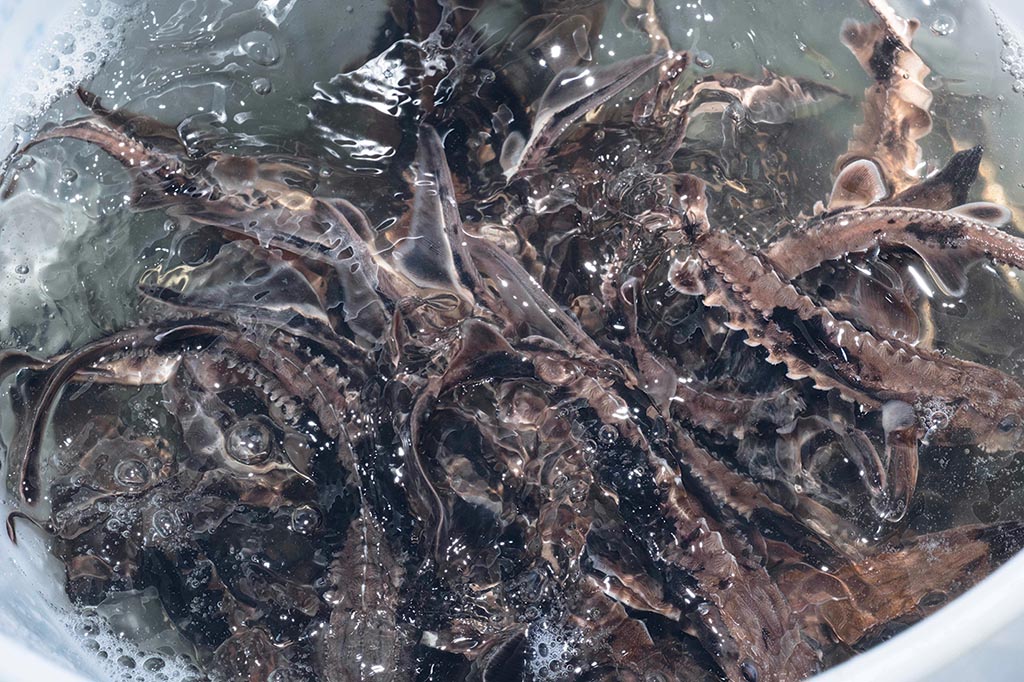
• Large-scale young-of-year lake sturgeon restoration stocking was implemented in the Cuyahoga (2,000 fish) and Sandusky (750 fish) rivers for the first time, along with continuation of annual Maumee River (3,000 fish) stocking that began in 2018. Lake sturgeon recaptures by Ohio trap net fishers and agency surveys have become frequent from Toledo to Lorain, with the largest fish now surpassing 40 inches. The restoration plans were informed by Habitat Suitability Indices that assessed the expectation of success and partnerships with federal agencies, universities and local community partners, allowing the capacity to commit to 25-year strategies. Ongoing research will allow evaluation of survival and eventual adult return rates to program rivers.
• Across Ohio, H2Ohio projects are making a difference for water quality and wildlife, thanks to strong partnerships with local conservation groups. Current efforts include the Croatian Lodge dam removal, Phase 2 of the Hocking River Shelly Lakes Wetland Project with Appalachia Ohio Alliance, Lower Killbuck Creek Projects at Crane Swamp Preserve and Bowfin Bottoms with the Killbuck Watershed Land Trust and the Aukerman Creek Stream Restoration with the Preble County Historical Society. Division staff provided technical guidance for restoring 870 acres of wetlands on private property and oversaw the completion of six wetland restoration projects.
• In 2024 and 2025, biologists captured and leg-banded 219 wild turkeys and fitted 97 hens with GPS transmitters to study survival and reproduction. Research teams also placed GPS collars on 19 gray foxes to gather data on habitat use and survival. In the state’s eastern regions, staff captured and marked four black bears as part of a new study on colonization. Additionally, a statewide small mammal survey led to the first confirmed sighting of the state-threatened eastern harvest mouse in more than 20 years.
• Ohio’s new Deer Donation Program, launched in the fall, gives hunters a chance to help families in need by donating harvested deer to local food banks. This effort supports deer population management goals while providing healthy, high-protein venison to fight food insecurity. The program is a partnership between the division and Ohio Penal Industries. Donated deer are processed in OPI’s facility at Pickaway Correctional Institution, where offenders gain valuable training in meat processing. The venison is then safely packaged and distributed through Ohio’s food bank network.
• Lake La Su An Wildlife Area in northwestern Ohio received 16 acres of native tree seedlings to enhance habitat for the endangered copperbelly water snake. This project is part of a larger effort to protect this rare species and stabilize the population. In a new partnership with the Toledo Zoo and Aquarium and the U.S. Fish and Wildlife Service, several copperbelly watersnakes were collected from the wildlife area to establish a captive breeding colony.
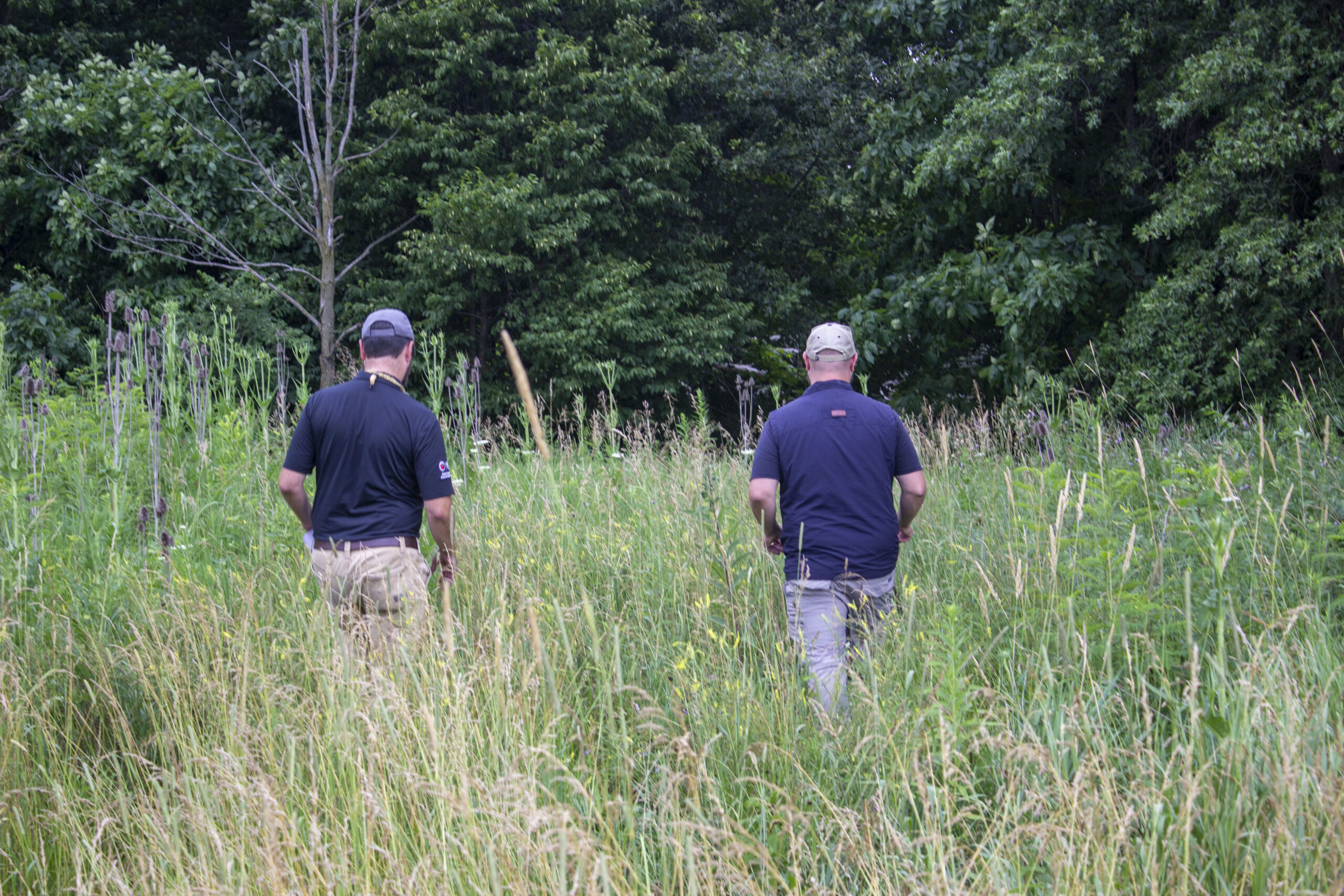
executive director of the Black Swamp Conservancy, walk toward the forest on their way to the shallow banks of
Marie DeLarme Creek. (Paul Rowley photo)
How does the Division of Wildlife plan to complement these accomplishments in 2026?
• A new conservation program, the Wildlife Habitat Initiative, offers incentive payments to farmers and landowners who implement conservation practices to improve wildlife habitat. The program focuses on supporting habitat for grassland birds, pollinators and other native wildlife. Implementing the Wildlife Habitat Initiative in partnership with the National Bobwhite and Grassland Initiative Foundation will provide $9 million of U.S. Department of Agriculture funding to restore and manage grassland and other wildlife habitats on private lands.
• The multi-year telemetry study into wild turkey nesting behavior and the survival of hens and poults, conducted in collaboration with Ohio State University, will conclude in 2026, with monitoring continuing into 2027.
• A voluntary outfitter accreditation program was launched in April 2025. Additional messaging and outreach efforts are in the works to gain interest and advertise the program benefits to hunters planning trips from out of state. The program aims to improve consumer confidence when selecting an outfitter based on their accreditation status, strengthen the reputation of the outfitting industry in Ohio and enhance communication with stakeholders.
• The division will re-launch the Backyard for Wildlife program. First established in the 1990s, this program helps property owners establish and maintain habitat for all manner of native Ohio wildlife. The program will provide up-to-date information on quality habitat projects such as bird feeding stations, pollinator gardens, nesting structures and more. Participants can find information at wildohio.gov this spring and can also apply to be a certified Ohio Backyard for Wildlife.
• The Ohio Bear Project will continue to shed light on the status of black bears in the state in coordination with the University of Dayton. Researchers aim to trap and GPS collar female black bears and collect data through trail cameras and public reports.
• In partnership with University of Toledo, the division completed a habitat suitability index for sauger spawning in the Maumee and Sandusky rivers. These rivers once supported natural sauger reproduction before the species was extirpated from the region. With this promising data in hand, 2026 will mark the launch of Ohio’s Sauger Restoration Plan. Long-term plans include maximizing fingerling production and using excess fry for annual stockings in both rivers.
• The division’s new P68C airplane, scheduled to arrive later this year, will replace two aging aircraft. The aircraft will be used to assist law enforcement staff in monitoring Lake Erie commercial fishing as well as illegal deer hunting activity. The airplane can also assist wildlife management staff with research efforts for deer, wild turkeys and waterfowl.
To think, these were just a sample of the Division of Wildlife’s work. Who knew that they’re involved in such a wide array of wildlife work? Well, I guess I did… but I sort of have had an inside look for many years. The agency continues to be driven by its mission: “To conserve and improve fish and wildlife resources and their habitats for sustainable use and appreciation by all.”
Seems to me that they’re doing a pretty good job.
“The best preparation for good work tomorrow is to do good work today.”
— Elbert Hubbard





Thanks, Jim! Great article and great accomplishments.
I’m looking forward to helping out in the “Backyard for Wildlife” Program when it launches again.
We really do need to have Ohio’s kids in their backyards find the joy and beauty in all the Nature around them–even in small city lots! That way, they will care for and appreciate the environment much better as they grow older.
Any championship endeavor be it sports or scholarship or outdoor pleasures–always “starts ’em out young!”