




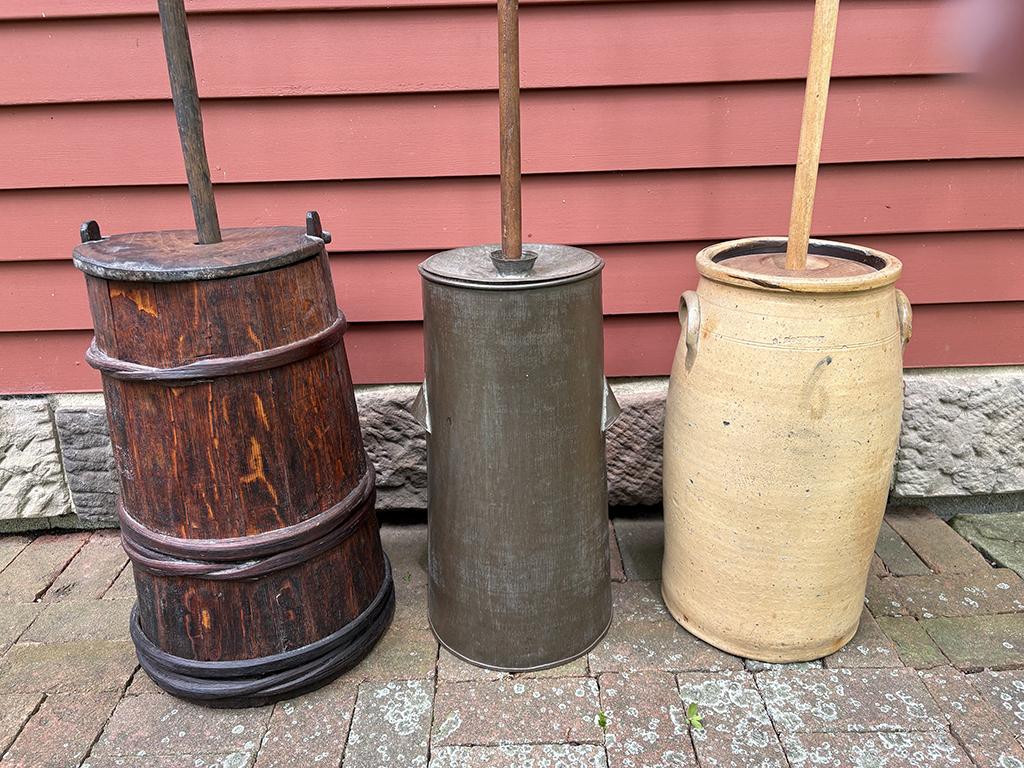
A recent column delved into the carving of butter prints which helped market butter churned by pioneer housewives. What was not discussed was the butter churns themselves.
Suffice it to say that out of all the inventions that blossomed across pioneer America, there were few if any household items that underwent as many incarnations and reinventions as the butter churn. It was as if Americans were obsessed with the notion of taking the odious chore of churning butter and transforming it into a kinder and gentler — even pleasurable — experience.
First off, no matter what the device might look like or how it operated, the purpose of the butter churn was to take cream and vigorously agitate it until the fat globules contained in it separated from the liquid, known as buttermilk.
The fat in butter does not float freely in the cream, but is stuck inside membranes. Churning beats these globules until the fat comes out and adheres together as butter. In short, churning transforms a fat-in-water emulsion (milk) to a water-in-fat emulsion (butter).
Dash churns
The earliest American churns were the dash churns — staved, barrel-like containers with plungers in them. Such churns, made by the village cooper, had their components bound together with thin, wooden saplings.
The plunger, or dasher as it was called, usually had short wooden crosspieces or a wooden disk on the end, with drilled holes to allow the liquid to circulate better and increase efficiency.
These wooden staved churns, whose popularity remained unrivaled for decades, had to be soaked in a creek or trough overnight prior to use to make the staves swell together and prevent leakage. As time passed, the sapling bands gave way to iron and tin hoops.
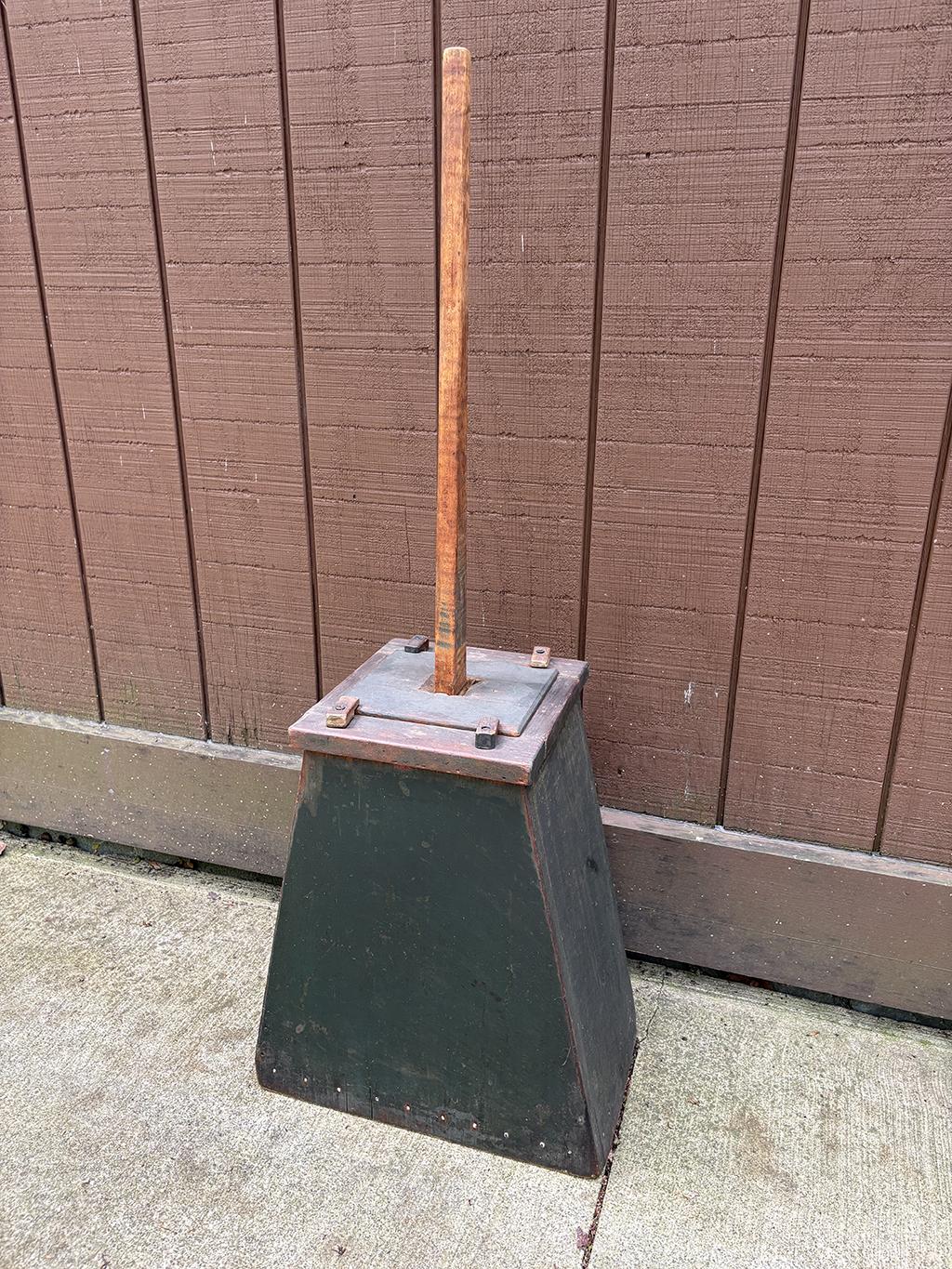
Churns evolve
Eventually, the village potters also began to craft butter churns which, although considerably heavier than their wooden counterparts, were easier to clean. Potters also decorated such churns with blue cobalt motifs of birds, flowers or patriotic motifs, making them more popular with housewives because they brightened up otherwise drab households.
Then the tinsmiths got in on the act, crafting butter churns out of tin. These were much lighter than either their pottery or wooden counterparts, easy to clean, but prone to rusting, especially if left in a damp milk room.
Then the cabinetmakers began producing butter churns in a vast array of forms. There were churns that rocked on rockers like a baby cradle, oval churns that were suspended from iron rods on a crossbuck frame and swung back and forth, churns that were shaped like barrels suspended in frames and made to be rotated end over end to agitate milk; there was even a patented churn shaped like a large cube which was rotated in similar fashion.
There were wig-wag churns in which the dasher was swung back and forth inside a triangular-shaped box, pump churns with long handles that pumped the dasher up and down and endless varieties of crank-type churns in which a handle cranked a series of dashers attached to a central armature.
Some of these churns achieved great marketing success and were used for decades across the length and breadth of the Ohio country, while others were one-hit wonders, produced by hand in very small numbers and found only in the communities where their creator resided.
Today, antique butter churns — from early handmade examples to later patented and mass-manufactured models — can readily be found on the antiques market. Their continuing presence in even modern decorating schemes is a tribute to the craftsmanship, artistry and inventiveness of our pioneer forebears.